
Review · THE UK
IRA Troubles Conflict Private Tour Museum Graves Murals and Political Analysis
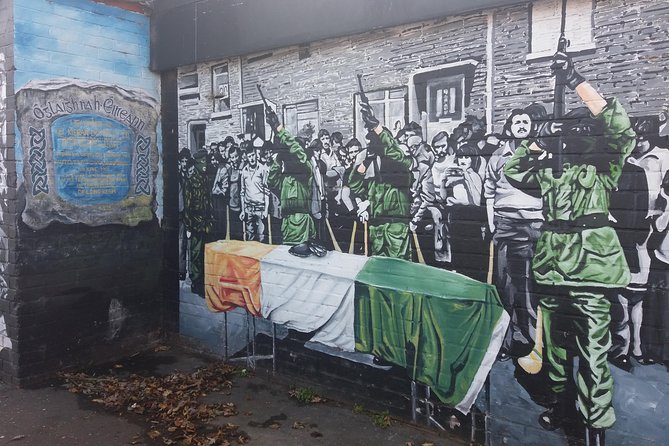
Belfast’s conflict is not locked away in a museum. It is painted across gable walls, marked by memorial gardens, and built into the streets between Falls Road and Shankill Road. This private tour puts you close to that living history, with a local guide explaining the Republican story of the Troubles, from the first clashes in 1969 through the peace process and present-day politics.
I like the access to places most city tours skip, especially the Eileen Hickey Irish Republican History Museum and the Republican plots at Milltown Cemetery. I also like the private format. Guides such as Barry, Paula, and Joe have adjusted the route for questions and personal interests, rather than delivering a fixed speech to a large group.
The main consideration is the viewpoint. This is an explicitly Irish Republican tour, not a neutral survey of every Unionist, Loyalist, and British argument. If you want a balanced account of both communities, choose a different Belfast political tour, or pair this one with a tour focused on the Loyalist side.
Key points to know before booking
- Private Republican perspective: The tour explains the conflict through Irish Republican history, memory, and politics.
- Rare museum access: The Eileen Hickey Irish Republican History Museum is normally open only Tuesday through Saturday, from 10 a.m. to 2 p.m.
- Murals and peace walls up close: You see Falls Road, Shankill Road, Divis, Ballymurphy, and both sides of a peace wall.
- Milltown Cemetery visit: The Republican plots include the grave of Bobby Sands and memorials to volunteers and civilians.
- Personal guides: Barry, Paula, Joe, Ciarán, Brendan, and other local guides have led this experience, depending on the booking.
- Three hours, $255.50 per person: The price is high for a short tour, but private transport and a tailored route add value for visitors with a serious interest in the subject.
Why Belfast’s streets tell the story better than a classroom
The tour begins around the International Mural Wall on Divis Street and the Falls Road, in the heart of Republican west Belfast. Here, your guide sets out the long story behind the Troubles, including Ireland’s relationship with Britain, the rise of Irish Republican politics, and the conditions that led to violence in 1969.
This introduction matters. Without it, the murals can look like bold political artwork with no clear connection to one another. With context, you begin to see how images of hunger strikers, dead volunteers, imprisoned activists, and international causes fit into a larger Republican narrative.
The experience uses a private vehicle, so you are not left trying to navigate a complicated series of neighborhoods on foot. You can ask about a name, symbol, or event as soon as it catches your eye. Guides have also adapted the route when a group wanted more time with a particular subject.
More private museum tours in the UK:
- British Museum London Guided Tour Semi-Private 8ppl Max
★ 5.0 · 984 reviews - National Gallery of London Museum Tour Semi-Private 8ppl Max
★ 5.0 · 178 reviews - British Museum & National Gallery of London Semi-Private 8ppl Max
★ 5.0 · 168 reviews
Murals on Divis Street and Falls Road
The murals are among the most visible parts of Belfast’s political culture. The International Mural Wall presents Republican messages and links the local struggle with causes around the world. Your guide explains the role of former prisoners in creating political murals and shows how the images changed as the conflict and peace process developed.
You will also see murals connected to the hunger strikes of 1981, including the well-known image of Bobby Sands. The tour explains the blanket protest, the dirty protest, and the prisoners’ campaign for political recognition. These subjects can be emotionally heavy, but the private setting gives you room to ask direct questions.
The route also includes the 2nd Battalion IRA Garden of Remembrance, associated with D Company, sometimes called The Dogs. You hear about the Belfast Brigade and the different battalions that operated in west, north, south, and east Belfast.
This is not a quick photo stop with a few dates. The guide connects the memorials to the people and neighborhoods around them. At the same time, the pace is brisk. Several stops last only five or ten minutes, so you should expect explanation from the vehicle and short walks rather than long periods at every mural.
Crossing the Peace Wall between two communities
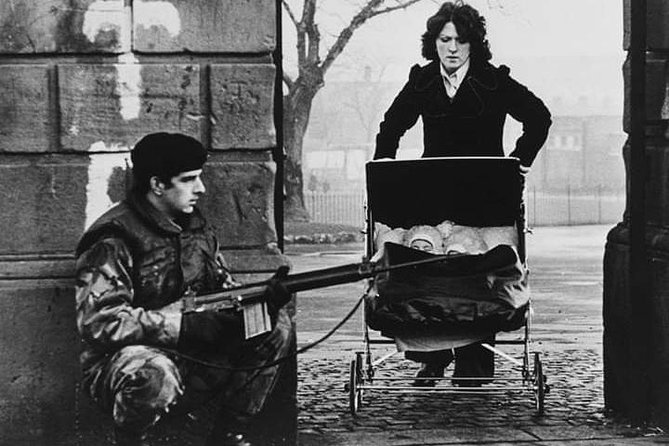
The peace walls are the clearest physical reminder that Belfast remains divided. They were first built in 1969 after sectarian riots, when homes in areas such as Bombay Street were burned and families were forced to leave.
The walls were intended as temporary barriers. Instead, many remained, and more were built even after the IRA ceasefire in 1994. The largest structures separate Republican and Nationalist areas from Loyalist and Unionist districts. Gates on some roads still close at night, a detail that makes the idea of a finished peace process feel less certain.
On this tour, you visit both sides of a peace wall and learn why it was built. You can also write your name or a message of peace on the wall. That small act is a useful pause in a tour filled with military symbols and memorials, though it should not make the division seem resolved.
One famous wall separates the Falls Road from the Shankill Road. It stretches for about 800 metres and rises as a large concrete barrier. Seeing it from both communities helps you understand that the separation is not simply a line on a map. It shaped daily life, travel routes, policing, housing, and personal safety.
Shankill Road and the Loyalist side
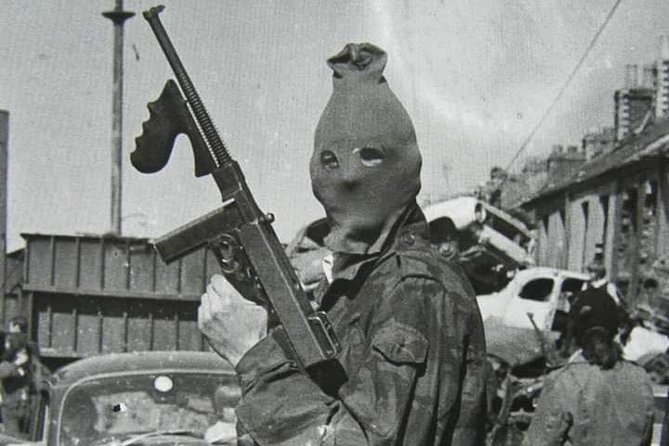
The tour crosses into the Shankill Road area, the center of Ulster Loyalism. Murals here show masked men, weapons, paramilitary emblems, and symbols of British identity. Your guide explains how Loyalism developed and how groups such as the UDA, UFF, and UVF operated during the conflict.
Because the tour is framed through Republican history, this section is explanatory rather than equal in length or emphasis to the Falls Road portion. That is important to understand before booking. You will see and discuss the Loyalist side, but the main story remains the Republican struggle.
I find this brief crossing valuable because it prevents the tour from becoming a visit to only one neighborhood. You see how both communities use walls and murals to preserve memory, defend identity, and mark territory. Still, anyone seeking a full account of Loyalist motives should treat this as one part of a larger Belfast history itinerary.
A few more museum visits around the UK worth comparing
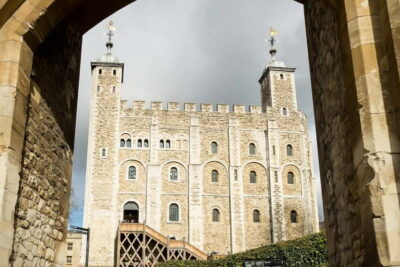
- London: Tower of London and Crown Jewels Exhibition Ticket
★ 4.6 · 28,769 reviews - Liverpool: Liverpool Football Club Museum and Stadium Tour
★ 4.8 · 10,764 reviews - Tower of London and Crown Jewels Exhibition Ticket
★ 4.5 · 6,677 reviews - London: Chelsea Football Club Stadium and Museum Tour
★ 4.8 · 4,576 reviews
Bombay Street and the Clonard Martyrs Memorial Garden
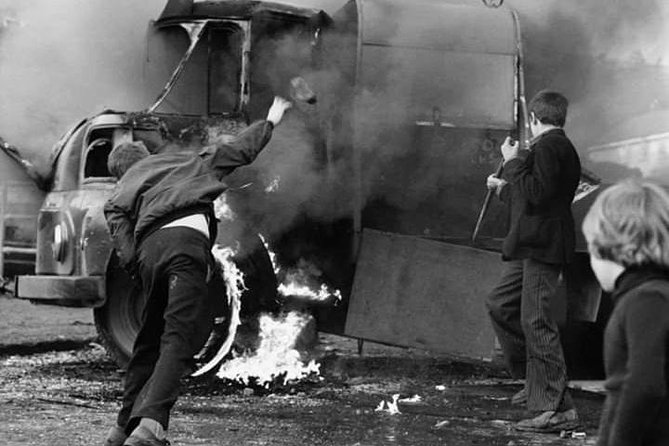
The Clonard Martyrs Memorial Garden on Bombay Street is one of the most detailed memorial sites on the route. Black iron gates feature a rising phoenix, and the garden contains several separate yards with plaques, Celtic crosses, lists of names, and memorial benches.
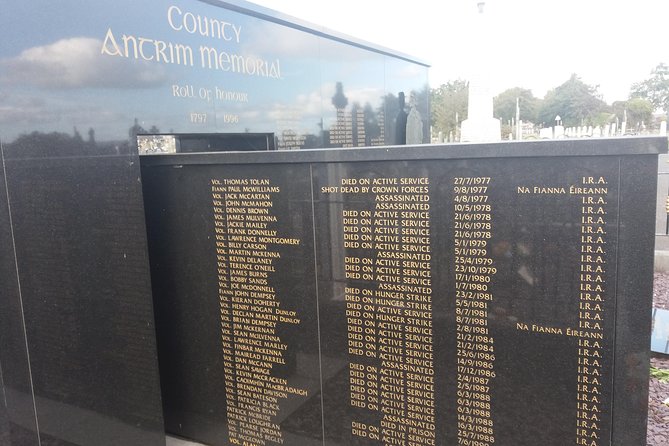
The site remembers Republican volunteers, civilians, and Republican prisoners from the Greater Clonard area. The plaques reach back to 1916 and include people who died in later campaigns. One section recalls civilians killed by Loyalists and British forces, while another lists volunteers from C Company of the 2nd Battalion, Belfast Brigade.
This is a place where the language of memory is openly partisan. The inscriptions honor those who resisted British rule and present their sacrifice as part of a continuing national struggle. Your guide can explain what the memorial means to the local community, while also helping you separate commemoration from a complete account of the conflict.
The stop takes about 30 minutes, longer than many of the mural visits. That is sensible. There is a lot to read, and rushing through the names would miss the point.
Milltown Cemetery and Bobby Sands
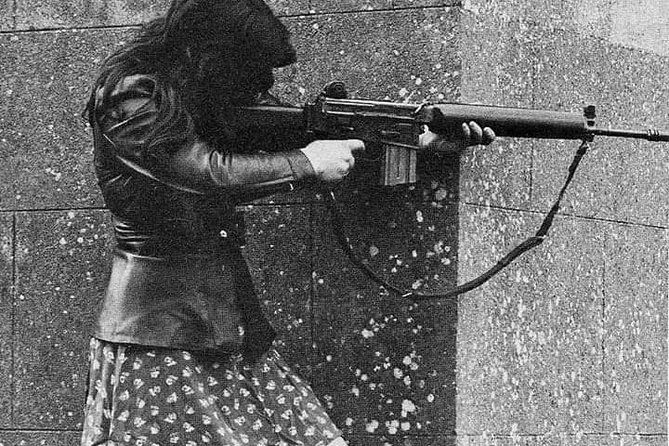
Milltown Cemetery is one of the most important Republican memorial sites in Belfast. The tour visits the Republican plots, where volunteers killed in the 1920s, the 1940s, the 1956 to 1962 campaign, and the Troubles are buried.
The most famous grave is Bobby Sands, the IRA prisoner who died after 66 days on hunger strike in 1981. He was also elected as a Member of Parliament while in prison. Your guide explains the prison protests, the hunger strikes, and the political effect of Sands’s death.
The Republican plots include the New Republican Plot, with the remains of 77 IRA volunteers, including Máiread Farrell. Graves marked with the Red Hand and tightly grouped memorials show how the cemetery became a place of political remembrance, not simply a burial ground.
You spend about 25 minutes here. That may feel long if your interest is mainly in murals, but I consider the time worthwhile. The cemetery gives names and dates to a conflict that can otherwise feel like a series of slogans. If you have a family connection to someone buried there, the guide may be able to make space for that purpose. One group was even taken to a flower shop so they could bring flowers to a family grave.
The private Irish Republican museum
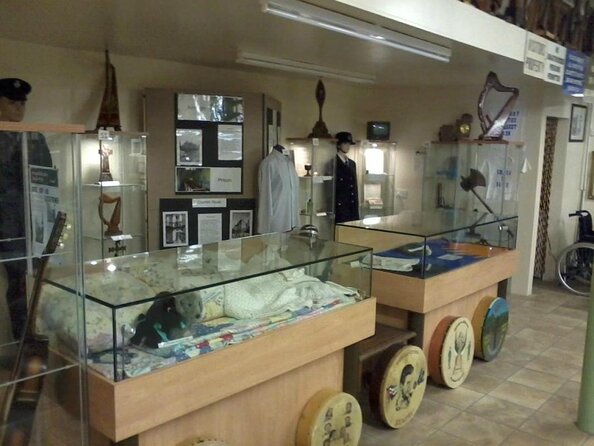
The Eileen Hickey Irish Republican History Museum is the most unusual part of the experience. It is a private collection rather than a standard public museum, and the tour includes access when it is open.
The museum focuses on resistance to British rule and Irish Republican history across many centuries, with particular attention to the modern conflict. You may see objects connected to imprisonment, protest, and paramilitary activity, including plastic and rubber bullets used by British Crown forces.
The guide may introduce you to former Republican prisoners who can speak about their own experiences. That personal element can make the museum far more affecting than a display of objects with brief labels. It also means the interpretation is strongly tied to Republican memory.
The museum opens only from 10 a.m. to 2 p.m., Tuesday through Saturday. If it is closed, the route substitutes a tour around Ballymurphy. Confirm the museum timing when you book, especially if you are visiting Belfast for only one day.
Clonard Monastery and the work for peace
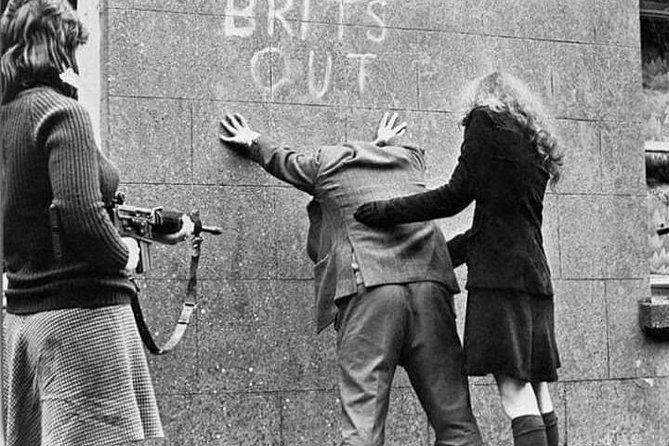
Clonard Monastery sits near the interface between Falls Road and Shankill Road. During the violence that began in 1969, priests from the monastery worked to protect local residents and help people caught between the communities.
The monastery was also associated with Fathers Alec Reid and Gerry Reynolds, two priests who played important roles in peace work. Their presence adds another layer to the story. The conflict was not only fought by armed groups and security forces. Clergy, residents, ex-prisoners, families, and local organizers all shaped what happened next.
This stop is short, about ten minutes, but it helps connect the political murals and memorials with the difficult work of negotiation. It also reminds you that Belfast’s religious labels do not tell the whole story. Catholic and Protestant identities were tied to national and political loyalties, but local relationships could be more complicated.
Divis Tower and Ballymurphy
Divis Tower overlooks the Falls area and became associated with a British Army observation post and sniper position that remained in place until 2005. The tour points out names and murals connected to the first two victims of the Troubles.
You then drive through Ballymurphy, a Republican area with murals honoring local volunteers and memorials to the Great Famine. One mural features Jim Bryson and his nickname, Big Louie, referring to a machine gun. The imagery is direct and sometimes stark, giving you a sense of how military conflict was presented inside the neighborhood.
The route includes a Welcome Wall and further views of Divis, followed by the largest peace wall in Belfast. These are quick stops, often around five minutes each. The advantage is coverage. The drawback is that you cannot study every mural or plaque at length.
What the private format adds
A private tour lets you ask the question that might not fit a standard group route. You can ask about a family name on a memorial, the meaning of a flag, the difference between the IRA and later Republican groups, or how the peace process changed daily life.
The guides vary. Barry has led many of the tours and is described as having studied Irish history at Queen’s University Belfast. Paula, Joe, Ciarán, Brendan, and Anton have also guided this experience. Personal stories are a major part of the appeal, especially when a guide grew up in Belfast during the Troubles.
That personal connection is useful, but it also requires care. A guide’s own experience can explain how events felt on the ground, yet it cannot represent every family or community. I would listen closely, ask respectful questions, and remember that this is a particular political lens rather than a final word on Northern Ireland.
Price, transport, and practical value
The cost is $255.50 per person for about three hours. That is expensive compared with a public walking tour, but the comparison is not quite fair. You receive private transportation, hotel pickup from the central meeting location at the Leonardo Hotel, an air-conditioned vehicle, and a route built around your group.
Pickup from other locations may cost extra. Additional charges apply for some hotels and landmarks, Lanyon train station, St George’s Market, Dublin train arrivals, cruise ship pickup, and drop-off. Airport pickup is not offered. You can also request a luxury Mercedes-Benz V-Class upgrade for £25 when available.
The tour is recommended for people who want a focused political history lesson, not for anyone seeking a general introduction to Belfast. It is also a good use of time for cruise passengers, provided you arrange the extra port pickup and leave enough room for delays.
The advertised rating is 4.9 from 67 ratings, with 97 percent recommending the experience. The strongest praise centers on the guides’ warmth, personal stories, broad knowledge of Irish history, and willingness to tailor the route. One guide even dropped a group at Kelly’s Cellars afterward, though you should not assume that extra stop is included.
Free cancellation is available up to 24 hours before the start time. Changes or cancellations inside that window are not accepted for a refund.
Who should book this Belfast Troubles tour?
Book it if you want to see the Falls Road, Shankill Road, peace walls, Milltown Cemetery, Bobby Sands sites, Clonard, Divis, and Ballymurphy in one tightly planned outing. The private museum and cemetery visits give it more substance than a quick mural drive.
I especially recommend it if you have already read about the hunger strikes, the IRA, the peace process, or the 1969 violence and want to connect those events with real streets and memorials. You will get more from the tour if you are willing to ask questions and accept a clear Republican interpretation.
Think twice if you need a carefully balanced presentation of Republican, Loyalist, and British positions in equal measure. The tour does not hide its purpose, and that honesty is helpful. For a rounded picture, pair it with a separate tour focused on the Loyalist community or a wider political history of Northern Ireland.
FAQ
How long does the tour last?
The tour lasts approximately three hours.
How much does the tour cost?
The listed price is $255.50 per person.
Is this a private tour?
Yes. Only your group participates, and the itinerary can be adjusted around your questions and interests.
What viewpoint does the guide present?
The tour presents the history of the Troubles from an Irish Republican perspective, including Republican history, the IRA, prison protests, the hunger strikes, and the peace process.
Which guides may lead the tour?
Guides who have led this experience include Barry, Paula, Joe, Ciarán, Brendan, and Anton. The assigned guide can vary.
Is hotel pickup included?
Free pickup is offered from the central meeting location at the Leonardo Hotel. Pickup from other locations may involve an additional charge.
Is cruise ship pickup available?
Yes, cruise ship pickup and drop-off are available for an extra £25 each way, paid directly to the guide.
Is airport pickup offered?
No. Airport pickup and drop-off are not offered.
Can I visit the private museum on every tour?
The museum is open only from 10 a.m. to 2 p.m., Tuesday through Saturday. If it is closed, the tour substitutes a visit around Ballymurphy.
Can I cancel for a full refund?
Yes, if you cancel at least 24 hours before the experience begins. Cancellations made less than 24 hours in advance are not refunded.
Should I book this tour if I want a balanced account of Belfast?
Book it only if you understand that the tour has a Republican focus. For equal attention to Republican, Loyalist, and British arguments, choose a different tour or add a second experience with a broader political scope.
Just added around the UK
- Belfast Titanic Museum and Sighseeing Tour★ 4.5 · 59 reviews
- Westminster and National Gallery 3.5-Hour Tour in Italian★ 4.9 · 28 reviews
- British Museum & Camden Town – Private Tour in Italian★ 4.8 · 26 reviews
- Glasgow: Rangers Football Club Museum★ 4.6 · 103 reviews
- Edinburgh The King’s Gallery Entrance Ticket★ 4.3 · 54 reviews
- The Royal Mint Experience: Ticket, Guided Tour & Exhibition★ 4.6 · 57 reviews
- London: National Gallery of London Masterpieces Guided Tour★ 4.9 · 78 reviews
- London: British Museum Highlights Guided Small Group Tour★ 4.9 · 113 reviews
Museum Tours in the UK, compared.
Tower of London and Crown Jewels Exhibition Ticket
Read our review →
Liverpool Football Club Museum and Stadium Tour
Read our review →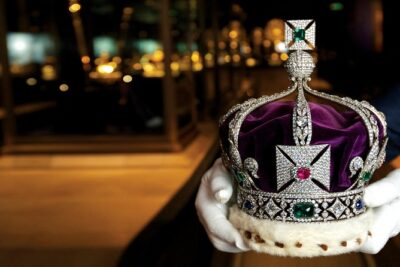
Tower of London and Crown Jewels Exhibition Ticket
Read our review →
Chelsea Football Club Stadium and Museum Tour
Read our review →

Browse the lists this tour appears in