
Review · GERMANY
Dresden: Guided Walking Tour and Chocolate Museum Ticket
Dresden’s past comes in striking layers: medieval hardship, Renaissance ambition, Baroque splendor, wartime destruction, and the peaceful change of 1989. This tour links those stories to a compact walk through the Old Town, ending with a self-guided visit to the Dresden Chocolate Museum. I like the route for two clear reasons: it covers the city’s most important sights without wasting time, and it adds a quirky local subject, Dresden’s old chocolate industry, to the usual palace-and-church tour.
I also like the practical format. You get a live German-language guide for the 90-minute walk, then use your ticket for the museum at any time that same day. The main point to consider is language: this is not the right choice if you need an English tour. The museum visit is also independent, so you should not expect the guide to continue with you.
Key points at a glance
- Dresden’s grand center in 90 minutes: Walk from Dresden Castle through the historic core to Frauenkirche.
- A strong run of landmarks: See the Semperoper, Baroque Zwinger, Brühl’s Terrace, Dresden Cathedral, and Augustus Bridge.
- History beyond architecture: Hear about the Middle Ages, Renaissance, Baroque era, the 1989 Peaceful Revolution, and German reunification.
- A separate chocolate stop: Visit the museum on your own, at any time during its 11:00 AM to 6:00 PM opening hours.
- A taste of Dresden’s sweet past: Learn about cocoa, milk chocolate, nineteenth-century factories, and Anton Reiche’s chocolate molds.
- Best for German speakers: The walking tour is conducted in German and lasts about an hour and a half.
A compact route through Dresden’s historic center

The meeting point is in the lower level of the QF Passage, in the seating area of Dresden Information. That is a useful detail to note before you set out. The tour does not begin on a random street corner, but inside a recognizable visitor center in the heart of the Old Town.
The walk is built for orientation. Rather than focusing on one building at length, it connects a string of major sights so you can understand how Dresden’s center fits together. You move through the former royal quarter, along the Elbe-side terraces, past palace buildings and church towers, and finish near Frauenkirche.
I like this arrangement for a first visit. You get the city’s visual highlights quickly, but the guide also supplies the events that make the stonework meaningful. Dresden is not just a pretty Baroque center. Its story includes hard medieval years, the energy of the Renaissance, royal display in the Baroque period, the damage of the twentieth century, and the peaceful political movement that helped end East Germany.
Because the walk lasts 90 minutes, expect a brisk overview rather than a slow architectural study. If you want long interior visits or time for detailed photographs at each stop, you will need to return on your own afterward.
More chocolate museums in Germany:
- Cologne: Chocolate Museum Entrance Ticket
★ 4.4 · 2,790 reviews - Lindt Home of Chocolate Museum Entry Ticket
★ 4.7 · 9,329 reviews - Choco-Story Brussels: Chocolate Museum Entrance with Tasting
★ 4.3 · 4,883 reviews
Dresden Castle and the royal quarter
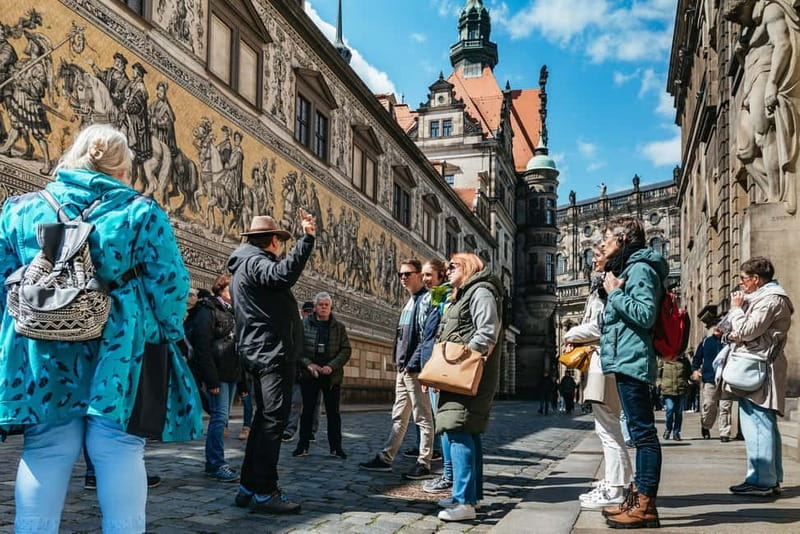
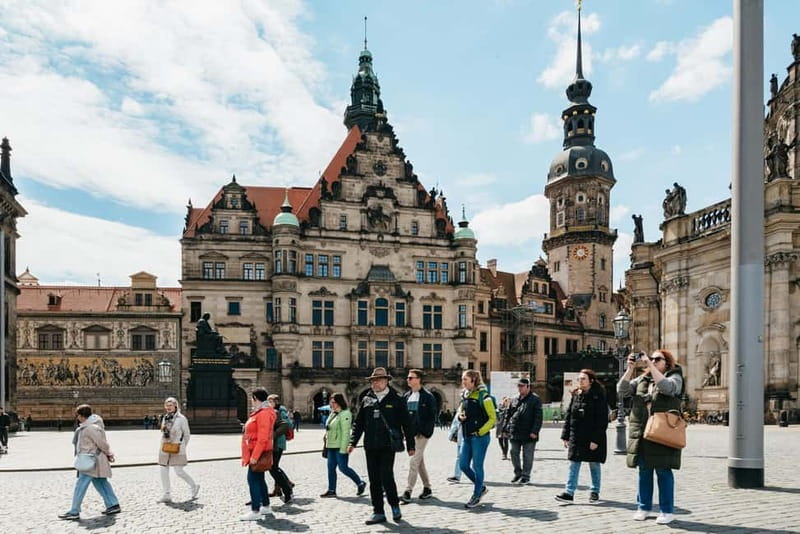
The route begins at Dresden Castle, one of the city’s central historic buildings. From here, the guide places you in the setting of the former royal court and explains how Dresden developed through its main periods.
This is where the tour’s historical structure works well. The Middle Ages give you the early backdrop, while the Renaissance introduces a period of new energy and ambition. The Baroque era then explains the grand scale of the buildings and public spaces that define the Old Town today.
You should listen for the contrast between the city’s cultural splendor and its more difficult chapters. The guide’s role is not simply to name buildings. It is to show why Dresden’s rulers invested so heavily in ceremony, art, churches, palaces, and public views.
The route also gives you a chance to see Dresden as a rebuilt city. The central sights look historic, but the city’s twentieth-century story is impossible to separate from them. That context matters, especially when you later stand before the Frauenkirche and other restored landmarks.
Procession of Princes and Stallhof
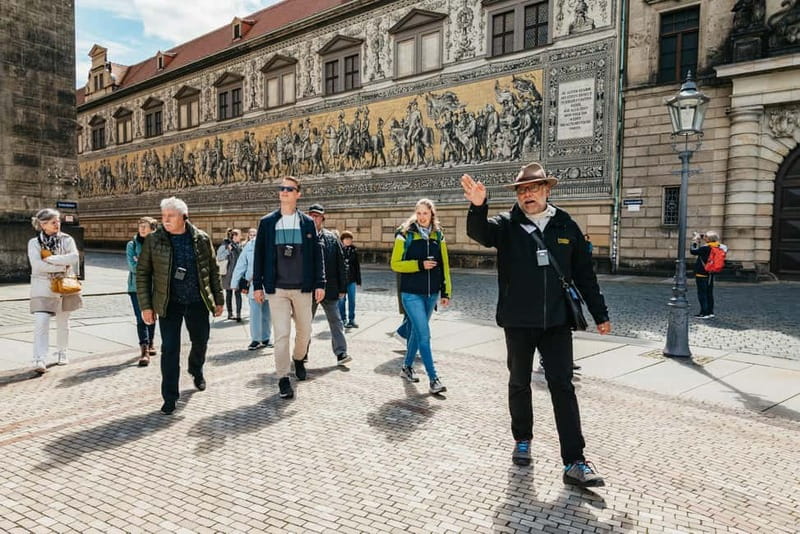
From the castle area, the walk continues toward the Procession of Princes and Stallhof. These sites bring royal Dresden to life through decoration and courtly display.
The Procession of Princes is known for its long wall image of rulers on horseback. It is one of the easiest places in the city to grasp Dresden’s relationship with its former dynasty. You can take in a large sweep of history while standing outdoors, with no museum ticket or long indoor stop required.
Stallhof, the former stable yard, adds a more enclosed sense of the palace complex. The setting helps you picture the working side of court life, not only the grand ceremonial image. It is a good reminder that royal districts needed service yards, stables, movement, and practical space behind the show.
I find this portion especially useful for visitors who might otherwise see the Old Town as a collection of unrelated façades. The guide connects the wall, courtyard, castle, and surrounding buildings into one royal complex.
Dresden Cathedral and the Semperoper

The walk then reaches Dresden Cathedral, another major landmark in the former court district. Its location near the palace buildings shows how closely religion and royal power were tied together in historic Dresden.
The cathedral also adds variety to the route. You are not only looking at secular palaces and civic buildings. Churches, opera, royal residences, and public squares all share this small central area.
The Semperoper brings the cultural side of Dresden into view. Its name is linked to architect Gottfried Semper, and the building remains one of the city’s best-known symbols of music and opera. You see it as part of the Old Town route rather than as an isolated theater stop.
The guide explains the building within Dresden’s larger story, including the city’s Baroque character and later rebuilding. You should not expect an opera performance or a lengthy interior tour as part of this activity. The value is in seeing the landmark, learning its place in the city, and deciding if you want to return for a separate visit.
A few more museum visits around Germany worth comparing
- NYC: Museum of Ice Cream Entry Ticket
★ 4.3 · 2,619 reviews - Vienna: Chocolate Workshop in Chocolate Museum w/ Tasting
★ 4.5 · 1,802 reviews - Brussels: Chocolate Museum Visit with Workshop
★ 4.6 · 1,474 reviews - Museum of Ice Cream New York City Admission Ticket
★ 4.0 · 1,154 reviews
Zwinger and the Baroque view
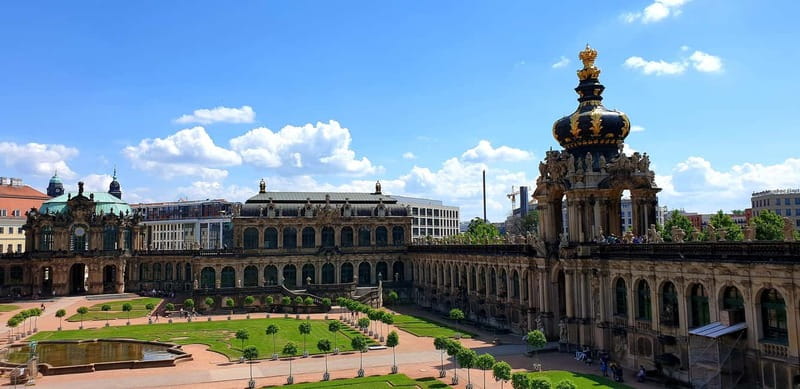
The Baroque Zwinger is one of the route’s visual high points. Its large courtyards, ornate details, and formal design show the ambition of eighteenth-century Dresden better than a short description can.
The tour gives you the broad view of the complex and places it in the period when Dresden sought to project royal power and artistic importance. This is a good spot to pause mentally and compare the city’s earlier medieval scale with the grander Baroque vision.
The Zwinger can be busy, and a guided walk cannot give you unlimited time to inspect every corner. Still, seeing it as part of a route that includes the castle, opera house, cathedral, and palace district makes the stop more useful than a quick photograph alone.
If you enjoy architecture, note how much of Dresden’s appeal comes from the relationship between buildings and open spaces. The courtyards, terraces, bridges, and river views are part of the experience. The walk helps you see those connections.
Brühl’s Terrace and Augustus Bridge
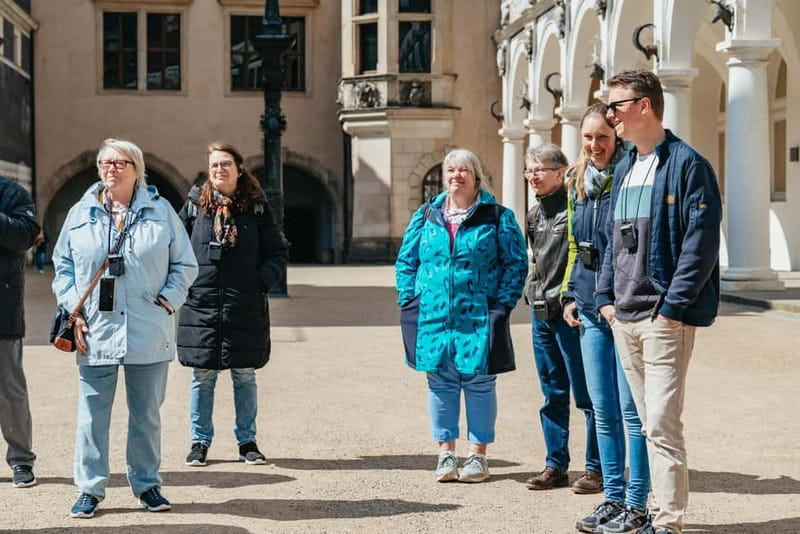
From the central palace area, the route heads to Brühl’s Terrace. This broad riverside promenade is known for its views and for its place in Dresden’s historic center.
The terrace offers a change of pace after the dense royal quarter. You get open views toward the Elbe and a better sense of Dresden’s setting. It is also one of the places where the city’s grand architecture can be viewed from a little distance instead of straight up from the pavement.
The walk continues toward Augustus Bridge, which links the Old Town with the opposite bank. The bridge is important not only as a crossing but also as a viewpoint. From here, you can understand why the river has shaped Dresden’s appearance and movement.
Do not expect a long riverside stroll. This remains a focused city walk, so the guide keeps the group moving. Wear comfortable shoes, particularly if you plan to continue sightseeing after the tour.
Frauenkirche and Dresden’s twentieth-century story
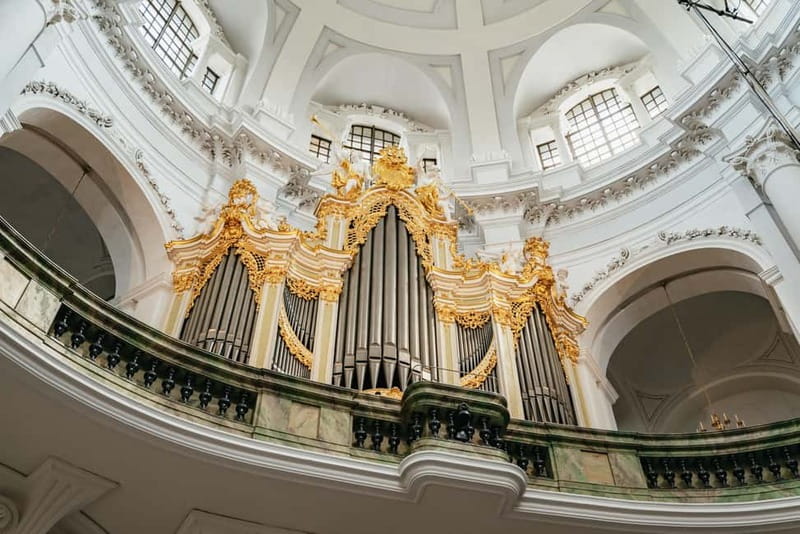
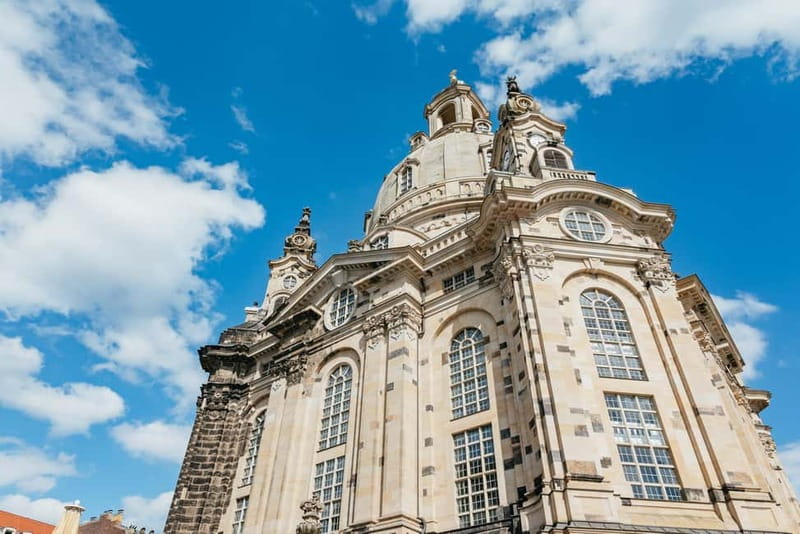
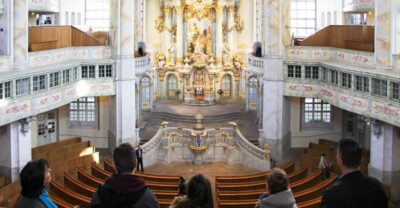
The route ends near Frauenkirche, Dresden’s most famous church and one of its strongest symbols of destruction and rebuilding. The church’s story gives the tour emotional weight without requiring a separate memorial visit.
The guide also discusses the Peaceful Revolution of 1989 and the reunification of East and West Germany. This is an important part of the experience. Dresden is often presented through its Baroque buildings, but the city’s modern political story explains how its people experienced the final years of East Germany and the changes that followed.
Ending near Frauenkirche is convenient. You are left in the center of the Old Town, close to other sights, cafés, museums, and public spaces. It also means you can stay in the area for photographs or return inside the church separately if you want more time.
The walk does not promise a complete account of Dresden. At 90 minutes, it offers a well-shaped introduction. I would use it as your first orientation, then choose one or two buildings for a longer independent visit.
Entering the Chocolate Museum after the walk
The chocolate museum is a separate part of the experience. Your walking tour ticket gives you entry on the day of the walk, but you visit on your own and the guide does not accompany you.
This flexible arrangement can work very well. The museum is open daily from 11:00 AM to 6:00 PM, so you can go before the walk, after it, or at another point in your Dresden schedule. You do not need to enter at the exact time selected for the walking tour.
There is one important exception. If you choose the 4:00 PM walking tour, you should visit the museum before the walk because of its closing time. That timing can be awkward, so check the day’s schedule before booking.
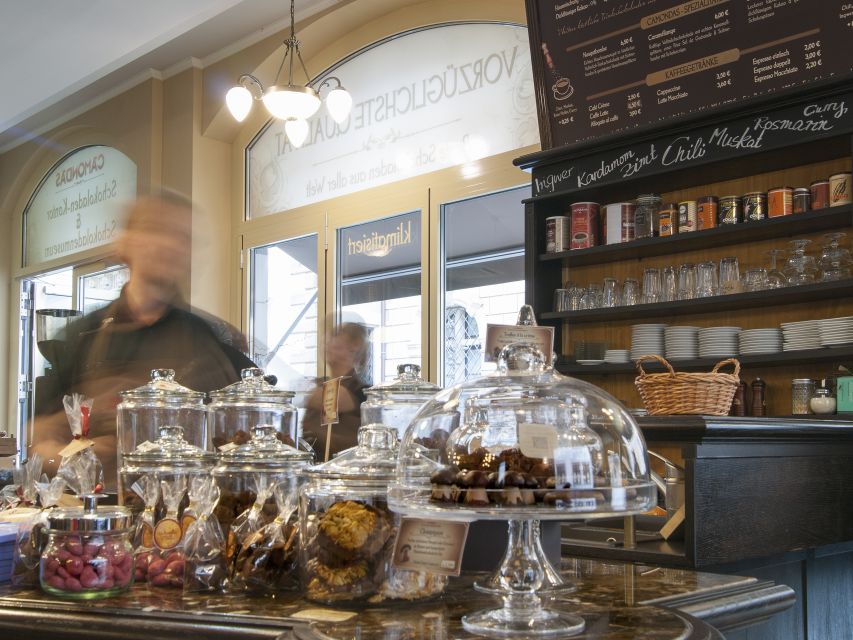
The museum adds a light, hands-on subject to a history-heavy morning or afternoon. Dresden once had a major connection with chocolate production, and the museum explains why the city was known as Germany’s chocolate capital.
Milk chocolate, cocoa, and Anton Reiche’s molds
The museum focuses on the path from cocoa bean to finished chocolate. You learn about the key ingredients, the making process, and the qualities that separate good chocolate from a basic sweet.
One of the most unusual features is the collection of chocolate molds associated with Anton Reiche. It is described as one of the world’s largest collections, giving the museum a strong historical angle beyond tasting samples.
You also learn about the many chocolate factories that operated in nineteenth-century Dresden. That industrial story helps explain why chocolate belongs in a Dresden sightseeing plan. This is not simply a modern candy shop attached to a city tour. It connects food production, invention, trade, and local identity.
The museum also explores the claimed Dresden origins of milk chocolate and lets you consider what early chocolate bars may have tasted like. The subject is especially appealing if you enjoy food history, old manufacturing methods, or unusual local museums.
At the end, you can taste German milk chocolate. The tasting is modest but well matched to the museum’s theme. It gives you a direct way to connect the displays about cocoa and production with the finished product.
Price, timing, and practical value
At $18 per person, this combines a guided city walk, museum admission, and chocolate tasting at a reasonable price. The value is strongest if you want a quick introduction to Dresden and would otherwise pay separately for a walk and a small museum visit.
The price is less attractive if you need a long tour in English or prefer to spend most of your time inside major buildings. The guided portion is in German, and the museum is self-guided. You are paying for a concise overview, not a full-day cultural program.
The reserve-now-and-pay-later option can help if your plans are still shifting. You can also cancel up to 24 hours before the activity for a full refund. The experience is wheelchair accessible, another practical advantage for visitors who need an accessible route, though the walk still takes place across the historic city center.
For school classes and youth groups with ten or more people under age 15, a private group tour is required. That rule does not affect most individual bookings, but it matters for larger educational groups.
Who should book this Dresden combination?
I would choose this experience if you are visiting Dresden for the first time, want the main Old Town sights explained in one stretch, and enjoy adding an unusual local subject to your day.
It suits:
- German-speaking visitors who want a lively, quick city introduction
- First-time visitors with limited time in Dresden
- Families who may appreciate the chocolate tasting after the architecture
- History fans interested in both the Baroque court and the events of 1989
- Visitors who prefer a flexible museum visit rather than a fixed group tour
I would be more cautious if you need English commentary, dislike walking tours with a brisk pace, or want a guide inside the chocolate museum. The museum visit is entirely your own, and that split format may feel less personal than a tour with one guide from start to finish.
Should you book it?
Book this tour if you want Dresden’s essential Old Town sights, a clear historical framework, and a small chocolate museum visit for $18. The strongest elements are the route from Dresden Castle to Frauenkirche, the stops at the Semperoper and Zwinger, and the unusual look at Dresden’s chocolate-making past.
Skip it if German is not comfortable for you or if you want detailed interior visits. For everyone else, it is a practical first look at Dresden, with enough variety to keep a short sightseeing session lively and enough flexibility to fit the museum around the rest of your day.
FAQ
How long does the Dresden walking tour last?
The guided walking tour lasts 1.5 hours.
What language is the walking tour in?
The live tour guide conducts the walking tour in German.
Where is the meeting point?
Meet in the lower level of the QF Passage, in the seating area of Dresden Information.
Is the Chocolate Museum visit guided?
No. You visit the Chocolate Museum independently, and the walking tour guide does not accompany you.
When can I use the Chocolate Museum ticket?
You can use the voucher to enter the museum at any time on the day of your walking tour. The museum is open daily from 11:00 AM to 6:00 PM.
What happens if I choose the 4:00 PM walking tour?
If you select the 4:00 PM walking tour, visit the Chocolate Museum before the walk because the museum closes at 6:00 PM.
More Walking Tours in Germany
- Berlin: Berlin Wall & East Side Gallery Walking Tour
★ 4.9 · 264 reviews - Berlin: Museum Island Guided Walking Tour
★ 4.9 · 38 reviews - Düsseldorf: Art:walk museum pass
★ 3.7 · 34 reviews - Berlin: Museum Island Guided Walking Tour
★ 4.9 · 28 reviews
Just added around Germany
- Stuttgart: Stuttgart Wine Museum Wine Tasting★ 4.7 · 55 reviews
- Stuttgart: Museum of Illusions Entry Ticket★ 4.2 · 507 reviews
- Stein: Public guided tour of the “Old Mine” museum★ 4.5 · 18 reviews
- Speyer: Technik Museum Speyer Ticket with an IMAX Dome Film★ 4.7 · 360 reviews
- Berlin: Bode Museum Ticket★ 4.5 · 214 reviews
- Munich: WOW Museum – Room for Illusions Ticket★ 3.5 · 14 reviews
- Munich Private Walking Tour with BMW Museum & Welt Entry★ 4.2 · 19 reviews
- Munich: Residenz Palace, Museum and Treasury Private Tour★ 4.9 · 15 reviews
Museum Tours in Germany, compared.

Dresden: Church of Our Lady Guided Tour of Gallery
Read our review →
Skip-the-Line: Berlin Wall Museum at Checkpoint Charlie
Read our review →Browse the lists this tour appears in