
Review · THE UK
Stratford-upon-Avon: Tudor World Museum Entrance Ticket
The most interesting part of Tudor World is its setting. You enter a 16th-century Grade II building in central Stratford-upon-Avon, then move through rooms designed to show how people lived during the age of Shakespeare, Elizabeth I, Henry VIII, and Francis Drake. It is history presented through places you can sit in, touch, and photograph, not just cases of old objects.
I like the plague cottage, which gives the subject a human scale, and I like the chance to sit in a Tudor dining room or stretch out on a Tudor bed. Children get their own quiz and a small prize, which gives families a simple reason to pay attention. The main drawback is that this is not a guided tour. If you want a lively historian explaining each room, the amount of reading may feel too heavy.
Key points at a glance

- Walk through a plague cottage: See how illness and treatment were understood in Tudor England.
- Enter a real 16th-century building: The museum sits just off Sheep Street, close to the Royal Shakespeare Theatre.
- Use the period sets: Sit in a Tudor dining room, lie on a Tudor bed, and visit a throne room.
- Keep children involved: A quiz and small prize add a clear goal for younger visitors.
- Learn at your own pace: Touchscreens, videos, and written displays replace a live guide.
- Pay about $10: The price is reasonable for a central, family-friendly indoor stop, especially on a rainy day.
Finding the museum near the Royal Shakespeare Theatre

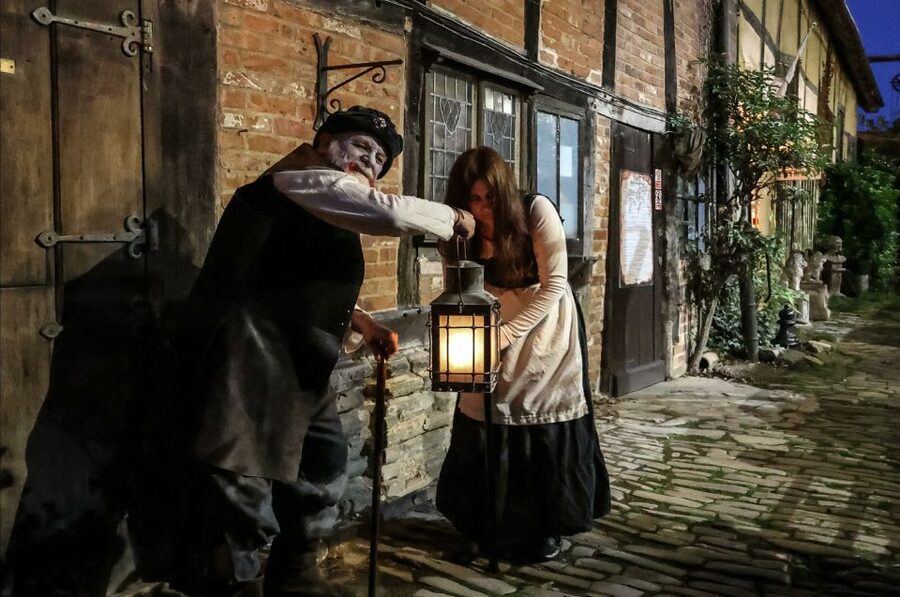
Tudor World is on Sheep Street in the center of Stratford-upon-Avon. Look for the large Tudor building, then go under the arch and continue across the cobbled courtyard to the entrance.
That approach matters. The museum is not presented as a modern attraction with a wide street-front entrance. You pass into an older building and courtyard first, which helps set the tone before you reach the displays.
The location is useful if you are already visiting Shakespeare-related sights. The museum is only a few meters from the RSC, so you can fit it around a theatre visit, a walk beside the River Avon, or a look at Shakespeare’s Birthplace. You do not need to set aside a full day in the usual sightseeing sense, but the ticket is valid for one day, so you have flexibility about when you enter.
I would plan this as one stop in a larger Stratford day rather than as your only activity. The central position makes it easy to combine with other sights, and the indoor setting gives you a useful break if the weather turns wet.
A few more museum visits around the UK worth comparing
- London: Tower of London and Crown Jewels Exhibition Ticket
★ 4.6 · 28,769 reviews - Tower of London and Crown Jewels Exhibition Ticket
★ 4.5 · 6,677 reviews - London Transport Museum Entrance Ticket
★ 4.5 · 1,323 reviews
What the Tudor setting adds
The museum is housed in a historic 16th-century Grade II building. That gives the experience a stronger sense of place than a display installed in a plain modern room.
You are not simply reading about Tudor England from a distance. You move through rooms arranged to suggest daily life, power, religion, illness, and social customs. The displays cover well-known figures such as Shakespeare, Henry VIII, Elizabeth I, and Francis Drake, but they also point toward ordinary people living in Stratford during the period.
That wider focus is important. Tudor history can easily become a parade of monarchs and famous names. Here, the museum connects those people with the town where William Shakespeare lived and with the practical concerns of the period, including food, disease, writing, and household life.
The historical settings are designed as accurately as possible, according to the activity information. I would still approach them as interpretive sets rather than preserved rooms from the lives of Shakespeare or Henry VIII. Their value is in helping you picture the period and giving younger visitors something physical to explore.
Moving through the plague cottage

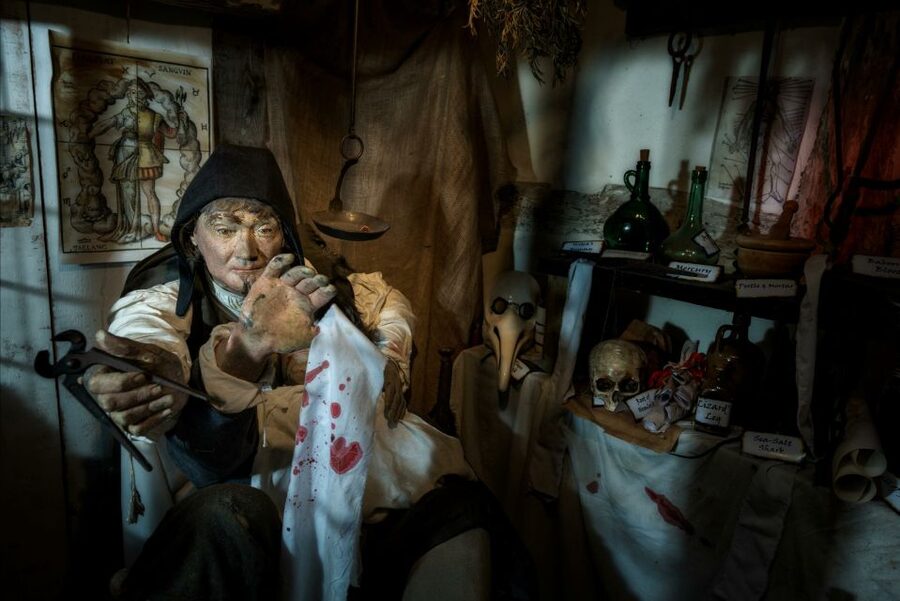
The plague section is one of the strongest reasons to visit. Stratford was affected by outbreaks during Shakespeare’s time, and the museum explains the plague as part of local Tudor life rather than as a distant event from a textbook.
The plague cottage gives you a look at how illness was treated and understood at the time. It is a useful reminder that people in Tudor England had very limited medical knowledge and few effective protections against infection.
This part may be more serious than the throne room or the photo-friendly period furniture. Parents should judge it according to their children’s age and sensitivity, since the subject is disease and death. Still, it offers a clear way to explain why plague shaped everyday life, town behavior, and fear in the 16th century.
I like this section because it links famous history with ordinary experience. Elizabeth I and Shakespeare may dominate the period, but the plague affected families, workers, and neighborhoods. The cottage helps put those people back into the picture.
Shakespeare’s Stratford and the Tudor world

The museum places Shakespeare within the broader world of Tudor England. You learn about the town where he lived, rather than treating him as an isolated literary figure.
That context can be useful before a visit to Shakespeare’s Birthplace or an RSC performance. You get a sense of the era’s social customs, beliefs, and daily routines, which may help you understand the world behind Shakespeare’s plays.
The presentation also includes Henry VIII, Elizabeth I, and Francis Drake. These figures represent different sides of the period: royal power, national identity, exploration, religion, and court life. The museum uses them to explain the age, while the room settings bring the information back to people and places.
I would not book this expecting a specialist Shakespeare lecture. There is no guide included, and the experience is built around displays, touchscreens, videos, and written information. If you enjoy setting your own pace and stopping at the topics that interest you, that freedom works well. If you want a continuous story told by an expert, you may find the visit less satisfying.
Same city, a completely different collection:
- Liverpool: Liverpool Football Club Museum and Stadium Tour
★ 4.8 · 10,764 reviews - London: Chelsea Football Club Stadium and Museum Tour
★ 4.8 · 4,576 reviews - Chelsea FC Stadium Tours and Museum
★ 5.0 · 1,908 reviews - Manchester: National Football Museum Admission Ticket
★ 4.4 · 1,243 reviews
Sitting at a Tudor table and lying on a Tudor bed
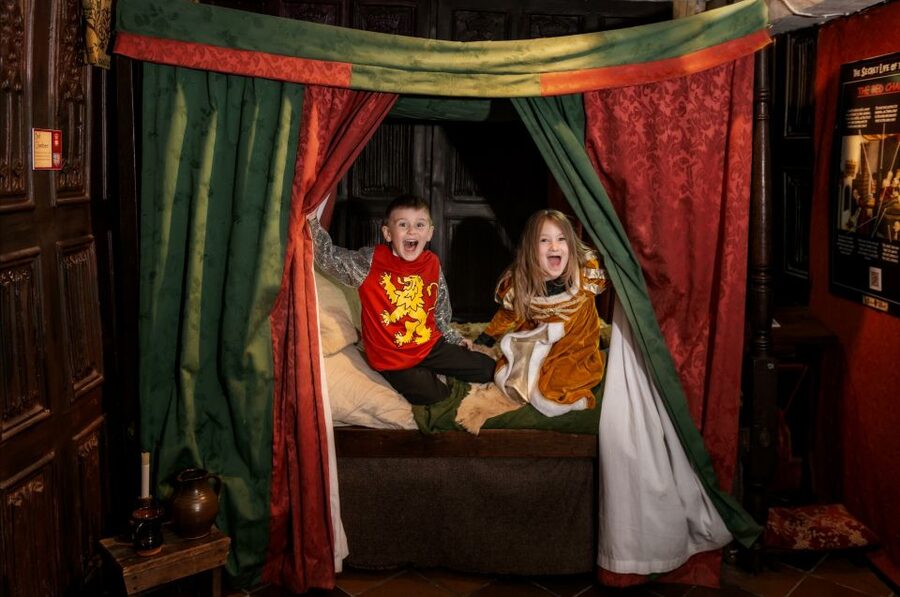
The museum includes several hands-on moments that make it more suitable for families than a traditional text-heavy museum.
You can sit in a Tudor dining room and consider how meals, furniture, and household life differed from today. You can also lie across a Tudor bed, an unusual feature that gives children a direct physical connection with the past. These are the sorts of details that make a period display easier to remember.
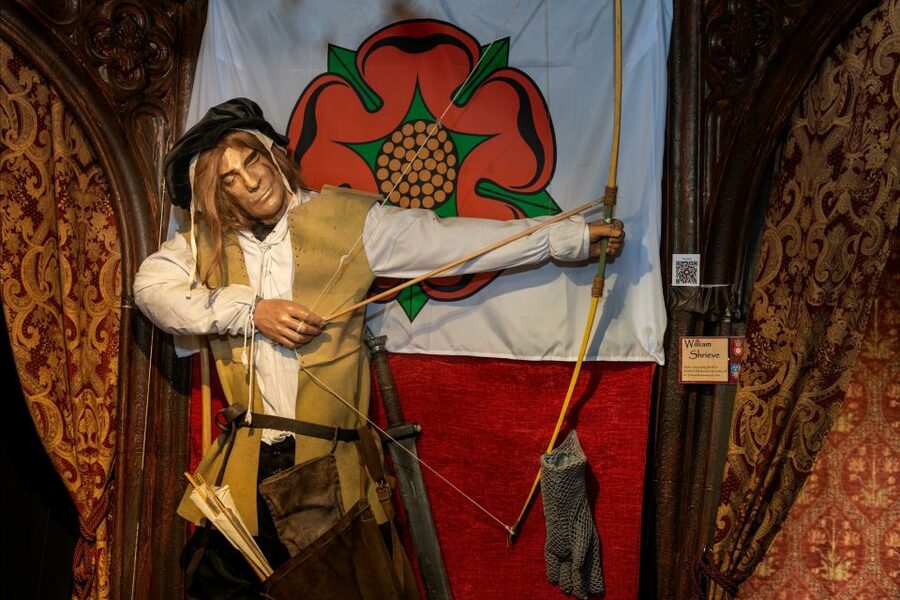
There is also a throne room, which provides a natural place for photographs. The sets are made for interaction and pictures, so you can expect to pause, pose, and examine the rooms rather than simply walk past them.
I would remind children that the museum is still a historical attraction, not a play center. The hands-on features support the information, but they do not replace it. The experience works best when you use the interactive rooms as prompts to ask questions about the people who used such furniture and spaces.
Touchscreens, videos, and the children’s quiz

Tudor World mixes old-fashioned displays with simple modern tools. Touchscreens and videos add variety to the reading, while the quiz gives children something specific to look for as they move through the museum.
The quiz is included, and children can receive a small prize if they do well. That may sound modest, but it can make a real difference during a museum visit. A child who might ignore a wall of text has a reason to search for answers and remember details.
Adults receive character cards. These add another layer to the visit, although the available information does not specify how many characters there are or exactly how the cards are used. I would treat them as an optional way to make the displays more social and engaging, rather than as a formal role-playing session.
You can also try writing with a quill and find out if you are a witch. Those features add humor and help break up the more serious material about disease and Tudor politics. They are small activities, but they suit the museum’s goal of making history physical and approachable.
How much time and value should you expect?
The ticket costs about $10 per person and is valid for one day. For a central Stratford attraction with period rooms, interactive features, and family activities, I consider that a fair price.
The value depends on what you want from a museum. Families may get more from the ticket because children have a quiz, a prize, and several things to touch or try. Adults who enjoy historical settings and local context should also find enough material to justify the cost.
The price is less compelling if you want a fully guided historical tour. No guide is included, and the experience relies on written displays, videos, and self-directed exploration. One person described the museum as too focused on reading and lacking a guide, which points to the main limitation: this attraction asks you to do more of the work.
I would allow enough time to read the sections that interest you and use the interactive features without rushing. The exact visit length is not specified, so I would not build a tight schedule around a particular end time. Since the ticket is valid for the day, you have some room to plan around other Stratford activities.
Who will enjoy Tudor World most?

I think the museum is best for:
- Families with children who enjoy quizzes, costumes, rooms, and simple hands-on tasks
- Visitors already exploring Shakespeare’s Stratford
- Adults interested in Tudor daily life as well as royal history
- People looking for an indoor activity near the RSC
- Anyone who prefers to explore at their own pace
It may be less suitable for visitors who want a live guide, a large collection of original objects, or a detailed academic treatment of Tudor history.
The experience also works for mixed-age groups because the subject matter ranges from playful to serious. Children can focus on the quiz, quill, witch activity, and period furniture, while adults can spend more time with the plague and historical context.
The activity information gives conflicting access details. It says the museum is wheelchair accessible, but it also lists wheelchair users under not suitable for the experience. I would contact Tudor World before booking if step-free access or room access is essential.
Practical booking advice for a Stratford day
You can cancel up to 24 hours before the activity for a full refund, and a reserve-now, pay-later option is available. That is useful if your Stratford plans depend on theatre times, weather, or other bookings.
No food or drinks are included, so plan refreshments separately. The museum is in central Stratford, where you can arrange lunch or a drink before or after your visit.
The ticket is listed as valid for one day, with availability and starting times shown during booking. Since there is no guide, do not expect to meet a named historian or join a scheduled storytelling group. You are buying access to the museum and its displays, not a guided walk through Stratford.
I would also check the access arrangements directly if you have mobility concerns. The cobbled courtyard and historic building may matter even if the venue describes itself as accessible.
Is Tudor World worth booking?
I would book Tudor World if you want a short, central introduction to Tudor life with rooms you can enter, furniture you can use, and activities that keep children involved. The plague cottage, throne room, Tudor dining room, and bed give the visit more character than a basic text display.
I would skip it if your priority is a guided tour or a large collection of original artifacts. The lack of a guide is the clearest weakness, and some adults may find the reading too dominant.
At about $10, it is a sensible add-on to a Stratford visit, especially for families and anyone interested in the everyday world behind Shakespeare’s name. Go in expecting an interactive self-guided museum, not a polished theatrical performance. That expectation will make the experience easier to judge and more enjoyable.
FAQ
Where is Tudor World Museum located?
The museum is on Sheep Street in central Stratford-upon-Avon, close to the Royal Shakespeare Theatre. Go under the arch and across the cobbled courtyard to find the entrance.
How much does entry cost?
The listed price is $10 per person.
How long is the ticket valid?
The ticket is valid for one day.
Is the museum guided?
No. A guide is not included. The museum uses historical settings, written displays, touchscreens, videos, and interactive activities instead.
What can children do at the museum?
Children can complete a quiz during the visit and may receive a small prize if they do well. They can also try activities such as writing with a quill and finding out if they are a witch.
Can I sit on the furniture?
The experience includes the chance to sit in a Tudor dining room and lie across a Tudor bed. You can also visit a throne room and take photographs throughout the museum.
Does the museum explain the plague?
Yes. You can learn about 16th-century plague outbreaks in Stratford and walk through a plague cottage showing how the illness was treated at the time.
Are food and drinks included?
No. Food and drinks are not included in the entry ticket.
Is the museum wheelchair accessible?
The activity information gives conflicting details. It describes the museum as wheelchair accessible but also says it is not suitable for wheelchair users. Contact Tudor World before booking to confirm the current access arrangements.
Just added around the UK
- Westminster and National Gallery 3.5-Hour Tour in Italian★ 4.9 · 28 reviews
- British Museum & Camden Town – Private Tour in Italian★ 4.8 · 26 reviews
- Glasgow: Rangers Football Club Museum★ 4.6 · 103 reviews
- Edinburgh The King’s Gallery Entrance Ticket★ 4.3 · 54 reviews
- The Royal Mint Experience: Ticket, Guided Tour & Exhibition★ 4.6 · 57 reviews
- London: National Gallery of London Masterpieces Guided Tour★ 4.9 · 78 reviews
- London: British Museum Highlights Guided Small Group Tour★ 4.9 · 113 reviews
- London: Westminster Abbey & Jubilee Galleries Guided Tour★ 4.9 · 56 reviews
Museum Tours in the UK, compared.

Tower of London and Crown Jewels Exhibition Ticket
Read our review →
Liverpool Football Club Museum and Stadium Tour
Read our review →
Tower of London and Crown Jewels Exhibition Ticket
Read our review →
Chelsea Football Club Stadium and Museum Tour
Read our review →



Browse the lists this tour appears in