

Review · THE USA
USS Midway Museum Admission: Valid Any Date
The USS Midway is not a ship-shaped museum. It is a real aircraft carrier, with a four-acre flight deck, cramped sleeping quarters, engine spaces, aircraft, and enough passageways to make you feel like you have entered a floating city. The scale is the main event.
I like the freedom to arrive any time during the 10 a.m. to 5 p.m. opening hours, and I like that the audio tour uses stories from former Midway sailors and officers. The main drawback is simple: this is a large, stair-filled ship, so two hours can feel rushed. Plan on three to five hours if you want to hear the volunteers and see the vessel properly.
Key points
- The flight deck is the star: See 25 restored aircraft and take in broad views of San Diego Harbor and downtown.
- The audio tour adds human detail: Former officers and sailors explain how the carrier worked and what daily life was like aboard.
- The ship is vast: You can visit 65 highlighted areas, from the bridge and engine room to galleys and sleeping quarters.
- Yellow-hat volunteers bring the ship to life: Retired military volunteers share stories and explain equipment throughout the vessel.
- Admission is flexible: Enter on your chosen date during museum hours, with last admission at 4 p.m.
- Wear good walking shoes: You will climb stairs, walk long distances, and move through tight areas.
A four-acre aircraft carrier in downtown San Diego
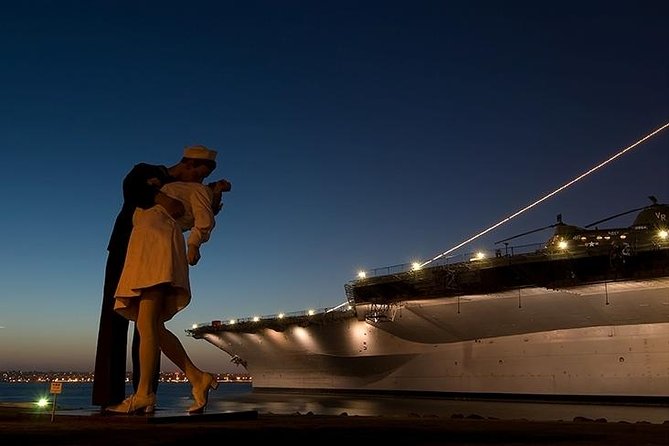
The USS Midway Museum sits on the Embarcadero, close to the heart of downtown San Diego. You board from Navy Pier, then begin exploring a ship that once carried more than 4,500 crew members.
That number matters. A carrier this large is easier to understand when you walk through its working spaces instead of seeing a model or reading a plaque. You can look across the flight deck and imagine aircraft moving overhead, then descend into the ship to see where sailors ate, slept, worked, and waited for orders.
The Midway served from 1945 to 1992 and was the longest-serving American aircraft carrier of the 20th century. For a decade, it was also the largest ship in the world. It was too large to pass through the Panama Canal, a detail that gives you a quick sense of its size.
Your ticket is for a self-guided visit, not a fixed group tour. That makes it easy to fit around a day in San Diego. You can arrive early, spend a few hours, stop for lunch at the café, and continue exploring afterward.
A few more museum visits around the USA worth comparing
- NYC: 9/11 Memorial & Museum Timed-Entry Ticket
★ 4.8 · 31,428 reviews - NYC: Empire State Building Tickets – Observatory & Museum
★ 4.7 · 25,757 reviews - New York City: American Museum of Natural History Ticket
★ 4.5 · 15,447 reviews
Starting on the flight deck
After boarding, make your way toward the flight deck. This is the part of the museum that immediately explains why the Midway is worth visiting.
The deck is huge and open, with 25 restored aircraft displayed across it. You can see planes up close, inspect their shapes, and walk around exhibits that explain naval aviation. Some aircraft are designed for children to climb aboard, which gives younger visitors something active to do rather than asking them to read display panels all day.
The deck also gives you a wide 360-degree view of downtown San Diego. The setting helps connect the ship to the city. You are not looking at a carrier in an isolated museum yard. You are standing on a working naval vessel in the same harbor where ships still operate.
Take your time here, but do not stop at the aircraft alone. Volunteers in yellow hats are stationed around the ship and can explain how the flight deck operated. Many are retired military personnel, and some served aboard the Midway. Their stories add practical details that a sign cannot provide.
The flight deck can be sunny and exposed, so early arrival is useful, especially during the summer when nearby parking is limited. Comfortable shoes are essential. The deck itself is easy to walk, but the rest of the ship involves stairs and long corridors.
The audio tour and 65 marked areas

The included audio tour is one of the best ways to organize your visit. It is narrated through the stories of former Midway sailors and officers, giving you a personal account of shipboard life rather than only a list of dates and specifications.
You can follow the tour through 65 highlighted locations. These include the bridge, engine room, galleys, sleeping quarters, officer’s country, and other working sections. Each area shows a different part of the carrier’s operation.
I suggest starting with the audio tour, then pausing whenever a volunteer is available. The audio gives you structure, while the yellow hats can explain details and answer questions in person. You do not have to choose one or the other.
A narrated video tour of the museum exhibits also runs continuously on the hangar deck. This can be helpful if you want a broad introduction before walking through the ship, or if someone in your group needs a quieter break from the stairs and narrow passageways.
The audio tour also lets you move at your own pace. You can skip a section that does not interest you and spend more time in the engine room, flight operations areas, or living quarters. That flexibility is especially useful for families with different interests.
Seeing daily life below deck
The lower decks make the Midway feel less like a display and more like a workplace. You can see restored sleeping quarters, galleys, and officer’s country, then picture how thousands of people lived together at sea.
The sleeping areas show how little private space most sailors had. The galleys and food-service areas help explain the constant work required to feed such a large crew. Officer’s country gives you a different view of the ship’s social structure and daily routine.
The engine room is another important stop. It shows the mechanical side of the carrier and helps you understand that the Midway was not only an aircraft platform. It was a self-contained city at sea, with power, food, sleeping areas, command spaces, and machinery all packed into one vessel.
Some passages and compartments are tight. If you dislike enclosed spaces or have limited mobility, pay attention to the route and ask staff for help. Elevator access is available from Navy Pier onto the ship, from the hangar deck down to the second deck, and up to the flight deck. The museum is described as accessible for people with disabilities, though the ship’s historic layout still means that some areas may feel more demanding than a conventional museum.
Same city, a completely different collection:
- NYC: Museum of Modern Art (MoMA) Entry Ticket
★ 4.6 · 12,540 reviews - 9/11 Memorial, Ground Zero Tour with Optional 9/11 Museum Ticket
★ 5.0 · 6,381 reviews - 9/11 Memorial Museum Admission Ticket
★ 4.5 · 6,376 reviews - All-Access 9/11: Ground Zero Tour, Memorial and Museum, One World Observatory
★ 5.0 · 4,886 reviews
Flight simulators and hands-on exhibits
The interactive exhibits help balance the more serious historical material. The flight simulators are a clear favorite for visitors who want to do something rather than simply look at displays.
These attractions can be particularly useful for families. Children can climb aboard aircraft, try interactive features, and get a better sense of aviation. Adults with an interest in military history, engineering, navigation, or aviation will find plenty of material beyond the hands-on sections.
The museum works best when you mix the two styles. Spend time with the aircraft and simulators, then follow the audio into the working parts of the carrier. That combination shows both the public image of naval aviation and the less visible labor that made it possible.
Do not expect every part of the ship to feel polished or spacious. The Midway’s appeal comes partly from its original scale and working layout. You will walk through utilitarian corridors, climb stairs, and follow signs through a vessel built for service rather than comfort.
How much time should you allow?

The advertised visit can take two to five hours, and that range is realistic.
Two hours is enough for the flight deck, several aircraft, a few major exhibits, and a quick look below deck. It is a reasonable plan if you have a packed San Diego schedule.
Three to four hours gives you time to use the audio tour, speak with volunteers, visit the living quarters, and see the main interactive displays without constantly checking the clock. This is the best target for most people.
Five hours makes sense if you want to explore nearly every accessible area, stop for food, listen to many volunteer explanations, and take your time with the aircraft. The ship is large enough that a careful visit can fill most of a day.
A useful plan is to arrive near opening at 10 a.m., begin with the flight deck, then work through the audio route below deck. You can stop at the café and continue afterward. Last admission is at 4 p.m., but entering late in the day will limit how much you can see.
What the $41 admission includes

Admission costs $41 per person. That is not a bargain basement museum ticket, but the price is reasonable if you allow at least three hours.
You are paying for access to a complete aircraft carrier, not one gallery. The ticket includes the audio tour, interactive exhibits, restored aircraft, the flight deck, living quarters, engine-room areas, and the museum’s marked route through the ship. It also includes any listed taxes and fees.
The value drops if you rush through in an hour. You will spend much of the price simply getting oriented and walking between decks. The value improves when you use the audio tour, stop to talk with volunteers, and give yourself time to understand what you are seeing.
The ticket also includes Embarcadero Adventure offers, which provide discounts for other nearby attractions. The exact savings depend on what else you plan to visit, but they may help if you are building a full sightseeing day around the waterfront.
Parking is not included. Paid parking is available next to the Midway through Ace Parking, but summer availability can be limited. Public transportation is nearby, so check that option before driving into downtown.
Practical advice for a smoother visit

Bring water and consider a snack. There is a café on board, but you may prefer to keep moving during the busiest parts of your visit. The ship is large enough that walking back to a particular area can take time.
Wear supportive shoes with good traction. You will walk across broad decks, use stairs, and move through corridors. Several people who planned a short visit wished they had allowed more time, and that is easy to understand once you see the ship’s size.
If you have children, set a meeting point in case your group separates. The carrier has many levels and routes, and people naturally stop at different exhibits. Families should also decide in advance how much time to spend on the simulators so that the hands-on areas do not consume the entire visit.
Service animals are allowed. Elevator access is provided on specified parts of the route, and the museum is near public transportation. If access is a major concern, contact the museum before arrival so you can confirm the best route for your needs.
The mobile ticket lets you proceed to the front gate rather than waiting in the ticketing line. This does not remove lines inside the attraction. You may still wait for simulators, popular areas, or access to a busy volunteer station.
Who will enjoy the USS Midway most?
I would recommend the Midway to anyone interested in aviation, naval service, engineering, or 20th-century American history. You do not need a military background to appreciate the ship. The layout itself teaches you how a large crew worked together.
Families can enjoy the aircraft and simulators, while older children may connect with the stories of sailors who lived aboard. Couples and solo visitors benefit from the flexible pace and audio tour. If you like museums that let you walk through the subject rather than only read about it, this is a strong choice.
It may be less suitable if you have only a short gap in your schedule, dislike stairs, or prefer a compact museum with a quick route. You can see the main highlights in two hours, but the ship rewards patience.
The volunteers are a major reason to slow down. Their personal connection to the Midway can turn an ordinary display into a story about work, discipline, navigation, aircraft operations, and daily life at sea. Ask questions when you find a yellow hat. That is often where the most memorable details appear.
Cancellation and booking details
You can cancel up to 24 hours before the experience start time for a full refund. Cancellations or changes made within 24 hours are not refunded or accepted, and the cut-off follows local San Diego time.
The experience is offered in English, and confirmation is provided when you book. The admission is valid for your selected date, with entry available during the museum’s regular operating hours.
Should you book the USS Midway Museum?
Book it if you can spare at least three hours and want one of San Diego’s most substantial waterfront attractions. The combination of aircraft, shipboard spaces, audio stories, volunteers, and city views gives you far more than a quick photo stop.
If you have only two hours, focus on the flight deck, aircraft, audio highlights, and one or two lower-deck areas. If you have five hours, start early, take your time, speak with the yellow-hat volunteers, and stop for food on board.
At $41, this is best treated as a half-day museum visit rather than a short attraction. For most people, the scale of the carrier and the chance to walk through real crew spaces make the admission worthwhile.
FAQ
What are the USS Midway Museum opening hours?
The museum is open daily from 10 a.m. to 5 p.m. The last admission is at 4 p.m.
How long should I spend at the USS Midway?
Plan on two to five hours. Two hours covers the main highlights, while three to five hours allows time for the audio tour, volunteers, aircraft, living quarters, and interactive exhibits.
Is the USS Midway visit guided?
The admission is for a self-guided visit. It includes an audio tour narrated by former Midway sailors and officers, and volunteers are available around the ship.
What does the admission ticket include?
The ticket includes museum admission, the audio tour, taxes, fees, interactive exhibits, restored aircraft, and access to the ship’s highlighted areas. It also includes Embarcadero Adventure offers with discounts for nearby attractions.
Can I arrive at any time?
You can board any time during regular museum hours on your selected date. The museum is open from 10 a.m. to 5 p.m., with last entry at 4 p.m.
Is parking included?
No. Parking is available next to the Midway through Ace Parking for an additional fee. Summer parking can be limited, so early arrival is encouraged.
Is the museum accessible?
Elevator access is available from Navy Pier onto the ship, from the hangar deck down to the second deck, and up to the flight deck. The museum is described as accessible for people with disabilities, though a moderate level of physical fitness is recommended.
Can I cancel my ticket?
Yes. You can receive a full refund if you cancel at least 24 hours before the experience start time. Cancellations within 24 hours are not refunded.
Just added around the USA
- Museum of Ice Cream Austin★ 3.5 · 85 reviews
- Admission to Richard Nixon Presidential Library and Museum Ticket★ 5.0 · 123 reviews
- The Turquoise Museum Curator’s Tour★ 5.0 · 12 reviews
- Turquoise Museum Visit★ 4.5 · 194 reviews
- Orlando: Titanic Artifact Exhibition Ticket★ 4.5 · 246 reviews
- The St. Augustine Old Jail Museum Guided Tour★ 4.6 · 68 reviews
- San Diego: San Diego Natural History Museum Ticket★ 4.7 · 33 reviews
- The Museum of Fine Arts, Houston Entry Ticket★ 4.6 · 82 reviews
Museum Tours in the USA, compared.




9/11 Memorial, Ground Zero Tour with Optional 9/11 Museum Ticket
Read our review →

All-Access 9/11: Ground Zero Tour, Memorial and Museum, One World Observatory
Read our review →

Browse the lists this tour appears in