
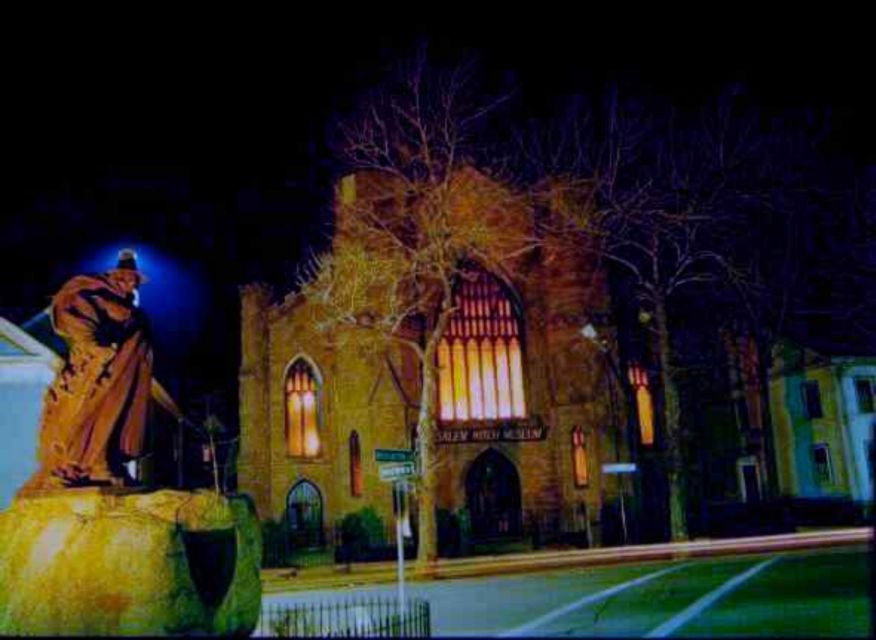
Review · THE USA
Salem Witch Museum Admission Ticket
The Salem Witch Museum uses 13 life-size stage sets to tell the story of the 1692 trials from a darkened auditorium. Scenes light up around you as a narrator explains the accusations, court proceedings, and executions. It is theatrical rather than hands-on, but the format gives you a quick, clear introduction to Salem’s most troubling chapter.
I like two things here: the first presentation puts the events in chronological order, and the second links Salem to later witch hunts and changing ideas about witchcraft. The ticket also includes both exhibits, so you are not paying separately for the museum’s follow-up discussion. The main drawback is that the experience is short and somewhat old-fashioned, with seating and displays that can make it hard to see or hear from the back.
Key points
- Thirteen illuminated stage sets surround the auditorium during the 30-minute Salem Witch Trials presentation.
- A second exhibit explains how the idea of a witch changed, from pre-Christian pagan beliefs to modern Wicca.
- The visit lasts about 1 hour and 15 minutes, making it an easy first stop in Salem.
- English narration is supported by translations in eight languages: Spanish, Chinese, French, German, Italian, Japanese, Russian, and English.
- The presentation is seated and wheelchair accessible, though large bags and luggage are not allowed.
- The $18 ticket includes both exhibits, but vouchers are not valid on weekends in October or on Halloween Day.
The first 30 minutes: Salem in 1692
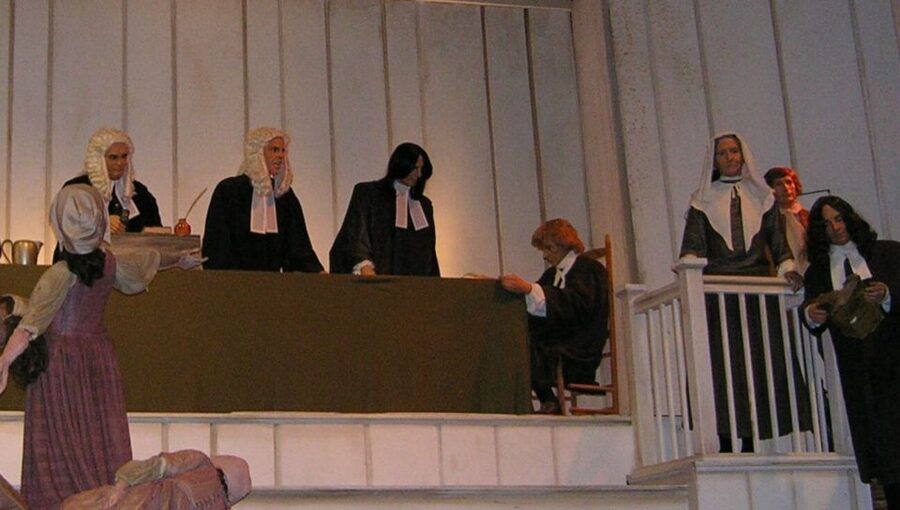
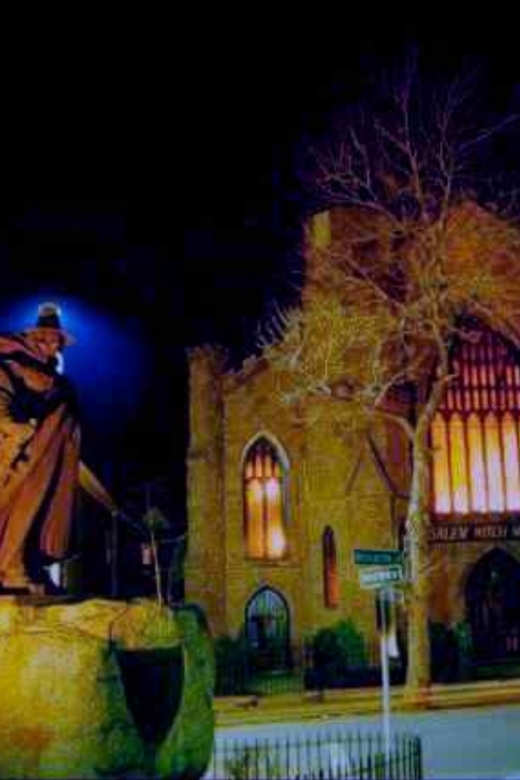
You begin at the Salem Witch Museum on Washington Square, where you exchange your voucher at the front ticket counter. The museum assigns you to the next available presentation, so the exact start time depends on the day and current schedule.
The first room is a large, darkened auditorium with seats arranged so you can look around the walls and upper sections. As the narration moves through the story, one scene after another lights up. The figures and sets show the people, accusations, court proceedings, and religious pressure that shaped the Salem Witch Trials.
This is not a conventional museum gallery where you walk from label to label. You sit still while the story unfolds around you. That makes the sequence easy to follow, especially if you know little about Salem before arriving. The dated stage presentation can feel a bit like an old-school historical show, but the simple format has one advantage: it keeps the story moving and avoids burying you in too many names and dates.
I especially like the chronological structure. You can see how suspicion grew, how accusations spread, and how the court system turned fear into punishment. The presentation also makes clear that this was not a spooky entertainment story. It was a painful episode involving real people, public pressure, and a legal process that failed badly.
The theatrical staging has limits. Depending on your seat, some figures may be partly blocked or difficult to see. A few people also find the narration too quiet, especially from the back of the room. If clear sound matters to you, sit as close to the front or center as possible. The museum provides seating throughout, which helps anyone who cannot stand for long periods.
The show lasts about 30 minutes. That is enough time to give you the basic framework, but not enough to explore every person or dispute in detail. Think of it as an introduction that prepares you for Salem’s other historic sites, rather than a full scholarly treatment of the trials.
A few more museum visits around the USA worth comparing
- NYC: 9/11 Memorial & Museum Timed-Entry Ticket
★ 4.8 · 31,428 reviews - NYC: Empire State Building Tickets – Observatory & Museum
★ 4.7 · 25,757 reviews - New York City: American Museum of Natural History Ticket
★ 4.5 · 15,447 reviews
The second exhibit: from pagan midwife to modern Wiccan
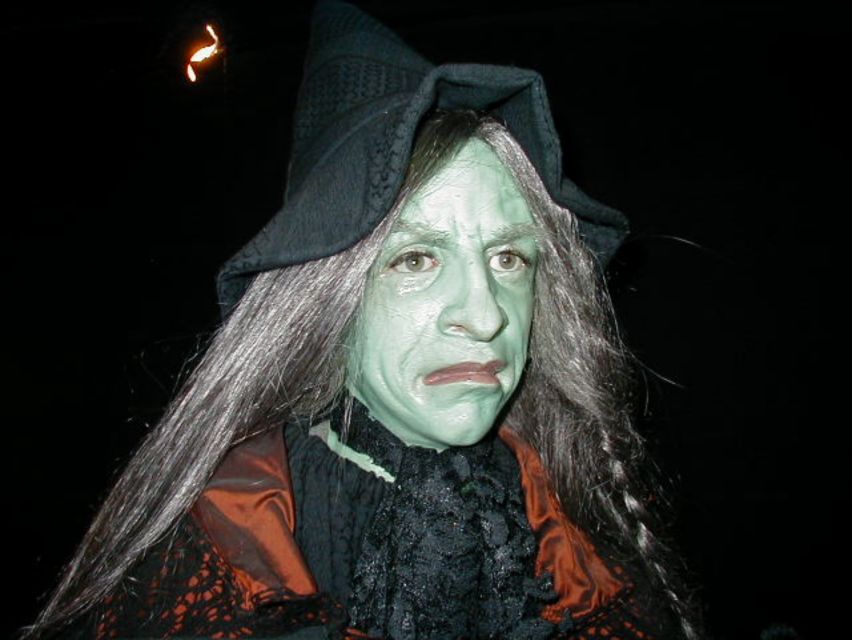
After the auditorium presentation, museum staff guide you through Witches: Evolving Perceptions. This section broadens the subject beyond Salem and looks at how the word witch has changed over time.
The life-size stage sets here trace the idea of witchcraft from pagan and pre-Christian beliefs to the modern-day Wiccan. The purpose is not simply to repeat the Salem story. Instead, it asks how communities define a witch, why certain people become targets, and how fear can turn into organized persecution.
A short presentation, lasting no more than 15 minutes, discusses witch hunts that took place after 1692. That wider view gives the museum more value than a single story about colonial Massachusetts. You begin to see witch hunts as a recurring pattern of accusation and blame, not just an isolated event from the past.
This part is guided, and the quality depends on the staff member leading your group. Sean, one guide named in visitor feedback, has been praised for mixing humor with serious historical detail. Other guides have also been described as friendly and well prepared. The museum’s staff can make the material lively, but the room can become crowded when groups join together.
That crowding is the main weakness of the second section. If you are standing at the back, you may have trouble seeing the objects being discussed or hearing every word. One practical solution is to move closer when the group shifts to a new display. If the room is full, do not hesitate to ask the guide to speak up.
The second exhibit also feels less polished than the opening presentation to some people. The first section has a clear beginning, middle, and end. The gallery depends more on a guide’s explanation, so the pace and clarity can vary. Still, its subject matter is important. It connects Salem to broader questions about religion, social fear, scapegoating, and the repeated use of witch-hunt language.
Why the short format can work well
The full visit takes about 75 minutes, including both exhibits. That is useful in Salem, where you may want to combine the museum with other sites around Washington Square and the historic center.
I would put the Salem Witch Museum near the start of your day. The first presentation gives you basic names, events, and themes that can make later stops easier to understand. Afterward, you can look at Salem’s historic buildings and memorials with a better sense of what happened in 1692.
The museum is also a good choice if your group has different interests. You do not need to commit to a half-day tour or a long walking program. You sit for the main presentation, receive a short guided explanation in the second area, and finish with the option to browse the gift shop.
The short length can be a plus for families, older adults, and anyone fitting Salem into a larger New England itinerary. Younger children may find the subject matter and quiet historical presentation less exciting than a hands-on attraction. The museum does not offer a long interactive program, so set expectations before you go.
The $18 ticket: fair value for a focused visit
At $18 per person, the ticket is reasonably priced if you want a clear introduction to the Salem Witch Trials. You receive access to both exhibits, not just the main auditorium show, and the museum delivers more context than a quick display of costumes or souvenirs.
The value depends on what you expect. If you want original documents, a large collection of objects, or hours of independent browsing, this may feel expensive for the amount of time inside. The first presentation is the main attraction, and the second section is compact.
I think the ticket works best as an orientation stop. You are paying for a structured story and a guided explanation, not for a large research museum. The presentation is easy to understand, the seating is comfortable, and the subject is handled as history rather than pure Halloween spectacle.
The gift shop adds another few minutes to the visit. It carries Salem and witchcraft souvenirs for different ages, though prices can feel high. You do not need to buy anything for the ticket to feel complete, but the shop is convenient if you want a small reminder of your visit.
Same city, a completely different collection:
- NYC: Museum of Modern Art (MoMA) Entry Ticket
★ 4.6 · 12,540 reviews - 9/11 Memorial, Ground Zero Tour with Optional 9/11 Museum Ticket
★ 5.0 · 6,381 reviews - 9/11 Memorial Museum Admission Ticket
★ 4.5 · 6,376 reviews - All-Access 9/11: Ground Zero Tour, Memorial and Museum, One World Observatory
★ 5.0 · 4,886 reviews
Language help and accessibility
The host and museum presentation are in English. Complimentary translations are available in Spanish, Chinese, French, German, Italian, Japanese, Russian, and English. Check how the translation system is provided when you arrive, especially if someone in your group is more comfortable following the story in another language.
The museum is wheelchair accessible, and staff have assisted wheelchair users during the visit. Seating is available in the main auditorium, which is helpful for anyone who needs to rest. The second exhibit is guided, so staying near the staff member is important if you want to hear and see everything.
Luggage and large bags are not allowed. Pack lightly and leave suitcases elsewhere before arriving. This matters most if Salem is one stop between hotels or train connections, since the museum is not a place to bring large travel bags.
Parking can be a challenge around the museum, particularly during busy periods. Build in extra time if you are arriving by car. The museum is at 19 1/2 Washington Square North, Salem, Massachusetts, and the activity ends at the same entrance.
When to schedule your visit
Your voucher is valid for the date purchased, and you should allow at least 1 hour and 15 minutes. The ticket is valid for one day, but you still need to check available starting times before booking.
The timing rule is especially important in October. Vouchers are not valid on weekends in October or on Halloween Day. Those are among Salem’s busiest dates, so check the restrictions carefully before building your schedule around the museum.
Because admission is for the next available presentation, arriving early gives you more breathing room. You will not want to rush across town if the next showing begins soon after you reach the ticket counter. The exact waiting time is not fixed, so leave a little space in your plan.
Free cancellation is available up to 24 hours in advance for a full refund. You can also reserve now and pay later, which helps if your Salem plans depend on weather or a changing New England itinerary.
What the museum gets right
The strongest part of the experience is the way the opening show makes a difficult story easy to follow. The lights, stage sets, and narration work together without requiring you to read a long wall of text. The format is simple, but it gives the 1692 events a clear sequence.
I also like the museum’s decision to move beyond Salem in the second exhibit. The story becomes more useful when it asks how witch hunts begin and gives examples from after 1692. You leave with a broader warning about mass suspicion, not just a collection of spooky images.
The staff can add a lot. Guides such as Sean have brought humor and energy to the second portion, while other staff members have been praised for their preparation and help with visitors who need assistance. The experience is at its best when the guide speaks clearly and keeps the group close to each display.
Where it could be better
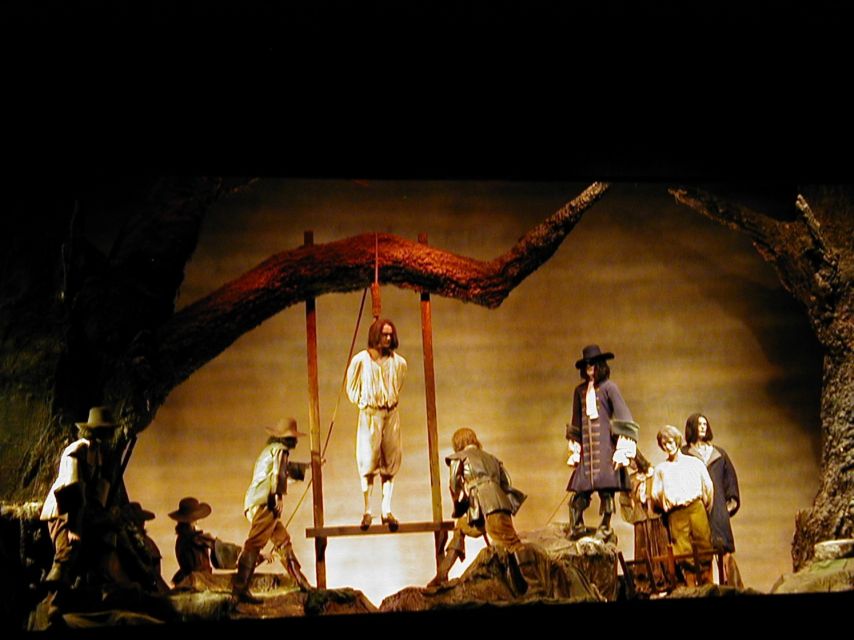
The museum’s presentation has remained much the same for decades, which gives it a familiar, old-fashioned feel. Some people enjoy that style. Others may find the mannequins and recorded narration a little cheesy compared with newer museum technology.
Sound and sight lines are the practical concerns. A quiet guide can make the second section frustrating, and people at the rear may not see the objects or figures being discussed. The first auditorium is more successful visually, but some scenes are still difficult to view from certain seats.
The visit is also short. You will not spend an entire afternoon here, and the museum does not attempt to provide a complete academic record of every trial. That is not necessarily a flaw, but it means you should choose the museum for its concise introduction, not for extensive original material.
Who should book the Salem Witch Museum?
I would recommend this ticket if you are visiting Salem for the first time and want a quick grounding in the 1692 trials. It suits families with older children, history-minded visitors, anyone who prefers sitting to walking, and people building a full day around several Salem attractions.
It is also a sensible choice if you want an experience that does not depend on good weather. The entire program takes place indoors, and the main presentation provides seats. The wheelchair accessibility and staff assistance make it a practical option for many mobility needs.
You may want to skip it if you dislike theatrical mannequins, recorded narration, or short attractions with guided group movement. Those looking for an extensive museum collection or a fully interactive experience will probably want something more substantial.
For most first-time visits, I would book it early in the day, sit near the front or center, and stay close to the guide in the second exhibit. At $18, it is a fair buy when you treat it as a focused historical introduction. It is not the whole Salem story, but it is a useful place to begin.
FAQ
Where is the Salem Witch Museum?
The museum is at 19 1/2 Washington Square North, Salem, Massachusetts 01970. Start at the front entrance and ticket counter.
How long does the museum visit take?
You should allow about 1 hour and 15 minutes for both exhibits and the visit as a whole.
What happens during the first presentation?
You sit in a large, darkened auditorium while 13 life-size stage sets illuminate one at a time. A narration presents scenes from the Salem Witch Trials during a presentation lasting about 30 minutes.
What is included with admission?
Admission includes both exhibits at the Salem Witch Museum: the Salem Witch Trials presentation and the Witches: Evolving Perceptions exhibit.
Is the second exhibit guided?
Yes. Museum staff guide you through the second exhibit, which includes a presentation of no more than 15 minutes about the changing idea of witches and examples of witch hunts after 1692.
Is the presentation available in languages other than English?
The host and museum presentation are in English. Complimentary translations are available in Spanish, Chinese, French, German, Italian, Japanese, Russian, and English.
Is the museum wheelchair accessible?
Yes, the museum is wheelchair accessible. Seating is available throughout the main auditorium.
Can I bring luggage or a large bag?
No. Luggage and large bags are not allowed.
Are tickets valid on weekends in October?
No. Vouchers are not valid on weekends in October or on Halloween Day. Vouchers are valid only for the date purchased.
Can I cancel my booking?
Yes. You can cancel up to 24 hours in advance for a full refund. Reserve now and pay later is also available.
Just added around the USA
- Museum of Ice Cream Austin★ 3.5 · 85 reviews
- Admission to Richard Nixon Presidential Library and Museum Ticket★ 5.0 · 123 reviews
- The Turquoise Museum Curator’s Tour★ 5.0 · 12 reviews
- Turquoise Museum Visit★ 4.5 · 194 reviews
- Orlando: Titanic Artifact Exhibition Ticket★ 4.5 · 246 reviews
- The St. Augustine Old Jail Museum Guided Tour★ 4.6 · 68 reviews
- San Diego: San Diego Natural History Museum Ticket★ 4.7 · 33 reviews
- The Museum of Fine Arts, Houston Entry Ticket★ 4.6 · 82 reviews
Museum Tours in the USA, compared.


9/11 Memorial, Ground Zero Tour with Optional 9/11 Museum Ticket
Read our review →

All-Access 9/11: Ground Zero Tour, Memorial and Museum, One World Observatory
Read our review →

Browse the lists this tour appears in