
Review · GERMANY
Hamburg: Entrance to the Museum Ship Cap San Diego
Cap San Diego is not a ship-shaped museum. It is the real thing: a 1961 cargo vessel where you can climb to the bridge, walk through passenger spaces, and feel the working side of an ocean voyage in the engine room. For $14, you get a full day of access and a rare look at the machinery and routines behind Hamburg’s South America trade.
I especially like the freedom to explore without a fixed group and the contrast between the calm saloon and the noisy, industrial parts of the ship. The emigrant film and cargo-handling exhibition add useful human and economic context. The main drawback is practical: this is a ship, not a smooth museum floor, with many stairs, narrow passages, and confusing turns.
Key points to know before boarding
- A genuine 1961 cargo ship: Cap San Diego carried general cargo between Hamburg and South America until the end of 1981.
- A full ship tour: You can move from the bridge and lookout areas to the saloon, cargo hatch, and machine room.
- Two useful exhibitions: Learn about Hamburg emigration from 1850 to 1930 and the change from general cargo to container shipping.
- Self-guided and flexible: Explore alone during opening hours, with an audio guide available if you select that option.
- Good value at $14: Your ticket is valid for one day, giving you time to see the ship at your own pace.
- Not suitable for everyone: Wheelchair users and people with limited mobility, claustrophobia, or mazeophobia should choose another Hamburg attraction.
Meeting Cap San Diego at Überseebrücke
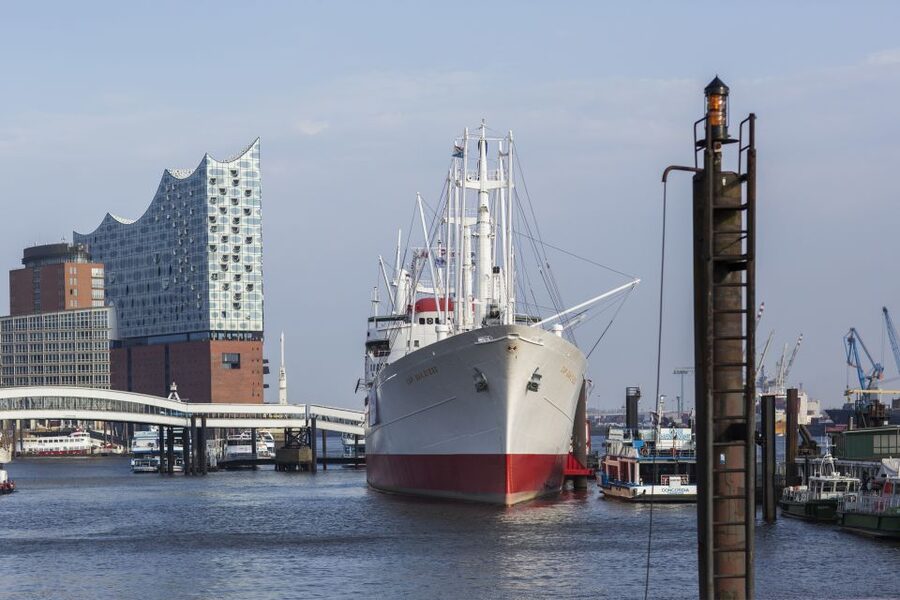
The ship entrance is at the end of Überseebrücke, a fitting location for a museum devoted to Hamburg’s seafaring past. Go directly to the entrance rather than looking for a separate tour office or meeting group.
The museum is open daily from 10 AM to 6 PM. The ticket is valid for one day, so you are not forced into a short visit. You can arrive when it suits your Hamburg plans, work through the main route, take a break if needed, and return during the same day if the entry conditions allow it.
At $14 per person, this is priced like a modest museum visit but gives you much more space to explore than a standard gallery. The value depends on your interest in ships. If you only want a quick waterfront photo, it is more than you need. If you enjoy working machinery, maritime history, or unusual museums, the ticket can fill a good part of your day without adding a major cost to your Hamburg budget.
There is no live guide leading a group. That is both a strength and a limitation. You can linger over the parts that interest you, but you also need to read the signs and find your way through the vessel. An audio guide is included only if you select that option when booking.
A few more museum visits around Germany worth comparing
- Berlin: Jewish Museum Berlin Entrance Ticket
★ 4.5 · 8,393 reviews - Berlin: DDR Museum Tickets
★ 4.3 · 3,443 reviews - Berlin: Natural History Museum Entrance Ticket
★ 4.6 · 3,382 reviews
A cargo ship with a working past
Cap San Diego was built in 1961 as one of six fast general cargo ships for the Hamburg South shipping company. These vessels carried goods between Hamburg and South America, including Rio de Janeiro and Buenos Aires, until the end of 1981.
That date range matters because the ship captures a period between older break-bulk cargo work and the container age. General cargo was loaded in separate pieces, packed into crates, sacks, barrels, or other units, then moved through cargo hatches. This required far more handling than modern container transport.
The ship is the last surviving member of that six-ship series. It has been a museum ship since 1988 and is described as the largest civil museum ship in the world. You are not simply looking at a model of maritime work. You are walking through the spaces built for it.
The imaginary voyage theme takes you back to the 1960s and 1970s. Picture a long Atlantic crossing to South America, with crew at work, passengers relaxing, and the ship’s machinery keeping the whole operation moving. You will not receive a staged live performance, but the preserved ship gives the idea a strong physical setting.
Start high on the bridge
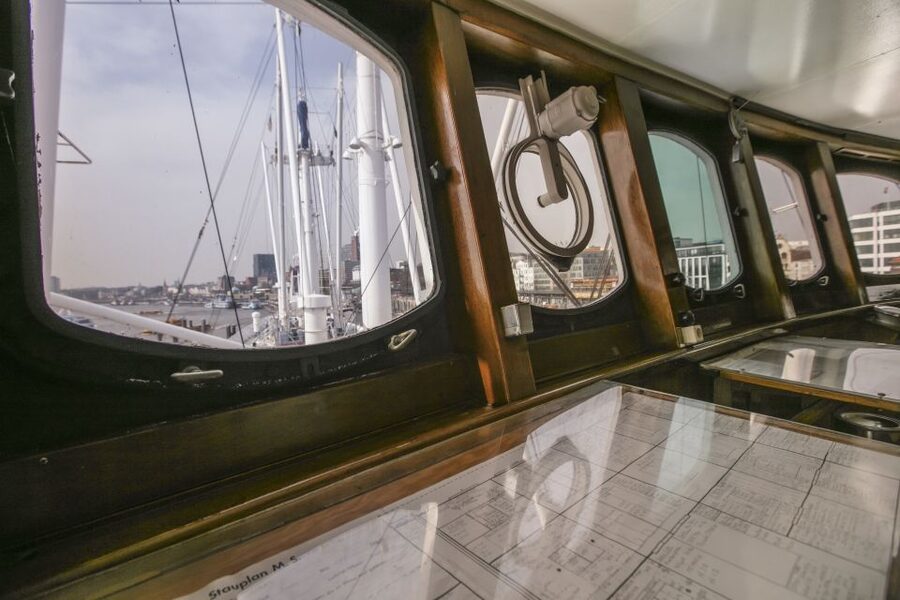
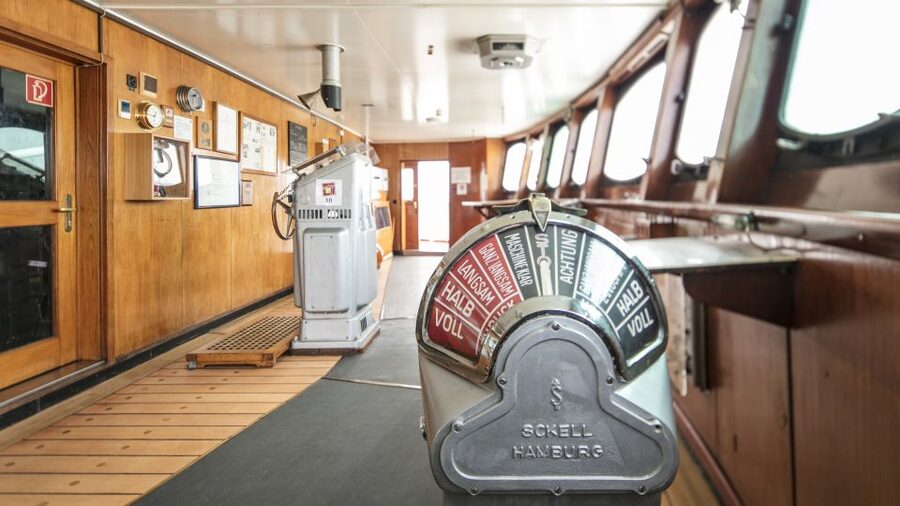
The bridge and lookout areas show the ship from the crew’s point of view. You can imagine standing watch, checking the route, and keeping an eye on the sea during the Atlantic run.
The appeal here is scale. On the ground, a large ship can feel like a collection of rooms and corridors. From the bridge, its purpose becomes clearer. This is the control point for a vessel designed to carry cargo across an ocean, not a decorative boat built only for display.
The bridge is also one of the better places to begin because it helps you form a mental map. After that, you can work downward through the ship. The route is not always perfectly marked, so take a moment to notice stairways and signs before moving on.
Do not expect a polished, linear museum route with an obvious beginning and end. The ship is best treated as a place to explore. If you make a wrong turn, you will usually find your bearings quickly, but a little patience helps.
The saloon and the passenger side of the voyage
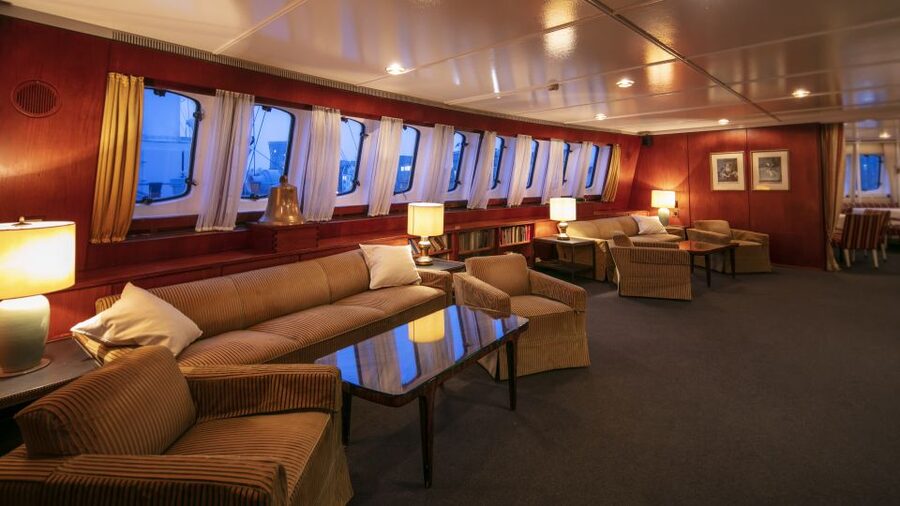
The saloon offers a change of mood from the working areas. This is where you can picture passengers settling in for the long crossing, with light music and a more relaxed atmosphere.
That contrast is one of the most effective parts of the visit. A cargo ship was not only engines, hatches, and heavy loads. It also carried people who ate, rested, talked, and watched the voyage unfold. The saloon gives you a sense of the social side of the trip without requiring a theatrical presentation.
I would place this stop between the more technical sections rather than rushing past it. The quiet rooms make the engine spaces feel louder and more purposeful when you return to them. They also help you imagine the distance between Hamburg and South America in an era when an ocean crossing was a major event.
The ship’s route to Rio de Janeiro and Buenos Aires gives the voyage a clear destination. You are not wandering through an anonymous vessel. The spaces relate to a regular trade connection between northern Germany and South America.
Same city, a completely different collection:
- Berlin: Neues Museum Entry Ticket
★ 4.6 · 3,261 reviews - Berlin: Museum Island Multiple Museum Entry Ticket
★ 4.4 · 2,861 reviews - Cologne: Chocolate Museum Entrance Ticket
★ 4.4 · 2,790 reviews - Dresden: Church of Our Lady Guided Tour of Gallery
★ 4.7 · 2,421 reviews
The machine room delivers the strongest physical impression
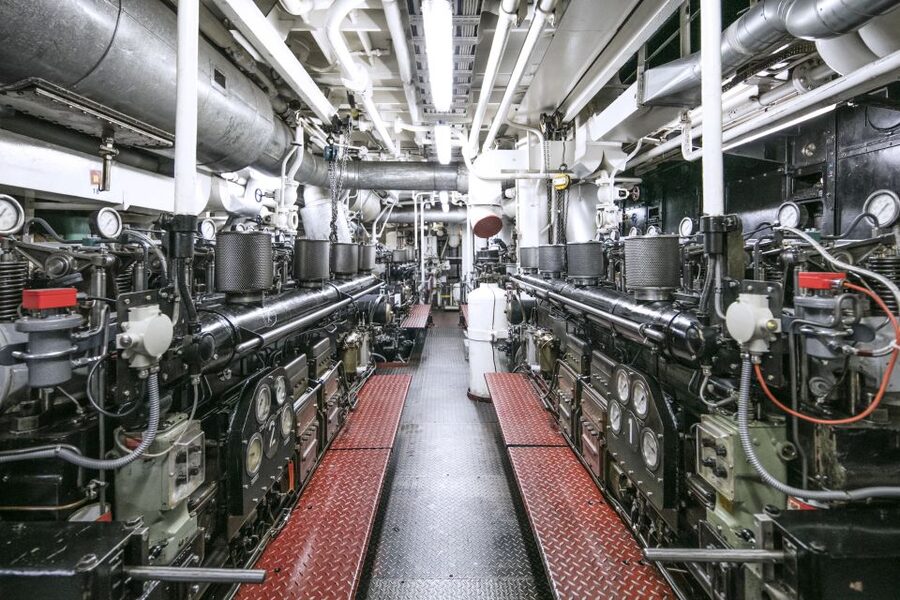
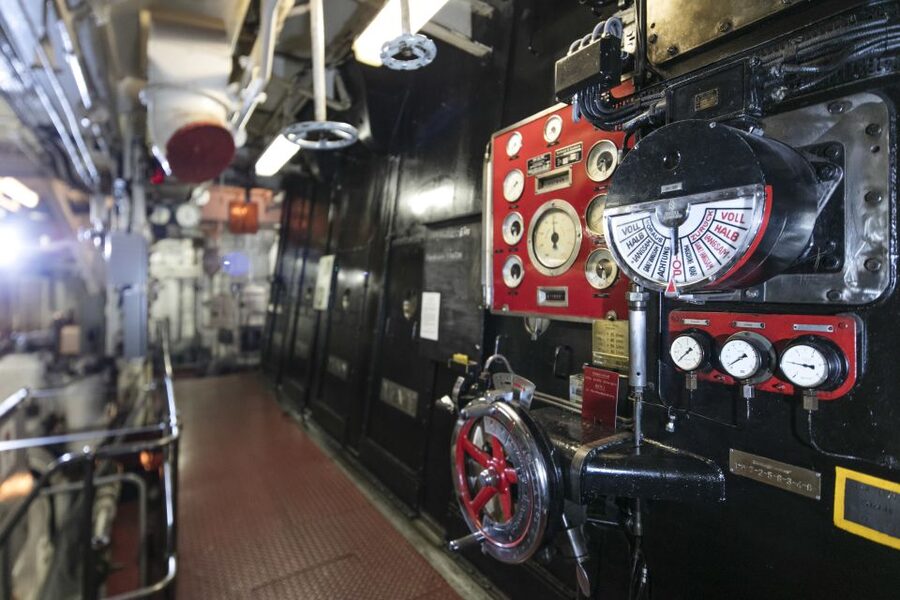
The machine room is likely to be the highlight for anyone interested in how ships work. Here, you can stand among the equipment and sense the steady pulse that kept Cap San Diego moving.
The experience is more physical than a label in a glass case. The size of the machinery, the confined setting, and the layers of pipes and equipment make the ship’s engineering easier to understand. You can picture the machine room as the vessel’s working heart, hidden from passengers but essential to every mile of the crossing.
The supplied material does not promise that the engines are running during every visit, so you should not book this expecting a guaranteed live demonstration. The important point is access. You can enter the machine area and see where the ship’s power was produced.
This section also explains why people with claustrophobia may find the museum uncomfortable. Passages and rooms can feel tight, and the ship’s layout includes enclosed areas and several levels. If you prefer wide, open galleries, this will feel more demanding than a normal museum.
Cargo hatch 2 explains the change to containers
In hatch 2, a permanent exhibition covers general cargo and container handling from 1960 to today. It uses historical images and explanatory texts to show how sea freight changed.
This is a valuable stop because it connects the ship to a major shift in global transport. Cap San Diego represents the general cargo era, when freight was handled piece by piece. The exhibition then takes you toward container shipping, which reorganized how goods were packed, moved, and transferred between ships, trucks, and rail.
You do not need a technical background to follow the display. The point is easy to grasp: cargo transport became more standardized, faster, and more suited to large-scale trade. Seeing that story inside an actual cargo ship makes it more concrete than reading about it in a separate transport museum.
The exhibition also gives the visit a stronger Hamburg connection. The city’s port is not just scenery along the Elbe. It is part of a long commercial system, and Cap San Diego lets you see one stage of that system from the inside.
The emigrant story adds human weight
During your visit, you can watch the documentary A Suitcase Full of Hope: Emigration Port of Hamburg. It focuses on the fate of emigrants who passed through Hamburg between 1850 and 1930.
This material broadens the museum beyond ship mechanics. Hamburg was a departure point for people leaving Europe, often with little more than luggage and uncertain plans. The film places individual lives beside the larger port story.
The documentary is especially useful if you are visiting with someone who is less interested in engines or cargo handling. It gives the ship a human subject and a clear historical question: what did it mean to leave Europe by sea, and what did people face before and after departure?
Plan time for the film instead of treating it as an optional extra. You can see the ship quickly, but the documentary helps connect the port, the ocean crossing, and the people whose futures depended on maritime travel.
The film covers an earlier period than Cap San Diego’s own working life. That is not a problem. It shows that Hamburg’s role as an emigration port belongs to a longer story, one that continued before this particular cargo ship was built.
Self-guided touring requires a little attention
The museum’s self-guided format works well for independent visitors. You can spend extra time in the machine room, move quickly through a section that does not interest you, or pause in the saloon without worrying about holding up a group.
An audio guide is available if you select that option. Without it, you will rely on the ship’s displays and your own exploration. The information provided does not identify a live guide, so do not expect scheduled commentary or a guide named at the entrance.
The route may require some orientation. Ship museums rarely follow a clean museum grid, and Cap San Diego has multiple levels, hatches, stairs, and working spaces. I recommend starting with the broadest route you can find, then returning to the sections you want to examine more closely.
Wear comfortable shoes and allow more time than you would for a single-room exhibition. The ticket is valid for one day, so there is no need to sprint. The ship rewards slow looking, especially when you compare the passenger areas with the cargo and machinery sections.
Who will enjoy Cap San Diego most
This is a strong choice for people who like maritime history, engineering, port cities, and museums with a physical setting. Families with older children may also find the ship more engaging than a traditional display, though the stairs and enclosed spaces require care.
It suits independent visitors who do not need a guide to keep the visit moving. You can create your own order: bridge first, machine room next, then the cargo exhibition and emigrant film, or the reverse.
It is less suitable for anyone with limited mobility. The ship is not wheelchair accessible, and the multiple flights of stairs make it difficult for people who cannot climb comfortably. Wheelchair users should skip this attraction rather than arriving and discovering that the route cannot work for them.
You should also think carefully if you have claustrophobia or mazeophobia. The museum is not dangerous for that reason, but the shipboard layout includes narrow, enclosed areas and passages that may feel disorienting. A normal city museum will provide a much easier physical visit.
Timing, cancellation, and practical value
Opening hours are 10 AM to 6 PM daily. Since the ticket is valid for one day, you have room to fit the ship around other Hamburg plans. A morning visit leaves the afternoon open, while a later visit may work if you want a focused look at the bridge, machinery, and exhibitions.
The booking terms allow cancellation up to 24 hours in advance for a full refund. You can also reserve now and pay later, which is useful if your Hamburg schedule is still changing.
The $14 price is fair because the ticket covers a large, unusual site rather than a short viewing platform. It also gives you time to absorb several different subjects: ocean travel, engine work, cargo handling, emigration, and Hamburg’s connection with South America.
The value drops if you only have a few spare minutes or dislike stairs. In that case, you may see too little of the ship to make the entry fee worthwhile. Give yourself enough time to explore the route at a comfortable pace.
My verdict on booking Cap San Diego
I would book Cap San Diego if you want a hands-on Hamburg attraction with real ship spaces, not just maritime objects behind glass. The bridge, saloon, machine room, emigrant documentary, and hatch 2 exhibition each show a different side of the vessel, and the self-guided format lets you set your own pace.
Book it especially if you enjoy engineering or want a break from standard art and city-history museums. Skip it if stairs, narrow spaces, or an unclear route would make the visit stressful. For most mobile visitors with an interest in Hamburg’s port, $14 buys a memorable and unusually direct look at how people, cargo, and machinery once crossed the Atlantic.
FAQ
Where is the entrance to Cap San Diego?
Go directly to the ship entrance at the end of Überseebrücke in Hamburg.
How much does admission cost?
Admission costs $14 per person.
How long is the ticket valid?
The ticket is valid for one day.
What are the museum’s opening hours?
Cap San Diego is open daily from 10 AM to 6 PM.
Is there a live guide?
No. This is a self-guided visit without a live guide. An audio guide is available if you select that option.
What can I see inside the ship?
You can visit the bridge, lookout area, saloon, machine room, cargo hatch 2, and the ship’s exhibitions.
What is shown in hatch 2?
Hatch 2 contains a permanent exhibition about general cargo and container handling from 1960 to today, with historical images and explanatory texts.
Is Cap San Diego wheelchair accessible?
No. The museum ship is not wheelchair accessible and has multiple flights of stairs.
Is the ship suitable for people with claustrophobia or limited mobility?
It is not recommended for people with claustrophobia, mazeophobia, or limited mobility because of the narrow shipboard spaces, enclosed areas, and many stairs.
Just added around Germany
- Stuttgart: Stuttgart Wine Museum Wine Tasting★ 4.7 · 55 reviews
- Stuttgart: Museum of Illusions Entry Ticket★ 4.2 · 507 reviews
- Stein: Public guided tour of the “Old Mine” museum★ 4.5 · 18 reviews
- Speyer: Technik Museum Speyer Ticket with an IMAX Dome Film★ 4.7 · 360 reviews
- Berlin: Bode Museum Ticket★ 4.5 · 214 reviews
- Munich Private Walking Tour with BMW Museum & Welt Entry★ 4.2 · 19 reviews
- Munich: Residenz Palace, Museum and Treasury Private Tour★ 4.9 · 15 reviews
- Munich: WOW Museum – Room for Illusions Ticket★ 3.5 · 14 reviews
Museum Tours in Germany, compared.




Dresden: Church of Our Lady Guided Tour of Gallery
Read our review →
Skip-the-Line: Berlin Wall Museum at Checkpoint Charlie
Read our review →Browse the lists this tour appears in