
Review · SPAIN
Madrid: Private Prado Museum Masterpieces Tour
The Prado’s greatest strength is not one famous painting, but the way its former Spanish Royal Collection brings major European artists into one building. In two private hours, your guide leads you from Bosch and Raphael to Velázquez and Goya, with the focus on the works that matter most.
I like the private format, which gives you room to ask questions instead of following a large crowd. I also like the clear focus on Las Meninas and The Third of May 1808, two paintings that reward explanation. The main drawback is time: two hours is enough for a sharp introduction, not a full tour of this huge museum.
Key points to know before you book
- Two hours, carefully focused: You see major works rather than trying to cover every gallery.
- A private art historian guide: Alicia has been especially praised for using chronology, comparisons, and clear explanations.
- The Prado’s Spanish core: Velázquez and Goya receive special attention, alongside Bosch, Raphael, Rubens, El Greco, Dürer, and Van der Weyden.
- Skip-the-line entry: Meet near the Goya statue in front of the museum ticket sales area.
- Private group with several language choices: Tours are offered in English, Spanish, French, and Italian.
- Good access and flexible booking: The tour is wheelchair accessible, and cancellation is free up to 24 hours before the start.
Why two hours can work at the Prado
The Prado is one of those museums where a first visit can get away from you. You walk in for one famous painting, turn a corner, and suddenly an hour has gone by. A private guide helps you avoid that trap by selecting the important works and giving them a clear order.
This tour covers European Western art from the 12th through the 19th century. Its center of gravity is Spanish art, drawn from the former Spanish Royal Collection, but you also encounter major painters from across Europe. That combination gives you more than a parade of famous names. You can see how different artistic ideas, religious subjects, court commissions, and political events appear across time.
Two hours is a sensible length if you want a first look without exhausting yourself. You will not see every room or study every artist in detail. Instead, expect a guided route through major masterpieces, with explanations designed to make the paintings easier to read.
I especially like this approach for someone who feels unsure in art museums. You do not need to know the difference between a Baroque painting and a Renaissance one before you arrive. A good guide can give you the basic visual clues, then show how those clues change from one artist to the next.
More Prado tours and tickets:
- Madrid: Prado Museum Entry Ticket
★ 4.6 · 20,699 reviews - Madrid: Small Group of Prado Museum Tour & Optional Tapas
★ 4.6 · 2,437 reviews - Madrid: Prado Museum Guided Tour with Skip-the-Line Ticket
★ 4.5 · 2,018 reviews
Meeting near Goya and getting inside
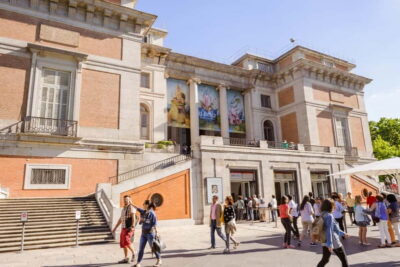
The meeting point is near the statue of Goya, in front of the Prado’s ticket sales area. This is useful because the location connects directly to one of the artists you will study inside. Arrive with your passport or ID card, as identification is listed among the items to bring.
The tour includes museum admission and skip-the-line entry. That matters at the Prado, where time spent sorting out tickets is time you are not spending with the art. Your guide handles the start of the visit, so you can concentrate on the museum rather than the entrance process.
The guide meets you at the designated point, and the tour ends back there. This makes the experience easy to fit into a day of sightseeing in central Madrid. Since starting times vary, check the available options before booking and choose a slot that leaves enough room around the tour for your other plans.
The tour is wheelchair accessible. Still, if anyone in your group has particular mobility needs, it is sensible to confirm the practical details when reserving, since the Prado is a large museum with many galleries.
A private route through the Prado’s European masters
The exact order of the works can depend on the museum and the guide, but the stated focus gives you a useful idea of the experience. You move through a selection of the Prado’s strongest European paintings, with the guide explaining what you are seeing and why it matters.
Hieronymus Bosch offers an early highlight. His paintings can look strange, crowded, and almost comic at first glance, but they often carry serious religious and moral messages. A guide helps you slow down and notice the small figures, symbols, and odd details that are easy to miss when you view the work alone.
Raphael represents a different kind of achievement. His paintings are known for balance, order, and controlled beauty. Seeing Raphael alongside later artists helps you understand how ideas about ideal figures and composition changed over the centuries.
The route also includes El Greco, whose elongated figures and intense spiritual mood are instantly recognizable. Rubens brings another shift, with powerful bodies, movement, and dramatic color. Albrecht Dürer and Roger Van der Weyden broaden the picture further, showing that the Prado is not only a museum of Spanish painting.
This range is where a private guide earns the price. You are not simply told that one artist came before another. The guide can compare how painters handled the human body, light, emotion, religion, and power. Alicia has been especially praised for organizing the visit through chronology and comparison, which is a strong method for making a large collection feel manageable.
Goya’s The Third of May 1808
Goya’s The Third of May 1808 is one of the tour’s key moments. Completed in 1814, the painting depicts the execution of civilians by Napoleon’s troops. Its force comes from the sharp contrast between the soldiers and the condemned people facing them.
The soldiers appear as a cold, organized wall of gray uniforms. Their faces are hidden, which makes them seem less like individuals and more like a machine carrying out an order. Opposite them, the civilians are exposed and brightly lit. The central figure raises his arms, his white shirt catching the eye, while the surrounding people show fear, grief, and resignation.
A guide can help you see why this is more than a historical scene. Goya gives the anonymous victims the emotional center of the painting. He does not turn the moment into a polished military victory. Instead, he makes the violence feel immediate and human.
This is the sort of work that benefits from context, but it also works on a first visual encounter. You can understand the fear and imbalance before you know every detail of the event. With a guide, you have the chance to connect the painting’s composition, color, and political meaning rather than simply taking a photograph and moving on.
More private museum tours in Spain:
- Bilbao: Private & Exclusive Guggenheim Museum Guided Tour
★ 4.8 · 296 reviews - Madrid: Prado Museum 3-Hour Private Tour
★ 5.0 · 129 reviews - Guggenheim Museum Private Tour
★ 4.9 · 57 reviews - Santiago de Compostela: Cathedral & Museum Private Tour
★ 4.8 · 54 reviews
Velázquez and the puzzle of Las Meninas
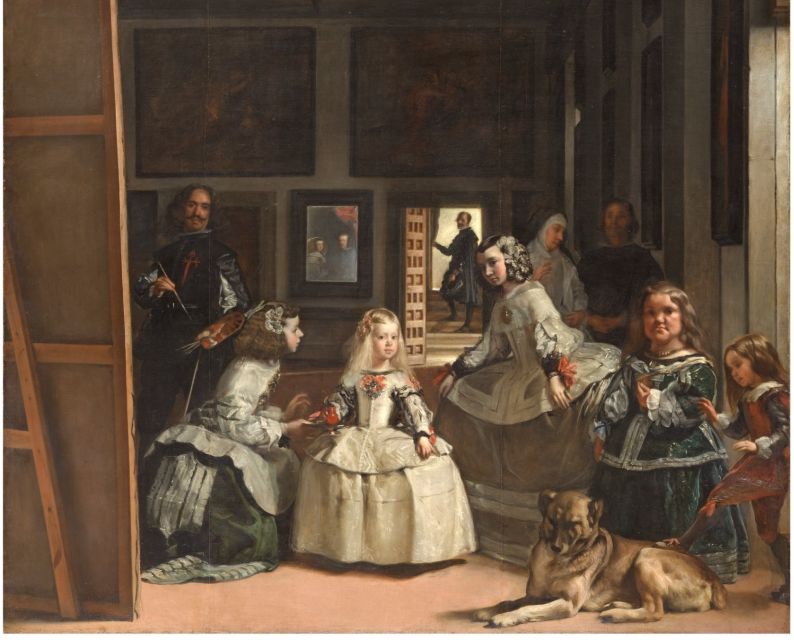
The other major focus is Velázquez’s Las Meninas, perhaps the Prado’s most famous painting. It shows a scene in the Alcázar of Madrid involving members of King Philip IV’s family, court figures, and Velázquez himself.
At first, the painting may look like a royal family portrait. Then you notice that the artist is included, the viewer seems to occupy a carefully chosen position, and a mirror adds another layer to the scene. Who is looking at whom? What is Velázquez painting? Why are some figures facing the viewer while others turn toward the royal couple?
Those questions are part of the painting’s lasting appeal. Las Meninas is not only a record of life at court. It plays with viewpoint, status, and the act of painting itself. The guide can point out the relationships among the figures and explain why the work has inspired later artists, including Goya and Picasso.
I would give this painting time even if you have seen it reproduced many times. In person, the scale and arrangement matter. The composition draws your eye around the room instead of offering one simple focal point. A focused explanation helps you appreciate the painting without turning the visit into a lecture on every possible interpretation.
How the guide shapes the experience
The strongest part of this tour is the guide’s role. A private visit gives you a more conversational setting than a large group. You can ask why a particular detail matters, request more time with a favorite painting, or say when you are ready to move on.
Alicia has received particularly strong praise for making the museum’s vast collection feel selective and clear. Her method uses chronology and comparisons, which means you get a sense of artistic change instead of isolated facts. She has also been praised for explaining ideas clearly in English, even though English is not her first language.
That detail matters because art tours can sometimes become either too academic or too shallow. The goal here is to give you enough information to see more, not to bury you in terminology. You should still expect an art history tour, but the private setting allows the guide to adjust the pace and level of detail to your group.
The tour is available in English, Spanish, French, and Italian. Choose the language in which you can comfortably discuss a painting, not simply the language you can follow in a short transaction. The more easily you can ask questions, the more useful the private format becomes.
What the $215 price means
At $215 per person, this is not a budget museum visit. You are paying for a private group, a local official art historian guide, museum admission, and skip-the-line entry. The value depends heavily on how much you want guidance and how many people are sharing the booking.
For a solo visitor or a couple, the cost is a premium for personal attention. You can enter the Prado for less on your own, then spend as long as you like wandering. That option is better if you already know the collection, enjoy reading labels, or prefer an unplanned visit.
For a family or small group, the calculation can look better. A private guide can keep different ages and interests together, explain the major paintings without sending everyone to separate rooms, and answer questions as they come up. You also avoid the common first-visit problem of leaving the Prado having seen plenty of art but not remembering what made it important.
The tour’s 4.8 rating from 75 reviews supports the idea that the guiding is its main strength, especially in the repeated praise for Alicia’s clarity, kindness, and ability to choose the right works. Still, a strong guide cannot change the basic limit of two hours. If you want a slow study of Spanish painting, plan a separate museum visit.
Who will get the most from this Prado visit
I would recommend this tour to a first-time Prado visitor who wants a strong foundation. It is also a good choice if one person in your group loves art and the others need a clear reason to care. Famous works such as Las Meninas and The Third of May 1808 provide common ground, while the wider selection shows that the museum is not limited to two Spanish masters.
Families may appreciate the private format, especially because the guide can explain complex ideas in a direct way. Art students and repeat visitors may also benefit if they want a fresh reading of the collection, though two hours will feel brief for anyone hoping to explore lesser-known works.
I would think twice if you dislike guided visits or want complete control over your route. The value here comes from selection and explanation. If your ideal museum day means lingering alone for half an hour before one painting, an independent ticket may suit you better.
The tour is also a practical pick for visitors with limited time in Madrid. You get the museum’s major artistic names, a guide to put them in order, and a clear two-hour commitment. That is far more useful than rushing through every gallery with no sense of priorities.
Booking details worth noting
The experience is a private group tour, with admission included. You can reserve now and pay later, which helps if your Madrid schedule is still taking shape. Cancellation is free up to 24 hours in advance for a full refund.
Children under 18 can enter the Prado free with proof of age. Children younger than 9 are also free, but you should still select a ticket for them during reservation so they can access the museum with your group.
Bring a passport or ID card. Meals and drinks are not included, though a two-hour museum visit is short enough that this should not complicate your day. Check the available starting times before you book, then meet your guide near the Goya statue at the front ticket sales area.
Should you book this private Prado tour?
Book it if you want the Prado’s greatest paintings explained in a sensible order, especially if Las Meninas, Goya, Bosch, and Rubens are new to you. The private format, skip-the-line entry, and strong focus on guide quality make the $215 price easier to justify for a family or small group.
Skip it if you prefer to wander alone, already know the museum well, or want more than two hours with the collection. For most first-time visitors who value context and personal questions, this is a focused and useful introduction to one of Madrid’s essential museums.
FAQ
How long does the Prado Museum tour last?
The tour lasts two hours. Starting times vary, so check availability when choosing your date.
Is museum admission included?
Yes. The entrance fee to the Prado Museum is included.
Is this a private tour?
Yes. The experience is for a private group rather than a shared large tour.
Which languages are available?
The live guide can conduct the tour in Spanish, English, French, or Italian.
Where does the tour begin?
Meet your guide near the statue of Goya, in front of the Prado Museum ticket sales area. The tour ends back at the meeting point.
Is the tour wheelchair accessible?
Yes, the activity is listed as wheelchair accessible.
What identification should I bring?
Bring a passport or ID card. Visitors under 18 may enter free with proof of age, and children younger than 9 are also free, but a ticket should still be selected for them during reservation.
Just added around Spain
- Girona, Figueres, Dalí Museum and Cadaqués Tour from Barcelona★ 4.5 · 36 reviews
- Erotic Museum Admission Ticket with Audioguide★ 5.0 · 527 reviews
- Dali Museum and Costa Brava Small Group Day Trip from Barcelona★ 5.0 · 77 reviews
- Football Club Barcelona Museum Immersive Tour Guided Visit★ 3.5 · 52 reviews
- Madrid by High-Speed Train with Prado Museum Private Tour★ 4.0 · 33 reviews
- Guitar Legends Hall: Entrance to the Immersive Rock Museum★ 5.0 · 25 reviews
- White Rabbit Museum: The Best Immersive Experience in Catalonia★ 5.0 · 538 reviews
- Private Dali Museum, Besalú & Girona Tour from Barcelona★ 5.0 · 15 reviews
Museum Tours in Spain, compared.
Park Güell and Gaudí House Museum Entry Ticket
Read our review →
Puro Flamenco Show with Optional Museum Ticket
Read our review →
Moco Museum Barcelona: Modern & Contemporary Art
Read our review →
Girona & Dali Museum Small Group Tour with Pick-up from Barcelona
Read our review →
Valencia: Oceanogràfic, Hemisfèric & Science Museum Combo
Read our review →Browse the lists this tour appears in