
Review · BUDAPEST
Budapest: Budapest Retro Interactive Museum Ticket
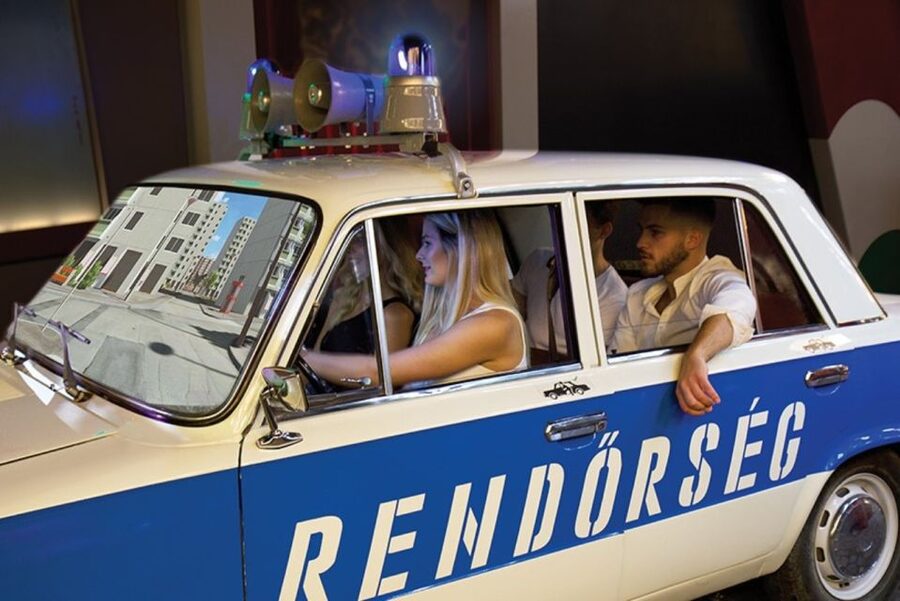
Budapest Retro Interactive Museum turns Hungary’s communist past into something you can handle, sit in, wear, and play with. You can patrol a virtual Budapest housing estate in a Soviet Lada police car, read a period news bulletin in a working television studio, and inspect the ordinary objects that filled homes in the 1970s and 80s. The hands-on displays make this more than a room full of dusty cases.
I especially like the typical apartment, where matching furniture, appliances, carpets, and televisions show how standardized daily life could feel. I also like the mix of serious history and simple fun, from vintage clothes on the interactive mirror to the nine motorcycles and three restored Soviet cars. The main drawback is that some information is not in English, and the museum can feel warm on hot days.
Key points to know before you go
- Patrol virtual Gazdagrét: Sit in a Soviet-made Lada police car and drive through a simulated Budapest housing estate.
- Read the news on camera: Use two original, functioning television cameras in a communist-era news studio.
- See an ordinary 1970s and 80s home: Explore period furniture, appliances, carpets, and household objects.
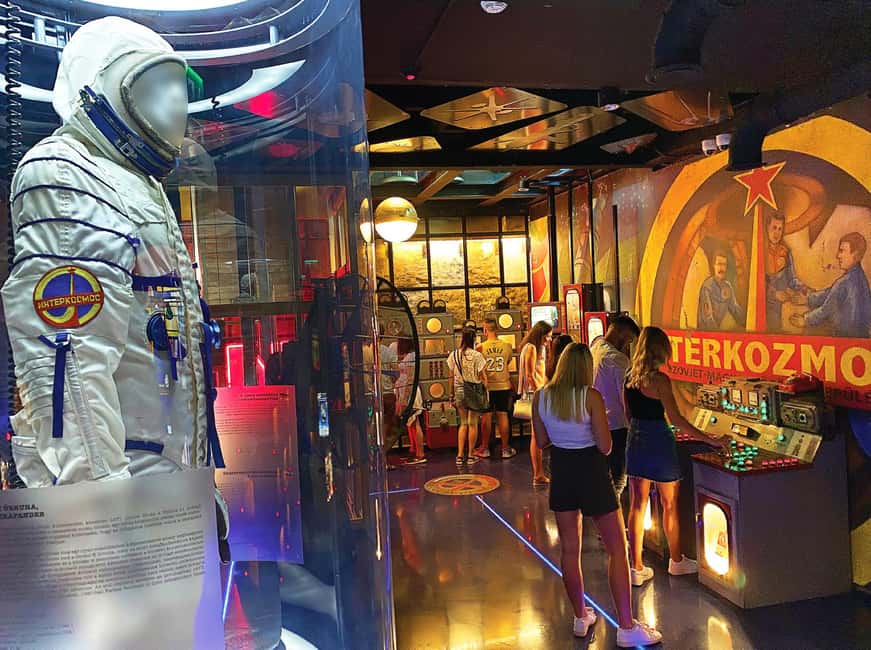
- Look for the space-age goulash: A dedicated room covers Hungary’s 1980 space mission, including a spacesuit and folk-art-patterned canned goulash.
- Plan 1 to 2 hours: The museum is packed with objects, but it is not a full-day attraction.
- Finish at the retro café: Stop for coffee, drinks, or pastries beside a jukebox after the exhibits.
Why this museum works better than a standard history display
This museum focuses on how people lived, not only on political leaders and official events. That choice gives you a more useful picture of communist Hungary. You see the schoolroom, the apartment, the television studio, the cars, the clothes, and the small objects that made up ordinary routines.
The period covered is mainly the 1970s and 80s, an era often associated with Hungary’s less rigid form of communism, sometimes called goulash communism. The phrase points to a system that was still controlled by the state, but offered more consumer goods and personal freedom than some other countries behind the Iron Curtain.
You do not need a detailed knowledge of Hungarian politics to enjoy the museum. The objects explain the setting. A refrigerator, school scarf, television, or food tin can tell you plenty about a society where practical use came first and many homes looked remarkably similar.
I find that approach particularly helpful for families. Children may not spend long reading political text, but they can sit in the police car, try a vintage outfit, and see a real television camera. Parents and grandparents can add their own memories of old household technology, school routines, or holiday camps.
More Museum Tours in Budapest
- Budapest: Cat Museum Budapest Entry Ticket
★ 4.4 · 2,210 reviews - Budapest: Light Art Museum Skip-the-Line Entry Ticket
★ 3.9 · 1,531 reviews - Budapest: Van Gogh Immersive Exhibition Ticket
★ 4.2 · 399 reviews
Three floors of everyday communist Hungary
The museum is arranged across three floors, with thousands of authentic objects placed in themed rooms. The size is manageable, but the displays are dense. You can move through quickly in about an hour, yet a slower visit takes closer to two hours if you stop to read, try the interactive stations, and examine the smaller items.
The presentation is designed to show the relaxed side of the period without pretending that life was simple or free. You see community activities, summer camps, and time at Lake Balaton alongside propaganda, standardization, and state-controlled education.
That balance matters. A museum about communism can become either a dry political lesson or a nostalgia display. Here, the everyday objects give the story some texture. The result is lighter in tone than a memorial museum, but it still shows how the system shaped ordinary life.
Some displays are less clear if you only read English. One visitor found parts of the exhibition difficult to understand because not all material was translated. You can still enjoy the visual exhibits and interactive features, but English-speaking visitors should allow for a few moments when the context is not obvious.
School life, red pioneer scarves, and Lake Balaton
The education section shows how children grew up under the communist system. Students wore distinctive red pioneer scarves and learned songs tied to official ideology. This is a useful reminder that political education did not sit apart from daily life. It entered the classroom, youth groups, ceremonies, and school activities.
At the same time, the museum shows the social side of childhood. Summer camps and group activities, including time at Lake Balaton, offered children a strong sense of community. For you, the interesting point is that these experiences were not simply fake or forced. A political system could impose ideology while still creating genuine friendships and happy memories.
That tension is one of the museum’s strengths. It avoids presenting the past as one single emotional story. You can recognize the pressure of propaganda while also seeing why some people remember parts of their youth with affection.
The school displays should appeal to adults who grew up in Eastern Europe, but children can also follow the basic story through the clothes, objects, and photographs. If you are visiting with kids, connect the red scarf and school material to the modern classroom. That makes the display easier to understand than a long explanation about political systems.
The working television studio
One of the museum’s most unusual features is a period news studio with two original television cameras that still function. You can stand in front of the setup and read communist-era news broadcasts, taking the role of the presenter.
This is a clever use of technology because it shows how carefully controlled information once reached the public. A television news bulletin could make official statements feel normal and authoritative. By putting you in front of the camera, the museum lets you see the performance side of state media.
It is also one of the best stops for a quick photograph or family video. The display is not just something to look at. You take part in it, even if only for a minute.
The studio may attract a queue when the museum is busy, since each person needs time to try it. If you want to use every interactive feature, avoid rushing through the building. The museum is small enough for a return visit to a popular station if another group is using it.
A few more museum visits around the world worth comparing
- Vatican: Museums & Sistine Chapel Entrance Ticket
★ 4.5 · 144,003 reviews - Paris: Louvre Museum Timed-Entrance Ticket
★ 4.6 · 71,977 reviews - Amsterdam: Van Gogh Museum Ticket
★ 4.7 · 52,054 reviews - NYC: 9/11 Memorial & Museum Timed-Entry Ticket
★ 4.8 · 31,428 reviews
The Lada police car and virtual Gazdagrét
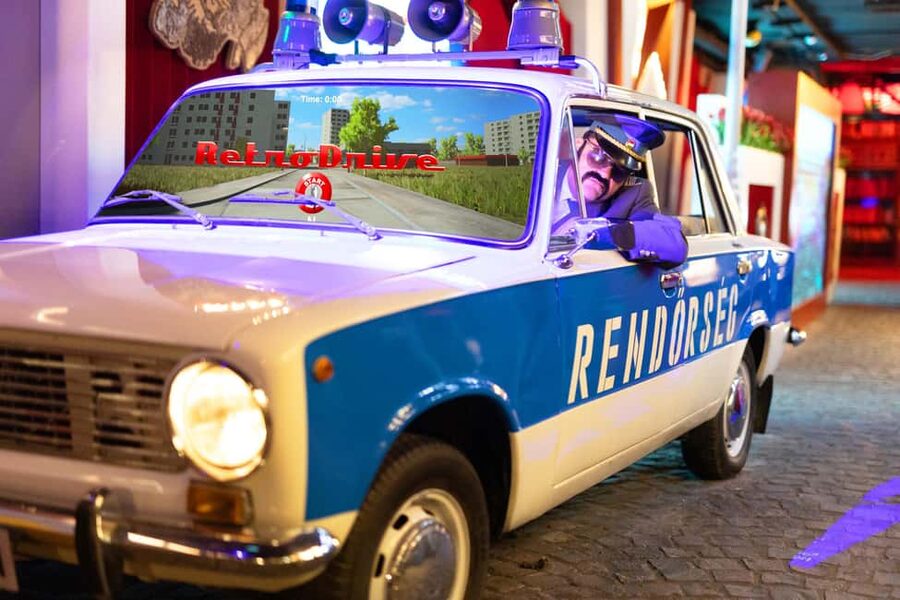
The Soviet-made Lada police car is likely to be the museum’s biggest crowd-pleaser. It has been converted into a simulator, allowing you to patrol a virtual version of Gazdagrét, a Budapest housing estate known for rows of similar apartment blocks.
This is not just a driving game added for amusement. Gazdagrét helps explain the planning style of the period. Large housing estates offered practical homes for growing urban populations, but the repeated blocks also created a very uniform cityscape.
Sitting inside the Lada gives you a direct sense of the machinery of that era. The car, the police setting, and the housing estate all belong to the same visual world. You are not simply looking at a vehicle behind a rope. You are placed inside a small scene from communist Budapest.
The simulator is especially useful for mixed-age groups. Younger children can enjoy the controls, while adults can think about what the housing estate represents. If the museum is crowded, this attraction may require patience because it is one of the displays people naturally want to try.
Motorcycles, Soviet cars, and the black Volga
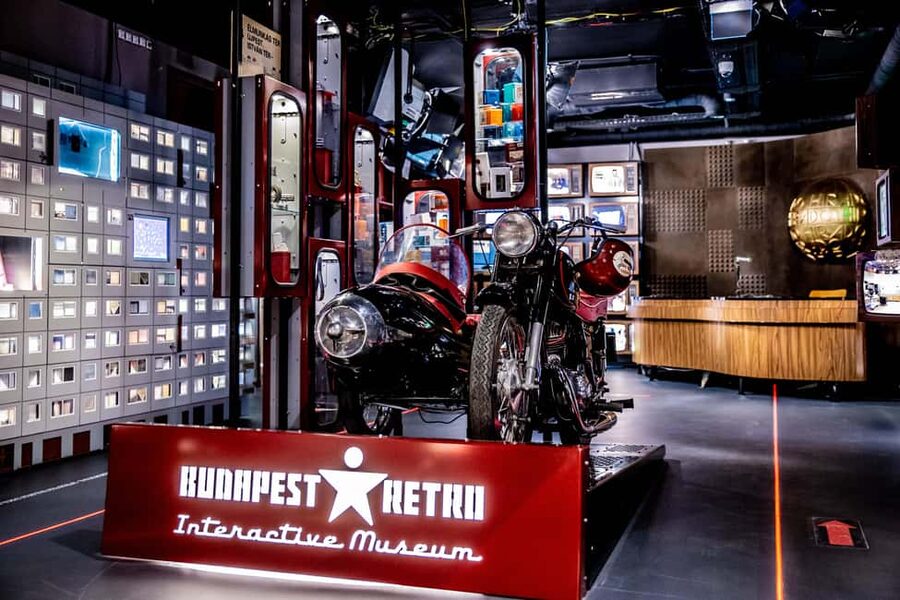
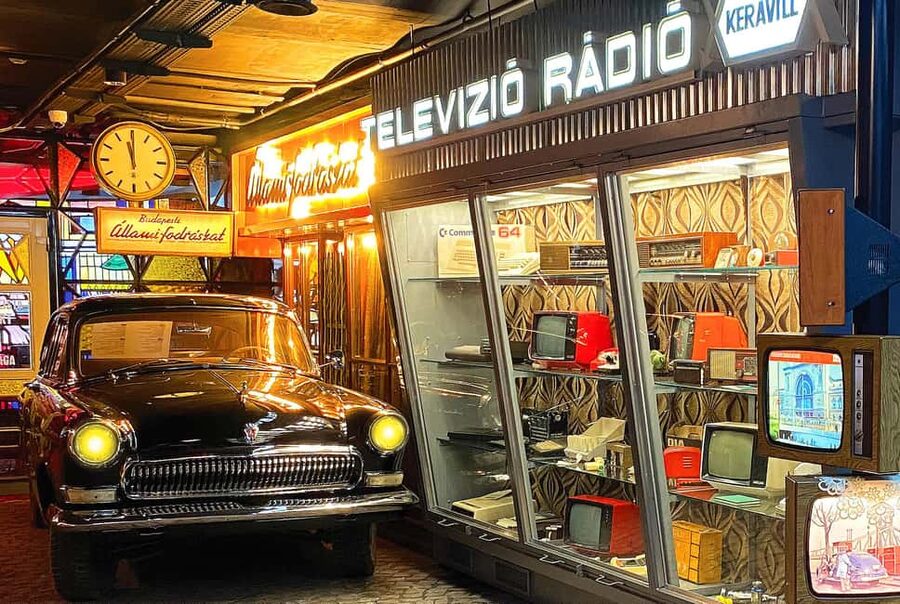
The vehicle collection includes nine motorcycles and three renovated vintage Soviet cars. The black Volga deserves special attention. It has the heavy, formal look associated with official vehicles of the Soviet era, and it gives the transport section a strong visual focus.
You can also compare the Volga with the Lada police car. One suggests authority and status, while the other feels more practical and familiar. Together, they show different parts of the period’s road culture.
The motorcycles add variety and help keep the vehicle display from becoming a single-theme collection. If you enjoy old cars, allow extra time here. Several visitors have singled out the classic vehicles and motorbikes as a highlight.
The collection is not enormous, so do not expect a large transport museum. Its value comes from how the cars fit into the wider story of housing, policing, work, and daily movement.
Hungary’s 1980 space mission
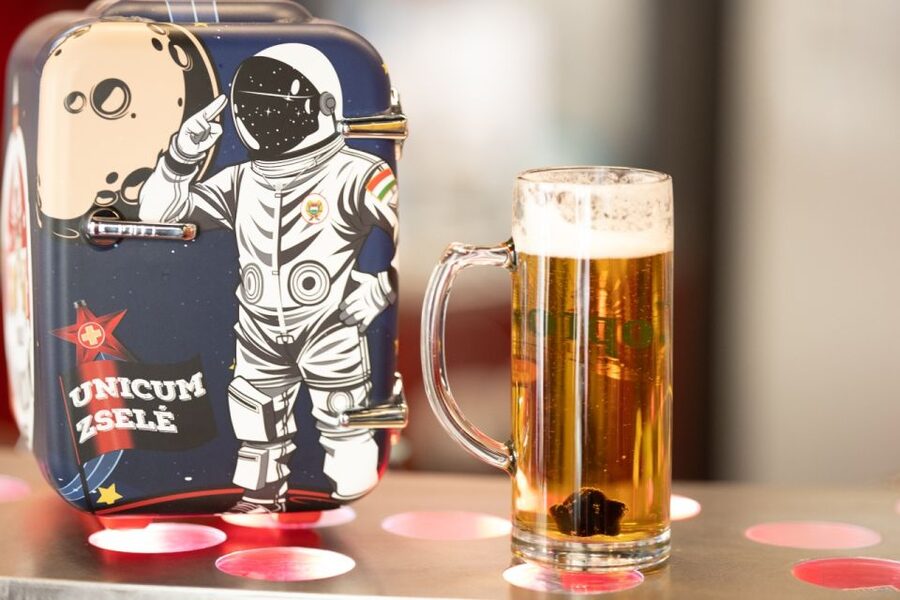
A separate room covers Hungary’s 1980 space mission, when the country became the seventh nation to send an astronaut into space as part of a Soviet mission. The display includes a spacesuit and a distinctive food item: canned goulash decorated with Hungarian folk-art patterns, presented as a gift to the crew of the Salyut 6 space station.
The goulash tin is a small but memorable object. It links national identity, Soviet cooperation, food, and technology in one package. You can see how Hungary presented itself through folk design even while operating within a Soviet-led program.
The space room also widens the museum’s story. Much of the exhibition deals with apartment blocks, schools, and household goods. Here, the focus shifts to national pride and international prestige. It shows that communist-era Hungary was not only about shortages or standard-issue products. It also had ambitious scientific and cultural symbols.
For children, the spacesuit gives the room an instant focus. For adults, the display offers a useful reminder that the space race shaped identity across the entire Eastern Bloc, not only in the Soviet Union and the United States.
The typical apartment and the interactive mirror
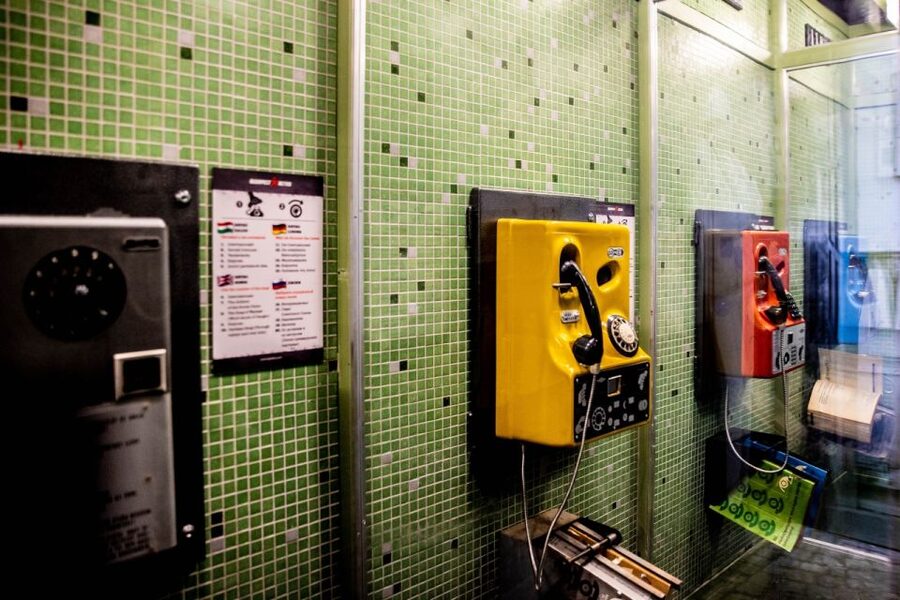
The apartment display may be the most revealing part of the museum. It recreates a typical home filled with period furniture, carpets, fridges, televisions, and other household items.
The design principle was functionality first. Apartment blocks spread through cities, and many units contained similar objects arranged in similar ways. When you walk through the room, you can see how a standard home could be comfortable and practical while also feeling highly uniform.
This display works because it deals with ordinary details. You are not looking at a grand official building. You are seeing the kind of interior where people ate, watched television, stored food, and raised families.
Nearby, the interactive mirror lets you try on vintage clothing digitally. It is a light touch, and it gives younger visitors a reason to spend more time with the period style. It also makes a good photo opportunity without turning the whole museum into a novelty attraction.
I would give the apartment more time than you might expect. Small items often explain the period better than the headline exhibits. Look at how furniture, appliances, and decoration fit together. The repeated styles tell you something about supply, taste, and the limits of consumer choice.
How long to stay and how the $17 ticket feels
The listed price is about $17 per person, although the exact cost varies by day of the week. For a visit lasting one to two hours, that is a fair price if you use the interactive displays and take an interest in the objects rather than treating the museum as a quick photo stop.
The value improves for families and groups with different interests. One person can focus on the history, another on the cars, and children can try the simulator, television studio, and interactive mirror. A small café and souvenir area also make the visit feel like a complete stop rather than a single exhibit room.
If you only want a large collection of vehicles, the ticket may feel less worthwhile because there are three cars and nine motorcycles, not a huge garage. If you want a thoughtful account of political history with extensive English interpretation, you may also find the text uneven.
The skip-the-line admission is useful when the museum is busy, especially if the Lada and television studio have attracted a queue. You present your voucher at the museum desk. The ticket is valid for one day, and free cancellation is available up to 24 hours before the visit. You can also reserve and pay later, which helps if you are still arranging your Budapest schedule.
The museum is wheelchair accessible. Seniors aged 65 and over who buy a senior ticket receive a complimentary coffee on Wednesdays.
The retro café and a sensible visit plan
After the exhibits, the retro bistro offers coffee, drinks, and pastries beside a jukebox. Food and drink are not included with admission, so think of the café as an optional finish rather than part of the ticket.
I like the idea of ending here because it keeps the period theme going without making the history feel heavy. A jukebox and a coffee give you time to talk about the objects you have just seen. The souvenir section is also worth a quick look if you want a small reminder of the visit.
For an efficient visit, start with the apartment and school displays, then move to the television studio, cars, motorcycles, and space room. Save the Lada simulator and interactive mirror for moments when you have time to wait. Finish at the café if you want a slower end.
On a hot day, do not assume the museum will be a cool refuge. Air conditioning has been a concern during warm weather. A one to two hour visit is still manageable, but plan your timing with the weather in mind.
Who should book the Budapest Retro Interactive Museum?
I recommend this museum if you want a clear, approachable look at everyday communist Hungary, especially if your group includes children or people who do not usually enjoy formal history museums. The working cameras, Lada simulator, vintage clothing, apartment, and vehicles give everyone something to do.
It is also a smart choice if you have already seen Budapest’s grand monuments and want a different side of the city. The museum explains the background behind the housing estates, consumer goods, schools, and public messages that shaped modern Hungarian memory.
I would be more cautious if you need every exhibit fully explained in English or expect a large museum that fills half a day. Some displays require you to rely on objects and visual clues, and the building can be completed in less than two hours.
For most visitors, the combination of real artifacts and hands-on stations makes the $17 ticket worthwhile. Book it if you want history with buttons to press, cameras to operate, and a police car to drive, not just labels to read.
FAQ
How long does a visit to the Budapest Retro Interactive Museum take?
Plan for 1 to 2 hours to see the three floors, try the interactive displays, and examine the period objects.
What does the museum focus on?
It focuses on everyday life in Budapest and Hungary during the communist era, especially the 1970s and 80s.
Can I drive a police car at the museum?
You can sit in a Soviet-made Lada police car that has been converted into a simulator. It lets you patrol a virtual version of Gazdagrét.
Can I use the television cameras?
Yes. The museum has two authentic, functioning television cameras in a period news studio, where you can read original communist-era news broadcasts.
Is the museum suitable for children?
Yes. The museum is designed for all generations and includes interactive features such as the Lada simulator, vintage outfits through an interactive mirror, and hands-on displays.
What vehicles are on display?
The collection includes nine motorcycles and three renovated vintage Soviet cars, including a black Volga and the Lada police car simulator.
Is there a café at the museum?
Yes. The retro bistro serves coffee, drinks, and pastries and includes a jukebox. Food and drinks are not included in the admission ticket.
Is the museum wheelchair accessible?
Yes, the Budapest Retro Interactive Museum is wheelchair accessible.
Just added around the world
- Girona, Figueres, Dalí Museum and Cadaqués Tour from Barcelona★ 4.5 · 36 reviews
- Football Club Barcelona Museum Immersive Tour Guided Visit★ 3.5 · 52 reviews
- Erotic Museum Admission Ticket with Audioguide★ 5.0 · 527 reviews
- Dali Museum and Costa Brava Small Group Day Trip from Barcelona★ 5.0 · 77 reviews
- Madrid by High-Speed Train with Prado Museum Private Tour★ 4.0 · 33 reviews
- Guitar Legends Hall: Entrance to the Immersive Rock Museum★ 5.0 · 25 reviews
- White Rabbit Museum: The Best Immersive Experience in Catalonia★ 5.0 · 538 reviews
- Private Dali Museum, Besalú & Girona Tour from Barcelona★ 5.0 · 15 reviews
Museum Tours in Budapest, compared.


Travelling Galaxy Star Wars Interactive Exhibition
Read our review →

Browse the lists this tour appears in