
Review · ATHENS
Ancient Agora of Athens Site & Museum Private Tour
The best part of this tour is the chance to see Athens where ordinary civic life once happened, not just where temples were built. You walk the old Panathenaic Way, visit the remarkably preserved Temple of Hephaestus, and finish in the Stoa of Attalos museum, where small objects help put the ruins into human scale.
I like the private format, since a guide can adjust the pace and explain things to children, history fans, or a mixed-age group. I also like that both admissions are included, a useful safeguard when you want a simple two-hour visit without sorting out separate tickets.
The main drawback is price. At $263.15 per person, this is a serious spend for roughly two hours, especially for a larger family. You are paying for private guidance and convenience, not simply entry to the archaeological site.
Ancient Agora of Athens Private Tour: Key Points
- Walk the Panathenaic Way: Follow the ancient processional road that led from the Dipylon Gate toward the Acropolis.
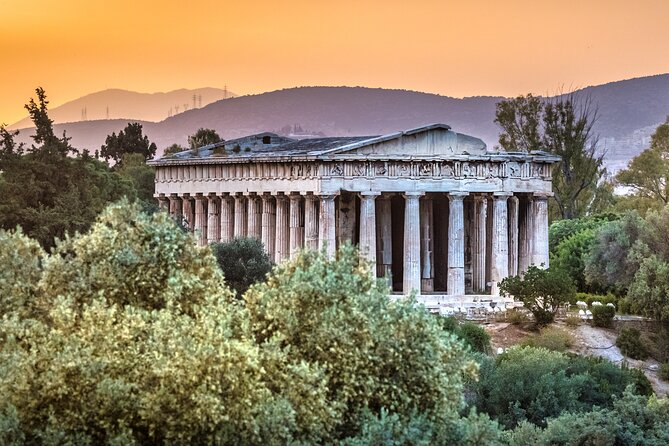
- See the Temple of Hephaestus: Visit one of the best-preserved ancient temples in Greece, described in the tour details under the alternate Temple of Aries name.
- Explore the Stoa of Attalos: Use the reconstructed colonnade and museum collection to make sense of the open-air ruins.
- Set the pace for your group: The private setup can be tailored to your interests and the ages of the people with you.
- Keep the visit compact: The two-hour length fits neatly before or after other Athens sightseeing.
- Check your ticket email carefully: Most ticket experiences worked smoothly, but one booking problem led to a guest buying replacement tickets at the gate.
Why the Ancient Agora Belongs on Your Athens Plan
The Acropolis gets the headlines, but the Ancient Agora explains how Athens functioned below the sacred hill. This was a civic center, a place of roads, public buildings, religious activity, trade, and daily business. It gives you a different view of the city than the grand temples above.
The site lies between the Acropolis and several low hills, including Areopagus and Kolonos Agoraios. That setting matters. You are not looking at an isolated ruin in a museum-like enclosure. The Agora sits within the old city, with the Acropolis defining the southern view and the Panathenaic Way cutting through the area.
I find this kind of visit more rewarding with a guide than with a quick glance at a map. The stones can be hard to read on your own. A licensed local guide can connect the road, buildings, hills, and religious ceremonies into one story. The private arrangement also means you can ask why a particular ruin matters instead of simply moving from plaque to plaque.
This is not a long tour. The planned visit takes about two hours, with roughly 20 minutes at the main Agora area, 20 minutes at the Temple of Hephaestus, and one hour in the museum. Those times are useful as a guide, not a rigid promise. Your group’s pace and interests will shape the balance.
More Museum Tours in Athens
- Athens: Acropolis, Parthenon & Acropolis Museum Guided Tour
★ 4.8 · 9,316 reviews - The Acropolis, Parthenon & Acropolis Museum Guided Tour
★ 4.7 · 8,493 reviews - Athens: Mythology of Delphi, Museum and Arachova Guided Tour
★ 4.7 · 5,102 reviews
Walking the Panathenaic Way Through the Agora
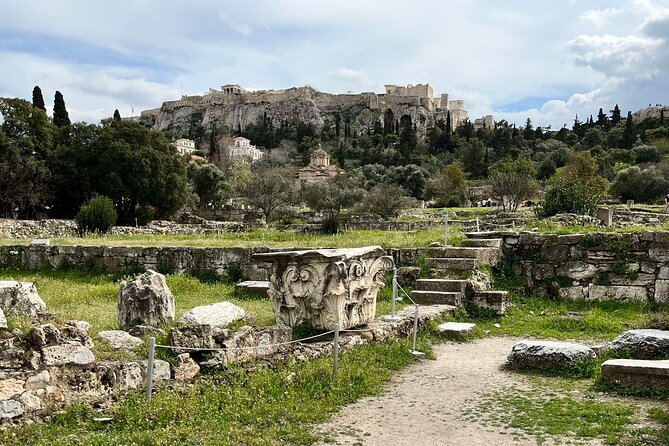
The first part of the visit brings you into the Ancient Agora itself. The site was crossed by the Panathenaic Way, one of the most important roads in ancient Athens. It ran from the Dipylon Gate, the city’s main entrance, toward the Acropolis.
This was not just a convenient street. It served as the processional route for the Panathenaic festival, held in honor of Athena, the city’s patron goddess. That detail gives the roadway real meaning. You are following the path used for a major civic and religious celebration, rather than simply crossing an old patch of ground.
Allow about 20 minutes for this first orientation. That may sound short, but it can work well if the guide uses the time to explain the site’s layout and purpose. You will want to look toward the Acropolis, note the surrounding hills, and understand how this open area fitted into the old city.
The short stop can also be a limitation. If you want a slow photographic walk through every visible ruin, two hours for the whole experience may feel tight. The private format helps, since you can tell the guide if your group wants more time outside and less time in the museum, but the listed plan gives the museum the largest share of the visit.
For families, this opening section may be easier than beginning with a long technical explanation. The story of a festival road is concrete. Children can picture a procession moving toward the Acropolis, while adults can ask about the city’s public life and religious customs.
The Temple of Hephaestus on Kolonos Agoraios
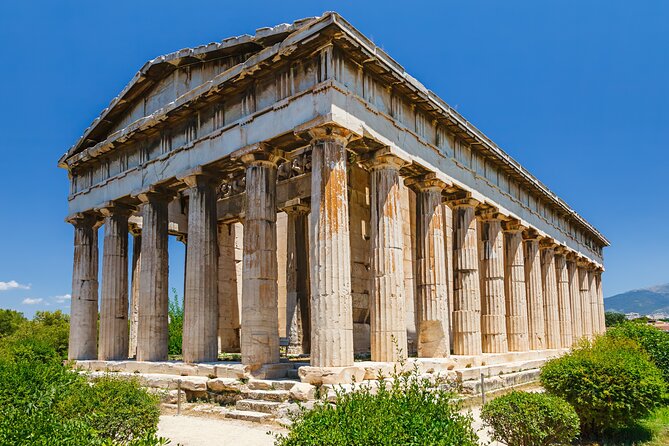
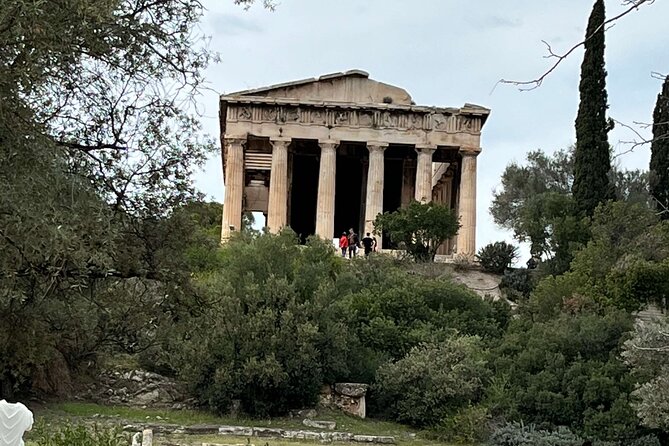
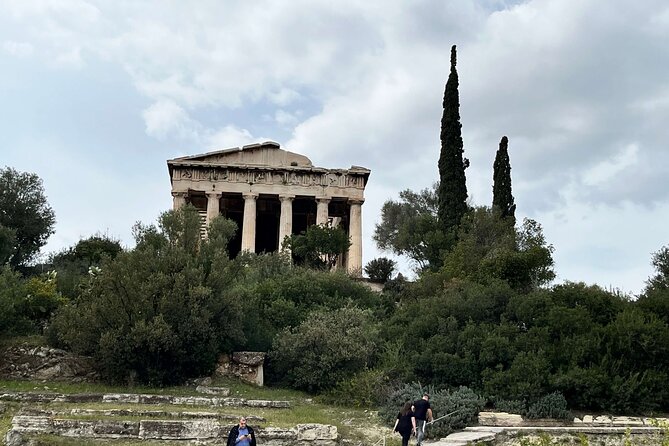
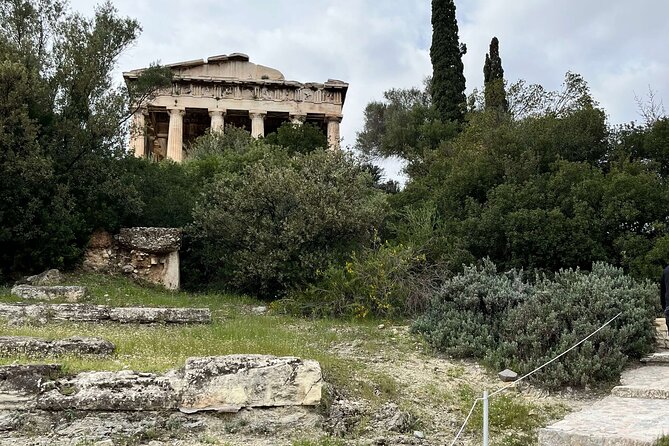
The second stop takes you to the temple on top of Kolonos Agoraios hill. The supplied tour information calls this the Temple of Aries in its stop title, but the detailed description identifies it as the Temple of Hephaestus, also widely known as Thisio. That is the name you should expect to hear during the visit.
This is one of the best-preserved ancient temples in Greece. One reason is that it was later converted into a Christian church, which helped protect the structure through the centuries. The temple was probably built between 460 and 420 BC by an unknown architect.
The building was dedicated to Hephaestus, the god associated with metalworkers, and Athena Ergani, who protected potters and cottage industries. Excavations around the hill found metallurgy workshops, supporting the identification of the temple as a place connected to Hephaestus.
That working connection makes the temple more interesting than a simple monument to a famous god. Athens was not only philosophers, politicians, and armies. It also depended on skilled makers, workshops, tools, pottery, and small industries. The temple reflects that side of the city.
Earlier ideas connected the building with Theseus, Hercules, or Ares, which helps explain why the alternate name in the tour description may appear. Your guide can clarify the naming without leaving you to sort out the issue alone.
Plan on about 20 minutes here. The hill gives you a strong view over the Agora and toward the Acropolis, and the temple itself rewards a careful look at its surviving form. One review singled out the view from the Temple of Hephaestus as a major reason the visit was worthwhile.
You should not expect a long interior exploration. The value is in seeing the temple in its setting, understanding its purpose, and noticing how much of the ancient structure remains. If you enjoy architecture, this may be the high point of the tour. If your main interest is objects and everyday life, the museum will likely hold your attention longer.
The Stoa of Attalos and Its Museum Collection
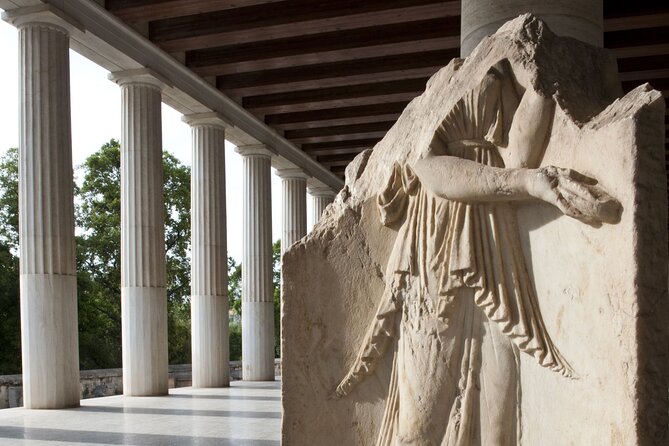
The final and longest stop is the Museum of the Ancient Agora, housed in the reconstructed Stoa of Attalos. The original stoa was built in the second century BC as a gift from Attalos II, king of Pergamon, to Athens.
A stoa was a covered public building with a colonnaded walkway and rooms behind it. In the Agora, a structure like this helped define the civic space and gave people somewhere to meet, work, shop, or conduct business. The reconstructed building now provides a clear sense of the scale and shape that can be difficult to imagine from foundations alone.
The museum collection comes from systematic excavations in the area. Its objects span a very long period, from the Neolithic era through the post-Byzantine and Ottoman periods. That range is important because it shows the Agora as a place with a long life, not a site that mattered only during the classical age.
You have about an hour here, which is sensible. The open-air ruins show the broad plan of the Agora, while the museum lets you focus on objects and evidence. Pottery, tools, inscriptions, and other finds can give a more personal sense of the people who used the area.
I like this inside-and-outside pairing. Without the museum, the ruins can remain abstract. Without the ruins, the objects lose some of their setting. Together, they make it easier to understand how the Agora changed over time.
One practical point is that the same included admission covers both the archaeological site and the museum. Several bookings used the electronic ticket at the Agora entrance and then scanned it again for the museum. That makes the combined ticket useful, especially if you want to visit the museum after walking the grounds.
More private museum tours in Athens:
- Acropolis and Acropolis Museum Private Tour with Licensed Expert
★ 5.0 · 445 reviews - Athens Acropolis & Museum PRIVATE TOUR with a Local Private Guide
★ 5.0 · 367 reviews - Acropolis Of Athens & Acropolis Museum Skip The Line Private Guided Tour
★ 5.0 · 102 reviews - Acropolis of Athens, Parthenon and Acropolis Museum private tour with dinner
★ 5.0 · 77 reviews
What the Private Format Adds
A private tour is most useful when your group does not all want the same thing. A child may need short explanations and movement. An adult with a strong interest in ancient architecture may want to linger at the temple. Someone else may care most about the museum objects. A private guide can adjust the emphasis more easily than a fixed group tour.
The experience is offered in English and includes guidance from an official licensed local guide. No guide name is provided in the booking information, so you cannot choose a particular person in advance. The private setup is the important feature here, not a named specialist.
The guide also helps with context. A dry guidebook can tell you the date of a temple or identify a road. A live explanation can connect the Panathenaic festival, the city’s industries, the temple’s later church use, and the museum finds. That is the difference between recognizing a ruin and understanding why it mattered.
Still, do not assume private means unlimited time. The advertised duration is about two hours. Ask at the beginning if your group has a special priority, such as the temple, the museum, or ancient civic life. That small conversation can help the guide shape the visit around what you actually want.
Is $263.15 Per Person a Fair Price?
The listed cost is $263.15 per person, with group discounts available. That is expensive if you compare it with the cost of entering the Ancient Agora on your own. The admission itself is not the main value of this booking.
You are paying for a private English-language guide, a customized visit, and the ease of having both site and museum tickets arranged together. For a couple, a family that values structure, or a small group splitting the cost, that may be reasonable. For a large group, even a discount may not make the total feel light.
The two-hour length also affects the calculation. This is not an all-day Athens experience. It is a focused introduction that leaves room for the Acropolis, the Acropolis Museum, Plaka, or another nearby sight. If you want a short guided visit with no separate ticket planning, the price has a clearer logic.
If you are comfortable reading site signs, carrying a map, and setting your own pace, self-guided entry will cost less. One review specifically praised having a map and reading the boards while walking through the site. That approach suits independent history fans who want to pause whenever they like.
I would pay the premium when the group includes children, older relatives, first-time visitors, or people who want a clear historical framework. I would hesitate if you are already an experienced ancient-history reader and mainly want quiet time among the ruins.
Tickets, Timing, and Small Practical Details
Your booking confirmation is issued at the time of booking. Electronic tickets have generally been delivered before the visit, and one successful booking received the ticket the day before the tour with instructions for entering the Agora. The ticket also provided access to the museum.
There was also a serious ticket-delivery problem in one case. The guest did not receive the voucher, checked spam, contacted support, and ended up buying new tickets at the gate. Since the provider replied that the ticket had been sent through Viator, the safest approach is simple: check the email address carefully, inspect your spam folder, and make sure you have the ticket before leaving for the site.
The experience is near public transportation, and service animals are allowed. Most people can take part. Children and young people up to age 25 from European Union member states receive free admission when they show an identity card or passport proving age and nationality.
Children up to age five from non-European Union countries also receive free admission with a passport confirming age and nationality. If someone in your group qualifies for free entry, tell the provider in advance so the correct ticket can be issued.
Free cancellation is available up to 24 hours before the start time. Changes or cancellations inside that 24-hour window are not accepted for a refund, and the cut-off uses Athens local time. Gratuities are optional and are not included.
Who Will Get the Most From This Tour?
This tour suits you best if you want an efficient historical introduction rather than a full-day archaeological study. The two-hour schedule is easy to fit into a busy Athens plan.
It is also a good choice for a mixed group. The guide can adjust explanations for different ages and interests, and the private format avoids the pressure of keeping up with strangers. Families may especially appreciate the short outdoor sections and the museum stop.
History fans will value the connection between the Panathenaic Way, civic life, metalworking, worship, and the objects found in the Agora. Architecture fans may prefer to give extra attention to the Temple of Hephaestus. Museum-minded visitors should make sure the final hour is not rushed.
You may want to skip the tour if your budget is tight, your group is large, or you prefer to explore independently. The Ancient Agora is well suited to a self-guided visit if you are willing to use a map and read the information panels.
Should You Book the Ancient Agora Private Tour?
Book it if you want a licensed English-speaking guide, a private pace, and site and museum entry handled together. The strongest part is the combination of a meaningful ancient road, a remarkably preserved temple, and a museum housed in the reconstructed Stoa of Attalos.
Think twice about the price if you only need admission or if two hours feels too short. Before the date, confirm that your electronic ticket has arrived and bring the required identification for anyone claiming free admission.
For most first-time Athens visitors, I would place this tour before the Acropolis if the schedule allows. The Agora gives you useful civic and religious context, so the Acropolis feels less like a collection of grand stones and more like the high point of a living city.
FAQ
How long does the Ancient Agora private tour last?
The tour lasts approximately two hours.
What language is the tour offered in?
The experience is offered in English.
Are Ancient Agora entrance tickets included?
Yes. Admission to the Ancient Agora archaeological site and the Ancient Agora museum is included.
Is a guide included?
Yes. Guidance throughout the visit is provided by an official licensed local tour guide.
What places are visited?
The tour includes the Ancient Agora of Athens, the Temple of Hephaestus, and the Museum of the Ancient Agora in the reconstructed Stoa of Attalos.
Can the private tour be adjusted for my group?
Yes. The private experience can be customized to the interests and ages of your group.
Do children qualify for free admission?
Children and young people up to age 25 from European Union member states qualify for free admission when they show identification proving age and nationality. Children up to age five from non-European Union countries also qualify with a passport.
What is the cancellation policy?
You can cancel up to 24 hours before the experience start time for a full refund. Cancellations or changes made less than 24 hours before the start time are not refunded or accepted.
Just added around Athens
- Ancient Athens tour: Acropolis, Parthenon and Acropolis Museum★ 5.0 · 256 reviews
- The Acropolis, Athens Walking City Tour and Acropolis Museum★ 5.0 · 442 reviews
- Athens: Acropolis Museum Ticket with Self-Guided Audio tour App★ 3.5 · 40 reviews
- Family Acropolis & Acropolis Museum Tour inspiredby Percy Jackson★ 4.5 · 40 reviews
- Acropolis of Athens, Parthenon and Acropolis Museum private tour with dinner★ 5.0 · 77 reviews
- Shore Excursion: Acropolis, Athens City tour and The New Acropolis Museum★ 4.5 · 30 reviews
- Athens National Archaeological Museum E-Ticket with Audio Guide★ 3.0 · 57 reviews
- Private Tour: Half day Athens Sightseeing and Acropolis Museum★ 4.5 · 28 reviews
Museum Tours in Athens, compared.
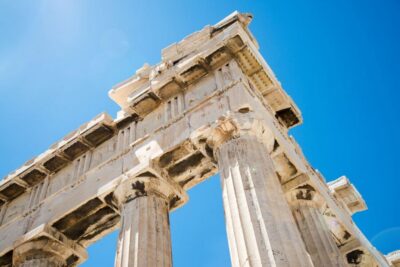
Acropolis, Parthenon & Acropolis Museum Guided Tour
Read our review →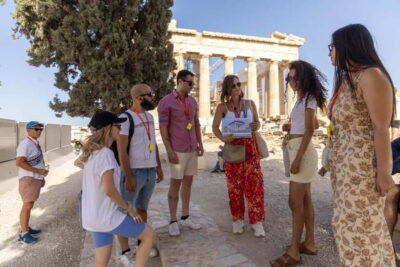
The Acropolis, Parthenon & Acropolis Museum Guided Tour
Read our review →Acropolis, Parthenon & Acropolis Museum Guided Tour
Read our review →
Acropolis monuments & Parthenon Walking Tour with Optional Acropolis Museum
Read our review →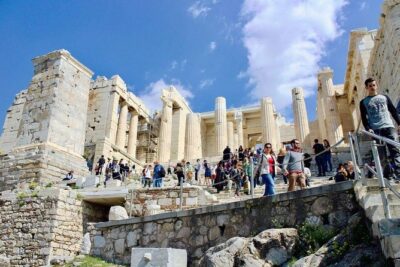
Athens All Included: Acropolis and Museum Guided Tour with Ticket
Read our review →
Acropolis Museum Ticket with optional Audio Guide
Read our review →
Small-Group Delphi, Museum & Arachova Day Trip
Read our review →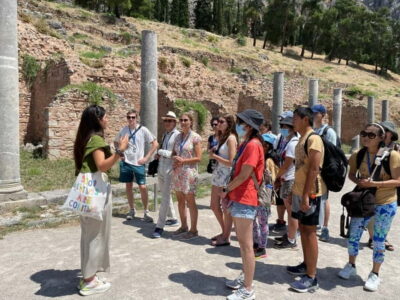
Delphi Oracle & Museum Tour with a Licensed Guide
Read our review →Browse the lists this tour appears in