
Review · ATHENS
Acropolis of Athens, Parthenon and Acropolis Museum private tour with dinner
The best part of this Athens experience is the private archaeologist guide who connects the broken stones on the Acropolis with the original art and stories displayed in the museum. I especially like the skip-the-line admission and the way the tour links the Parthenon, Theatre of Dionysus, and Acropolis Museum instead of treating them as separate sights.
I also like the late-afternoon timing, when the marble can glow and the museum may feel calmer. Guides such as Stelios, Anna, Rosa, Maria, Giota, and Hermes have been praised for clear storytelling and patient pacing. The main drawback is the price, $265.49 per person, and the dinner can range from excellent to merely adequate depending on the restaurant seating and meal arrangement.
Key points to know before booking
- A private archaeologist makes the ruins easier to read: You get room for questions, a flexible pace, and context that an audio guide cannot provide.
- The museum completes the Acropolis visit: Original sculptures, friezes, and statues help you understand what the hilltop buildings once looked like.
- Expect a serious uphill walk: Marble steps, uneven ground, heat, and little shade make moderate fitness important.
- The dinner is an optional part of the package: It may include Greek dishes and wine, sometimes at a rooftop restaurant with a Parthenon view.
- Plan on three to five hours: Some guides have extended the experience close to five hours, but the tour is not a full-day outing.
- Check the meeting and ticket details: The stated meeting point is Porinou 5, near the Acropolis, and hotel pickup is not guaranteed.
Why a private guide changes the Acropolis
The Acropolis is easy to admire and surprisingly hard to understand on your own. You see columns, foundations, carved marble, and grand views, but the site does not hand you a clear story. A private archaeologist can explain what belongs to the classical period, what was altered later, and why the ruins look so incomplete.
That personal format matters here. You can stop to ask about temple design, mythology, politics, or the damage caused over centuries. If you are traveling with teenagers, a curious child, or someone who studied Greek architecture, you can spend more time on the subjects that hold your attention.
Past guides have included Stelios, Anastasia, Giota, Hermes, Grigoriou, Maria, Rosa, Mariza, Anna, and Daphne. The guide assigned to you may be different, so do not book on the assumption that you can request a particular person. Still, the repeated strength of this experience is clear: guides tend to bring the subject alive with stories, humor, mythology, architecture, and practical help on the climb.
The tour is offered in English and is private, so only your group participates. A minimum of two people is required. That makes the cost easier to justify for couples, families, or small groups who want a tailored visit rather than a large walking tour.
More Museum Tours in Athens
- Athens: Acropolis, Parthenon & Acropolis Museum Guided Tour
★ 4.8 · 9,316 reviews - The Acropolis, Parthenon & Acropolis Museum Guided Tour
★ 4.7 · 8,493 reviews - Athens: Mythology of Delphi, Museum and Arachova Guided Tour
★ 4.7 · 5,102 reviews
Starting near the Acropolis at Porinou 5
The stated meeting point is Porinou 5, Athens 117 42, near the Acropolis and public transportation. The tour information also refers to meeting at the Athens Red Line ticket station. Read your confirmation carefully, since one detail that has caused confusion is the exact start time and meeting arrangement.
Hotel pickup and drop-off are listed as not included, even though pickup may appear as an available feature during booking. Some guides have met customers at their hotels, but you should treat that as something to confirm, not a standard promise.
Bring your mobile or paper voucher. Admission is described as pre-booked and skip-the-line, while the stop-by-stop itinerary labels admission tickets as not included. That is an important wording conflict. Before you travel, confirm exactly which Acropolis and museum tickets are covered by your booking and whether any discount category applies.
Walking up the south slope
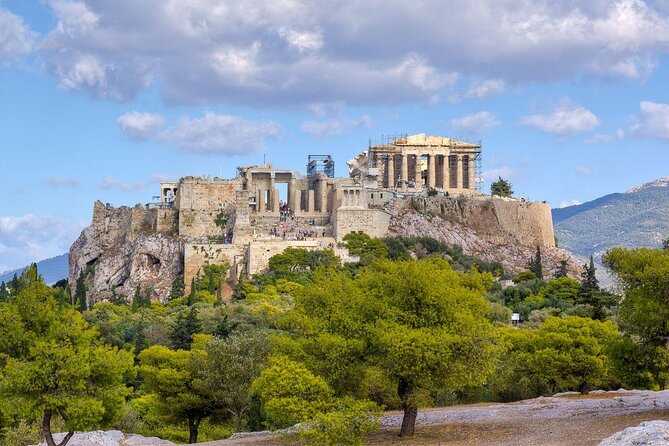
The route heads up the south slope of the Acropolis. This is the right approach for understanding the hill as more than a single monument. You will pass theaters, sanctuaries, gates, and temples before reaching the Parthenon.
The walk takes place on steep and uneven surfaces. Marble can be slick, especially on worn steps, and the afternoon sun can be fierce. One guide took extra care with older customers and adjusted the pace for someone recovering from spinal surgery. That is encouraging, but you still need a moderate level of fitness and shoes with a secure grip.
Shade is limited. A thoughtful guide may pause under trees where possible, but you should bring water, sun protection, and a hat. The route is not suited to someone who cannot manage stairs or uneven ground.
Theatre of Dionysus and the birth of drama
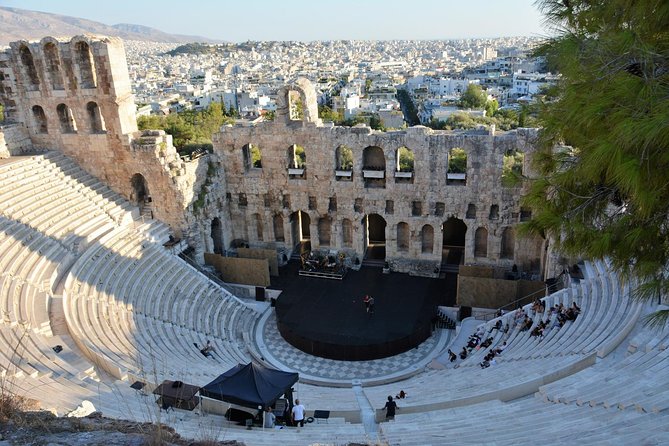
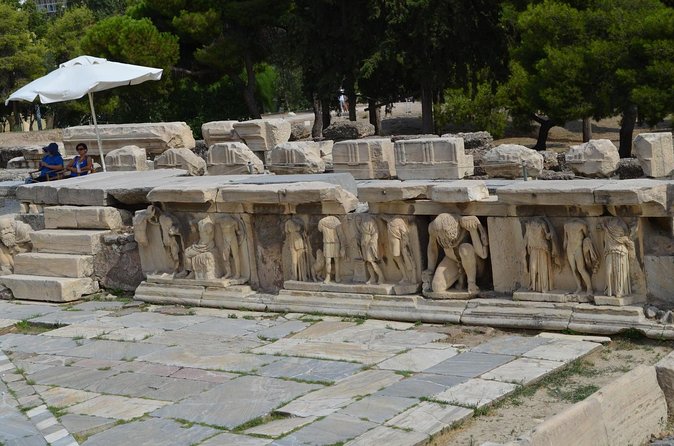
The Theatre of Dionysus sits at the foot of the Acropolis. It is often described as the world’s first theater, and its stone seating gives you a direct sense of how performance fit into public life in ancient Athens.
Your guide can point out the setting where works by Euripides, Sophocles, and Aeschylus were performed. Sit briefly if the route allows, and picture an audience watching tragedy or comedy below the Acropolis. This is one of the most human stops on the tour. The Parthenon is grand, but the theater helps you imagine the people who lived, argued, worshipped, and watched plays here.
The stop is short, listed at about 14 minutes. That is enough for an explanation and a look around, but not enough for a long independent exploration.
More Acropolis Museum visits:
- Athens: Acropolis, Parthenon & Acropolis Museum Guided Tour
★ 4.8 · 3,579 reviews - Acropolis monuments & Parthenon Walking Tour with Optional Acropolis Museum
★ 5.0 · 2,678 reviews - Athens All Included: Acropolis and Museum Guided Tour with Ticket
★ 4.5 · 2,673 reviews - Athens: Acropolis Museum Ticket with optional Audio Guide
★ 4.4 · 2,652 reviews
Odeon of Herodes Atticus and the south slope
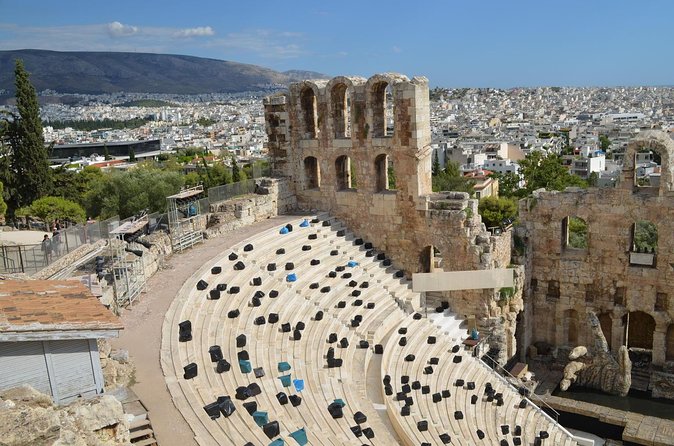
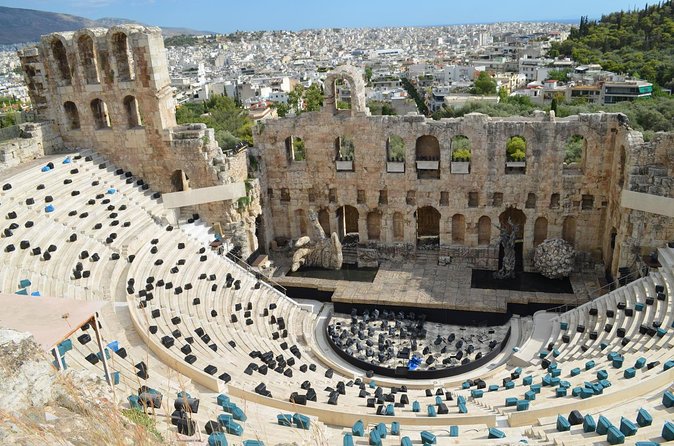
The Odeon of Herodes Atticus is a stone theater built in AD 161 and restored in 1950. Unlike most ancient structures on the hill, it still serves as a performance venue during the Athens Festival.
You will view it from the outside rather than attend a performance. Its steep seating and curved stone walls make a strong contrast with the open ruins above. Your guide can also explain the Asclepeion, a healing sanctuary once dedicated to Asclepius, the ancient god of medicine.
This section adds welcome variety. You are not simply moving from one temple to the next. You are seeing entertainment, medicine, religion, and civic life in the same compact area.
The Propylaea and Temple of Athena Nike
The Propylaea is the monumental gateway to the Acropolis. It was designed to make arrival feel important, and it still frames your first full view of the summit.
Nearby is the small Temple of Athena Nike, built around 420 BC. It is an early fully Ionic temple on the Acropolis and is easy to overlook beside the larger buildings. This is where a guide earns the fee. Without help, you might focus only on the Parthenon and walk past the smaller structure with little idea why it matters.
The itinerary allows about 15 minutes at the Propylaea and 15 minutes at Athena Nike. In practice, the exact pace depends on crowd levels, access conditions, and how many questions you ask.
The Parthenon, the tour’s main event
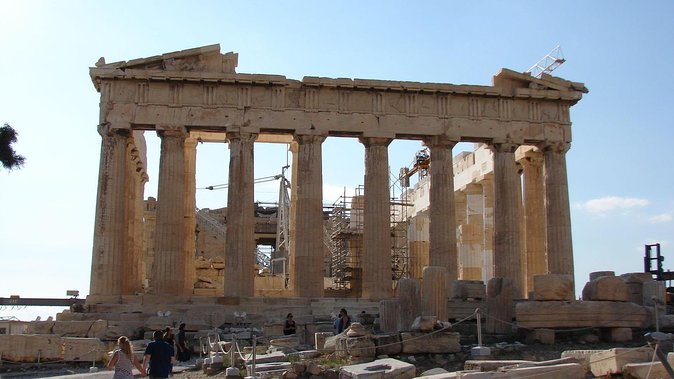
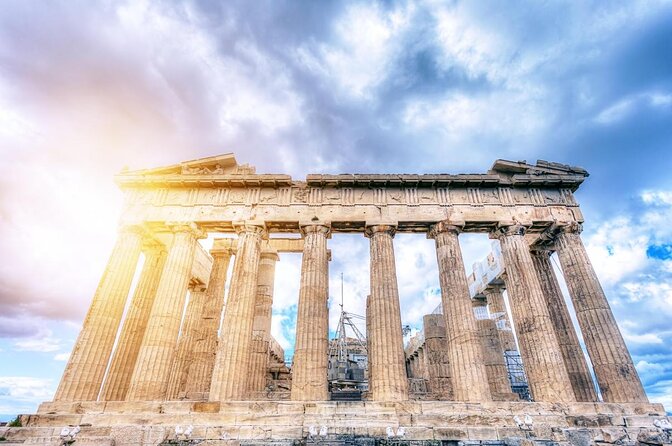
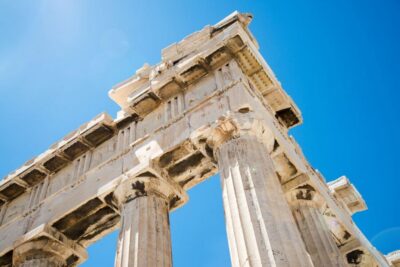
The Parthenon was begun in 447 BC, when Athens was at the height of its power. It was dedicated to Athena, the city’s patron goddess, and designed as a temple of remarkable balance and precision.
You will walk around the perimeter rather than enter the building. Your guide can point out the Doric design, surviving sculpture, later changes, and the long sequence of uses that followed. The Parthenon served as a temple, church, and mosque before suffering major damage.
Look closely at the details your guide identifies. The building is not simply a pile of ancient columns. Its proportions, optical refinements, and sculptural program were part of a carefully planned statement about Athens and its place in the Greek world.
The Parthenon stop is listed at about 30 minutes. That is enough for a guided circuit and photographs, but the crowd may limit where you can stand. Keep your expectations practical. You are viewing a famous ruin in a busy archaeological site, not entering an empty monument.
The Erechtheion and the Acropolis sanctuary
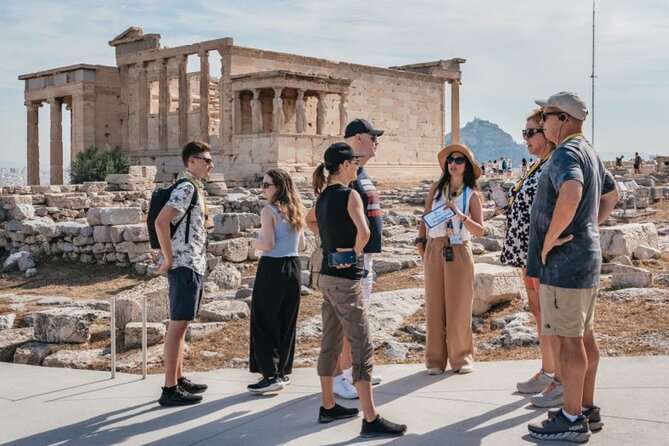
The Erechtheion sits on the north side of the Acropolis and was dedicated to both Athena and Poseidon. Its unusual design reflects the fact that this was a sacred area with several traditions and cults, not just a straightforward temple.
The building is especially memorable for its porch and sculpted female figures, although what you see at the site may include copies while originals are protected in the museum. This is one reason the two-part route works so well. The hill shows you the setting, while the museum lets you study the surviving pieces at close range.
The listed visit is about 14 minutes. You will not receive every detail of the sanctuary in that time, but a private guide can focus on the questions that interest you most.
Why the Acropolis Museum matters
The New Acropolis Museum is not an optional afterthought. It gives you the evidence needed to make sense of the hilltop.
Inside, you will see statues, friezes, architectural pieces, and other objects found on the Acropolis and its slopes. Glass floors reveal archaeological remains below the building, connecting the modern museum with the ancient settlement underneath. The galleries are light and open, a pleasant change after the exposed stone and glare of the summit.
The museum visit is listed at about 90 minutes. That is a useful introduction, though it is not enough to inspect every display in detail. One guide began with the museum so the group could see original pieces before viewing the buildings and copies outside. That is a smart teaching order, especially if you have little background in Greek art.
I like this part of the route because it turns admiration into understanding. You can see how fragments fit into the larger monuments, how sculptures were made, and how much of the Acropolis story survives beyond the famous columns.
Dinner with the Parthenon in view
The final meal takes place at a nearby restaurant, and the dinner option may include classic Greek dishes and a bottle of wine. Several guides have escorted groups to a rooftop restaurant where the Acropolis was visible at sunset or lit up after dark.
The meal has received mixed value judgments. Some groups describe generous multi-course meals, excellent lamb, friendly staff, and a memorable evening view. Others found the food only fair or felt the seating faced an elevator or stairwell rather than the advertised panorama. One group also had to remind the restaurant about the included bottle of wine.
That does not make dinner a bad choice, but it does mean you should see it as a convenient finish, not the main reason to pay for the tour. The view and the chance to sit down after the climb are valuable. The restaurant experience may be less consistent than the guiding.
The meal is listed as optional in the inclusions, so confirm whether your selected price includes dinner. If you choose it, ask what the set menu covers and verify the wine arrangement when you sit down.
Is $265.49 per person a fair price?
At $265.49 per person, this is an expensive Athens activity. The value depends heavily on your group size and on whether dinner and admission tickets are included in the exact package you select.
For two people, you are paying for a private licensed archaeologist, several hours of focused explanation, skip-the-line access, the Acropolis, the museum, and possibly dinner. That can be fair if you want a strong first introduction and would otherwise pay separately for tickets, a guide, and a meal.
For a larger family or group, the private format becomes more attractive because everyone shares one guide. Group discounts may also be available. For a solo visitor, the required minimum of two people means this is not the natural choice.
I would pay the premium for a first visit if you value context, dislike waiting, and want to ask many questions. I would skip it if you are happy reading your own guidebook, prefer a slower museum visit, or mainly want a rooftop meal. The dinner alone does not justify the price.
Timing, duration, and crowd levels
The advertised duration is approximately three to five hours. Some groups have finished in about four hours, while others received nearly five hours with a generous guide. The museum is listed at 90 minutes, the Acropolis at 90 minutes, and the remaining stops fill out the walking route.
Late afternoon can be a good choice. The stone may look especially warm, and the museum can be quieter than during the busiest part of the day. You still need to prepare for heat and crowds, particularly at the Acropolis itself.
Do not schedule a tight connection immediately afterward. The end point is the restaurant, and the actual finish can vary with walking speed, questions, museum time, and dinner service.
Who should book this tour?
This is a strong match for first-time visitors who want the main Athens sights explained in one connected outing. It also suits families, couples, and older visitors who would benefit from a private pace and help on the climb.
The tour is particularly useful if you want to understand Greek mythology, classical architecture, and the political meaning of the Acropolis rather than simply take photographs. Guides have also done well at keeping teenagers engaged, which is not a small achievement at an archaeological site.
Think twice if you have limited mobility, since the route includes stairs, slopes, worn marble, and uneven ground. Ask in advance about the pace and access arrangements. Also confirm the start point, hotel pickup, ticket coverage, dinner inclusion, and restaurant view before paying.
Should you book it?
Book this tour if you want a serious introduction to ancient Athens and prefer a private guide over a self-guided visit. The Acropolis and museum work better together, and the best guides turn the stones into a readable story.
I would be less eager to book the dinner upgrade if your main goal is Greek food. The meal can be pleasant and the nighttime Parthenon view can be lovely, but the food and seating are not always the strongest part of the package.
For most first-time visitors with the budget for it, the guiding is the real purchase. Confirm the practical details before departure, wear sturdy shoes, and leave enough time for the walk and meal. With those expectations, this is a well-planned way to meet Athens’ most important ancient sights.
FAQ
How long does the tour last?
The tour lasts approximately three to five hours. Some visits have run close to five hours, depending on the guide, pace, questions, and dinner arrangements.
Where does the tour start?
The stated meeting point is Porinou 5, Athens 117 42, near the Acropolis. The information also refers to meeting at the Athens Red Line ticket station, so check your confirmation for the exact location and time.
Is hotel pickup included?
Hotel pickup and drop-off are listed as not included. Some guides have met customers at their hotels, but you should confirm this directly rather than assume it is part of your booking.
Are entrance tickets included?
The package describes skip-the-line entrance tickets as included, while the stop details label admission as not included. Confirm the ticket coverage for your specific booking before the tour.
Is dinner included?
Dinner is listed as optional. Some packages include a Greek meal and wine at a nearby restaurant, so check the exact option you select.
Is this a private tour?
Yes. Only your group participates, and a minimum of two people per booking is required.
What level of fitness is needed?
You should have a moderate level of physical fitness. The route includes uphill walking, stairs, uneven surfaces, and worn marble at the Acropolis.
More Dining Experiences in Athens
- Madrid: Prado Museum & Lunch at World’s Oldest Restaurant
★ 4.8 · 73 reviews - Cairo: Giza Pyramids, Egyptian Museum & Nile Dinner Cruise.
★ 4.4 · 24 reviews
More Dinner Experiences in Athens
- Munich: Beer and Food Tour with Dinner & Oktoberfest Museum
★ 4.7 · 1,086 reviews - Bilbao: Guggenheim Museum Skip-the-Line Guided Tour & Dinner
★ 4.6 · 456 reviews - Bucharest: Dinner+Tour at Museum of Communism after closing
★ 4.9 · 46 reviews - Lima: Huaca Ruins and Larco Museum at Night with Dinner
★ 4.9 · 35 reviews
Just added around Athens
- Ancient Athens tour: Acropolis, Parthenon and Acropolis Museum★ 5.0 · 256 reviews
- The Acropolis, Athens Walking City Tour and Acropolis Museum★ 5.0 · 442 reviews
- Athens: Acropolis Museum Ticket with Self-Guided Audio tour App★ 3.5 · 40 reviews
- Family Acropolis & Acropolis Museum Tour inspiredby Percy Jackson★ 4.5 · 40 reviews
- Shore Excursion: Acropolis, Athens City tour and The New Acropolis Museum★ 4.5 · 30 reviews
- Athens National Archaeological Museum E-Ticket with Audio Guide★ 3.0 · 57 reviews
- Private Tour: Half day Athens Sightseeing and Acropolis Museum★ 4.5 · 28 reviews
- Private Tour Athens: Acropolis, Parthenon, Museum, Olympian Zeus★ 4.5 · 15 reviews
Museum Tours in Athens, compared.
Acropolis, Parthenon & Acropolis Museum Guided Tour
Read our review →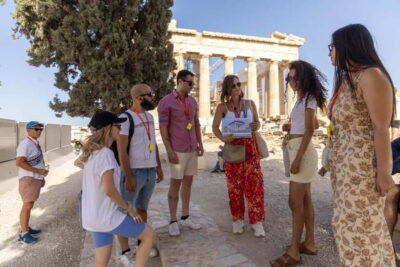
The Acropolis, Parthenon & Acropolis Museum Guided Tour
Read our review →Acropolis, Parthenon & Acropolis Museum Guided Tour
Read our review →
Acropolis monuments & Parthenon Walking Tour with Optional Acropolis Museum
Read our review →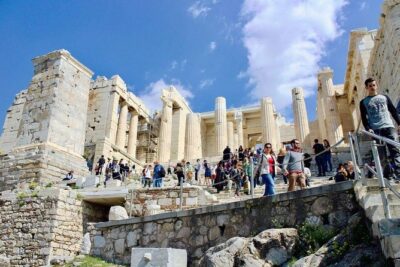
Athens All Included: Acropolis and Museum Guided Tour with Ticket
Read our review →
Acropolis Museum Ticket with optional Audio Guide
Read our review →
Small-Group Delphi, Museum & Arachova Day Trip
Read our review →
Delphi Oracle & Museum Tour with a Licensed Guide
Read our review →Browse the lists this tour appears in