
Review · SPAIN
Albarracín Monumental and Pérez Toyuela House Museum
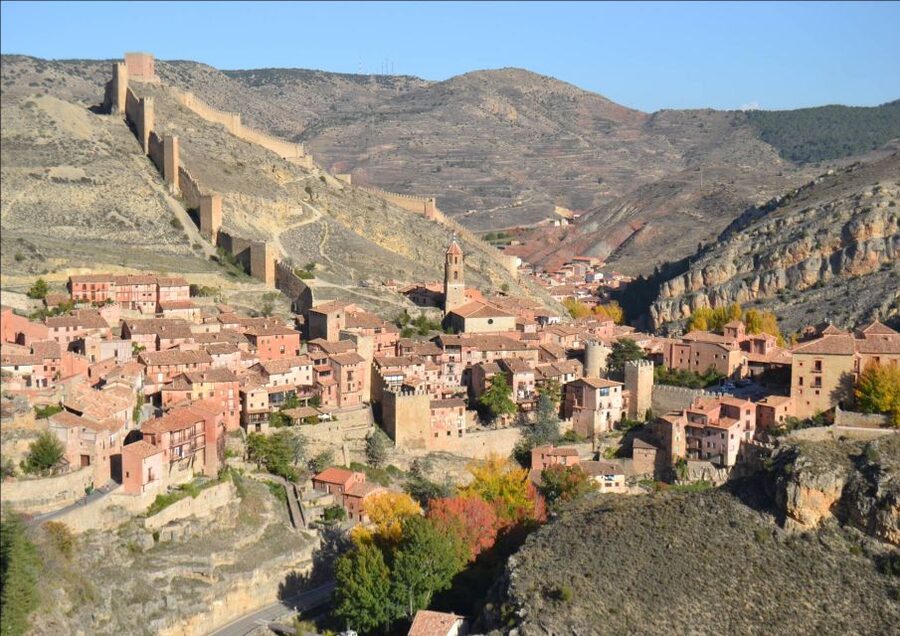
Albarracín’s narrow lanes and reddish stone houses are only half the story. This 90-minute walk takes you from the Plaza Mayor through the town’s medieval core and into the Pérez y Toyuela House Museum, an old family home filled with furniture, clothing, tools, toys, and everyday objects. It is a useful way to see both the grand façades and the domestic life behind them.
I like the clear local focus, especially the attention given to noble houses such as Casa Monterde y Antillón, Casa Navarro y Arzuriaga, Casa Azagra, and Pérez y Toyuela. I also like that the guide points out small architectural details, from wrought iron to pine eaves, rather than rushing from monument to monument. The main drawback is that the tour is Spanish only, and the walking route is not suitable for people with mobility impairments.
Key points
- A 90-minute walk through medieval Albarracín: Start in Plaza Mayor and follow the old streets, monuments, gates, and river viewpoints.
- The Pérez y Toyuela House Museum: See original furniture, household objects, clothing, toys, tools, and other traces of family life.
- Local official guides: Guides from Albarracín and Teruel lead the visit. Cristina and Lucía have received especially warm praise for their friendly, engaging approach.
- Noble homes and family history: Learn how prosperous families displayed status through coats of arms, balconies, ironwork, and carved details.
- Churches and city walls from outside: See Santa María, Santiago, the former Escolapios convent, the Cathedral, Virgen del Carmen, and the old gates.
- Good value at $10: The price includes the guide and museum admission, but not transport, food, or drinks.
Starting in Plaza Mayor, where Albarracín comes together
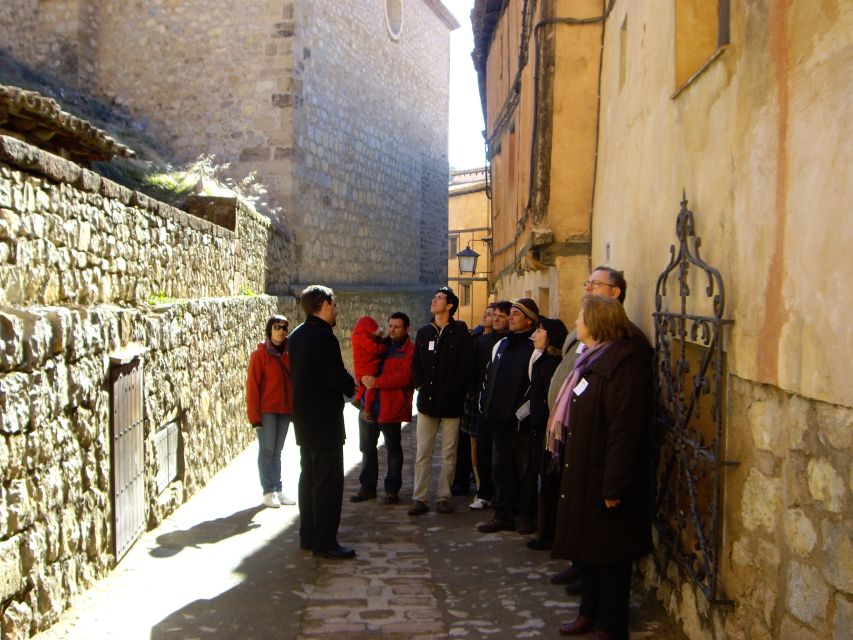
The tour begins in Plaza Mayor, the natural meeting point of Albarracín’s streets. This is where you receive a historical introduction before setting off through the old town. The square’s Renaissance town hall, corner balcony, and Castilian-style balconies give you an immediate lesson in the town’s visual language.
I find this a sensible starting point. Albarracín can feel like a maze, with lanes climbing, twisting, and narrowing without much warning. A short introduction here helps you understand the town before the route pulls you into its smaller corners.
The guide is local to the area and speaks Spanish. Cristina and Lucía are two guides who have been singled out for making the walk lively and easy to follow. Cristina is also known for sharing details about transhumance, the seasonal movement of livestock, which adds a useful connection between the town’s buildings and the rural life around it. The specific guide is not guaranteed, so book this experience for the local Spanish-led format rather than for one named person.
Albarracín has received major official recognition. It was declared a National Monument in 1961 and received the Gold Medal for Merit in Fine Arts in 1997. It has also been proposed for World Heritage status. Those labels matter less than what you see on foot, but they explain why the town’s old fabric has been preserved so carefully.
A few more museum visits around Spain worth comparing
- Madrid: Prado Museum Entry Ticket
★ 4.6 · 20,699 reviews - Barcelona: FC Barcelona Museum “Barça Immersive Tour” Ticket
★ 4.4 · 10,944 reviews - Madrid: Reina Sofía Museum Entrance Ticket
★ 4.5 · 8,788 reviews
Walking the lanes and spotting the homes people miss
The most enjoyable part of the route is often not a single monument. It is the walk between them. Albarracín’s houses sit tightly together, with irregular angles, wooden balconies, projecting upper floors, and warm-colored walls that make each turn look slightly different.
The guide draws attention to architectural details you could easily pass without noticing. Look for wrought-iron work, pine eaves, family coats of arms, and the ways upper stories extend over the street. These features tell you who had money, who wanted to display it, and how homes were adapted to a compact medieval town.
You will see the Casa de la Julianeta and the Rincón del Abanico, two of the town’s most recognizable examples of unusual domestic architecture. Casa Azagra is another important stop. These are not grand palaces in the usual sense. Their appeal comes from their shapes, tight placement, and connection to the old street plan.
The route also introduces houses linked to some of Albarracín’s important families. Casa de los Monterde y Antillón, Casa Navarro y Arzuriaga, and the Pérez y Toyuela house show how family identity was placed directly onto the town. A coat of arms was not simply decoration. It announced lineage and status to anyone passing by.
You should expect some uneven walking and changes in level. Comfortable shoes and practical clothing are important. The route is short, but a small town built on historic terrain does not behave like a flat city promenade.
The Pérez y Toyuela House Museum brings the town indoors
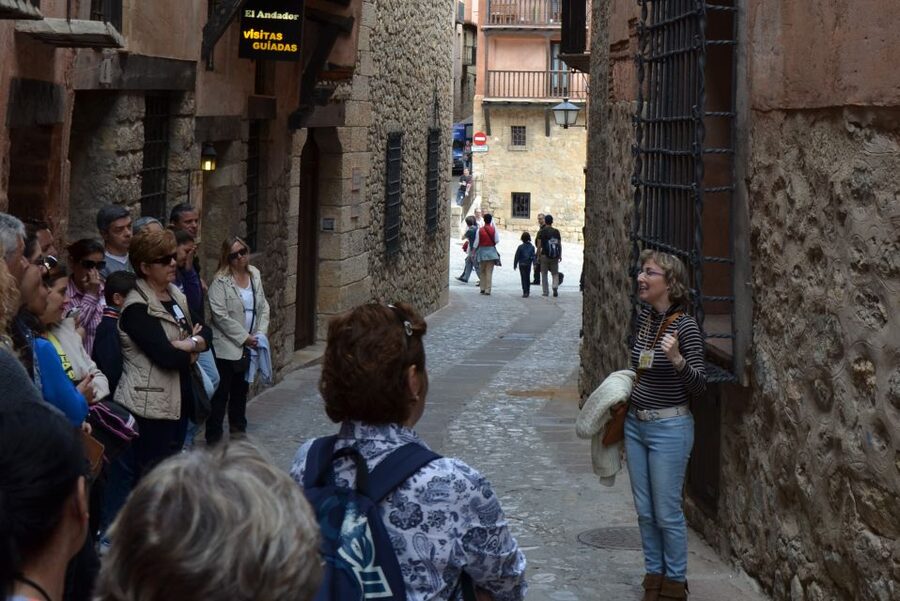
The museum is the most distinctive part of this experience. Without it, the tour would remain a well-guided look at façades, streets, and monuments. Inside the Pérez y Toyuela House, you get a more personal picture of how an old Albarracín family lived.
The house belonged to one of the city’s oldest and most important families. The preserved rooms contain original furniture, belongings, decoration, and clothing. You may also see objects such as toys, work tools, and a radio. These modest items can explain daily life more clearly than a coat of arms or a formal façade.
I like this contrast. The noble houses outside show public identity. The museum shows private routines. A family’s standing may have been announced by its architecture, but the objects inside reveal work, leisure, family life, and changing technology.
The museum is especially worthwhile if you enjoy social history rather than only grand monuments. A radio, a child’s toy, or a work tool can make the past feel more immediate than a formal date. One visitor described the old objects as the most interesting part of the experience, and I can understand why. They give the tour a human scale.
The museum visit is included in the $10 price. The description presents the interior as an optional addition to the walking tour, so check the exact format when booking if seeing the inside of the house is your main reason for going. The guide and museum admission are included, while food, drinks, and transportation are not.
Churches, convents, and the old Episcopal Palace
The route also passes several religious buildings, generally viewed from outside. These include Santa María, the Church of Santiago, the former Escolapios convent, the Cathedral, and the Church of Virgen del Carmen.
You should not book this tour expecting a full interior tour of every church. The focus is the town as a whole, with religious buildings forming part of the architectural story. Their locations help explain how Albarracín organized civic, noble, and religious life within a compact area.
The old Episcopal Palace is another important building on the route. Along with the noble homes, it shows the scale of wealth and authority available to certain families and institutions during the seventeenth and eighteenth centuries.
The guide also discusses legends connected with Albarracín. The information provided does not promise a separate storytelling session, so expect these tales to appear as part of the broader walk rather than as the sole focus. That balance suits the town. You get history, architecture, and local tradition without turning the whole visit into a theatrical performance.
One caution: the quality of a walking tour depends greatly on the guide’s delivery. Cristina and Lucía have been praised for being warm, clear, and entertaining. Another experience was less successful, with too many jokes and too little useful information. That mixed response is worth keeping in mind. The format is strong, but the tone may vary by guide.
Same city, a completely different collection:
- Barcelona: Park Güell and Gaudí House Museum Entry Ticket
★ 4.5 · 6,326 reviews - Seville: Puro Flamenco Show with Optional Museum Ticket
★ 4.8 · 6,088 reviews - Barcelona: Picasso Museum Skip-the-Line Guided Tour
★ 4.5 · 3,355 reviews - Moco Museum Barcelona: Modern & Contemporary Art
★ 4.6 · 3,229 reviews
Walls, gates, and views over the Guadalaviar River
Albarracín’s wall is one of the city’s defining features. It wraps around the old settlement and helps explain the town’s defensive shape. You will see the remaining original gates, including Portal de Molina and Portal del Agua, two of the four historic portals.
These gates are more than photo stops. They mark the points where the enclosed town connected with the outside world. As you move between them, you can better understand why the streets are narrow and why the settlement feels compact.
The route also includes views toward the Guadalaviar River. These outlooks provide a break from the close walls and twisting lanes. They show the town’s position in relation to the surrounding terrain without turning the experience into a long countryside walk.
I would bring your camera, but I would also pay attention to how the views relate to the buildings. The river, walls, and high houses are part of one story. Albarracín’s appearance comes from the way its setting shaped the town, not just from individual monuments.
Why the 90-minute length works
At 1.5 hours, this is a focused introduction rather than an all-day historical program. That length suits visitors who want context before exploring on their own. You get an organized route through the most notable areas, followed by the house museum, without giving up a large part of your day.
A short tour also helps with energy. Albarracín’s streets can be demanding, especially for anyone unused to uneven historic lanes. Ninety minutes is long enough to cover the main sights, but short enough to leave time for your own photographs, meals, or further wandering.
The tradeoff is depth. You will not receive an exhaustive study of every building, church, or family. The tour gives you a framework and highlights the key examples. If you want a detailed architectural survey, you may find the time limited. If you want to understand what you are looking at before exploring independently, the pace should work well.
The route is not suitable for people with mobility impairments. Comfortable shoes are essential, and comfortable clothing will make the walk easier. No transportation is provided, so you need to reach the meeting point in Albarracín yourself.
Is $10 a fair price?
At $10 per person, the value is strong because the fee includes both a local guide and entrance to the Pérez y Toyuela House Museum. You are paying for interpretation, not just access to a building.
The real value depends on how much you want an organized introduction. Albarracín is visually striking enough to reward independent wandering, but you can easily miss the meaning of a coat of arms, the role of a noble house, or the purpose of an old city gate. A guide connects those details and gives the streets a clearer shape.
The price does not include transport, food, or drinks. That is normal for a short town walk, but it matters if you are comparing the total cost of a day trip from elsewhere in Aragón. You will need to arrange your own way to Albarracín.
The booking terms are flexible. You can reserve now and pay later, and cancellation is allowed up to 24 hours before the start for a full refund. Availability determines the starting time.
Who should book this Albarracín tour?
I would recommend this experience to first-time visitors who want a clear introduction to Albarracín’s old town. It is also a good fit if you care about architecture, family history, traditional homes, or ordinary household objects.
You will get the most from it if you understand Spanish. The guide language is Spanish, and the quality of the explanation is central to the experience. If you do not speak Spanish, the buildings and views will still be attractive, but you may miss much of the historical content.
This is a sensible choice for visitors with limited time. The route covers the main visual highlights, adds a museum that you might not find on your own, and finishes within 90 minutes.
I would be more cautious if you have mobility limitations, dislike uneven streets, or want extensive interior access to religious buildings. The tour views the churches from outside and focuses on the town walk plus the Pérez y Toyuela House Museum.
Should you book it?
Book this tour if you want Albarracín explained by a local Spanish-speaking guide rather than simply photographed. The combination of Plaza Mayor, medieval lanes, noble houses, city gates, river views, and the Pérez y Toyuela interiors gives you both the public and private sides of the town.
The strongest reason to go is the museum. Original furniture, clothing, toys, tools, and household belongings make the history personal. The main caution is guide variation, along with the Spanish-only format and uneven route.
For $10, this is a practical, well-priced introduction to one of Aragón’s most distinctive historic towns. It works best as your first look at Albarracín, followed by your own slower walk through the streets.
FAQ
Where does the tour begin?
The tour begins in Plaza Mayor in Albarracín, where the guide gives a historical introduction before leading you through the old town.
How long does the experience last?
The tour lasts approximately 1.5 hours.
What language is the tour in?
The live guided tour is in Spanish.
Is the museum entrance included?
Yes. The entrance fee to the Pérez y Toyuela House Museum is included, along with the local guide.
What can I see in the Pérez y Toyuela House Museum?
The museum preserves original furniture, belongings, decoration, clothing, toys, work tools, a radio, and other household objects connected with the Pérez y Toyuela family.
Does the tour include transportation?
No. Transportation is not included.
Is food or drink included?
No. Food and drinks are not included.
Is the route suitable for people with mobility impairments?
No. The experience is not suitable for people with mobility impairments. Comfortable shoes and comfortable clothing are recommended.
Just added around Spain
- Girona, Figueres, Dalí Museum and Cadaqués Tour from Barcelona★ 4.5 · 36 reviews
- Football Club Barcelona Museum Immersive Tour Guided Visit★ 3.5 · 52 reviews
- Erotic Museum Admission Ticket with Audioguide★ 5.0 · 527 reviews
- Dali Museum and Costa Brava Small Group Day Trip from Barcelona★ 5.0 · 77 reviews
- Madrid by High-Speed Train with Prado Museum Private Tour★ 4.0 · 33 reviews
- Guitar Legends Hall: Entrance to the Immersive Rock Museum★ 5.0 · 25 reviews
- White Rabbit Museum: The Best Immersive Experience in Catalonia★ 5.0 · 538 reviews
- Private Dali Museum, Besalú & Girona Tour from Barcelona★ 5.0 · 15 reviews
Museum Tours in Spain, compared.
Park Güell and Gaudí House Museum Entry Ticket
Read our review →
Puro Flamenco Show with Optional Museum Ticket
Read our review →
Moco Museum Barcelona: Modern & Contemporary Art
Read our review →
Girona & Dali Museum Small Group Tour with Pick-up from Barcelona
Read our review →
Valencia: Oceanogràfic, Hemisfèric & Science Museum Combo
Read our review →Browse the lists this tour appears in