
Review · LONDON
London: Royal Museums Greenwich Day Pass
The most memorable moment here may be the simplest: put one foot east and one foot west on the Prime Meridian Line at Greenwich Observatory. Then look across London from the hilltop, where the City and the River Thames spread out below. This is part science lesson, part royal history, and part good old-fashioned photo stop.
I like the way the pass links two very different sights. Cutty Sark gives you a hands-on look at life at sea, while the Observatory explains the clocks and measurements that helped the world agree on time and position. I also like that The Queen’s House and the National Maritime Museum sit nearby, giving you more to see without another admission charge.
The catch is time. Six hours can cover the main sights, but only if you plan your order carefully. Greenwich Park is lovely, but the walk uphill to the Observatory can be demanding, and the displays at the Observatory can easily keep you there for several hours.
Key points at a glance
- Stand on the Prime Meridian: Place yourself in the eastern and western hemispheres at the Observatory’s Meridian Courtyard.
- See Harrison’s famous clocks: Learn how precision timekeeping changed navigation and global trade.
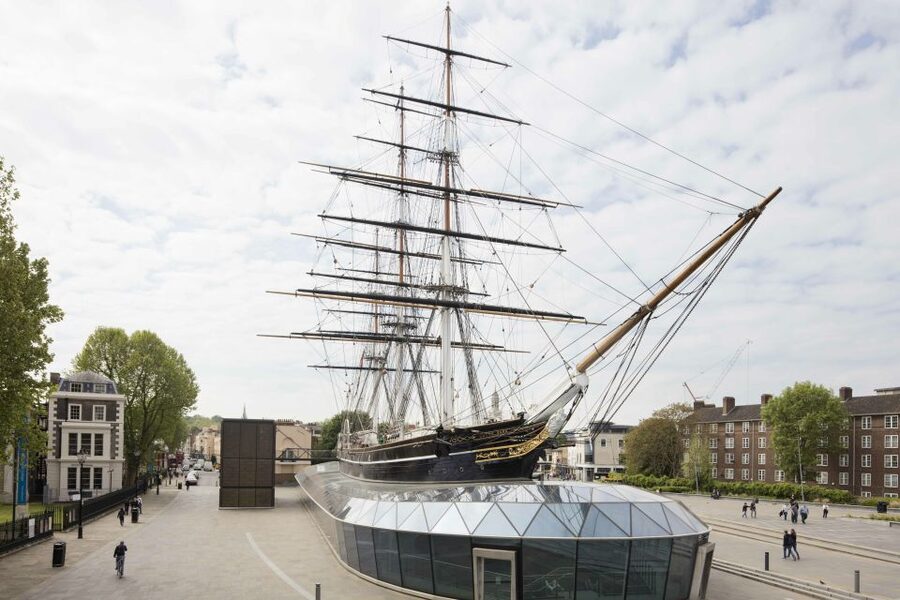
- Climb aboard Cutty Sark: Visit the sailors’ quarters, take the wheel, and walk the main deck beneath 11 miles of rigging.
- Add two major free museums: The Queen’s House and National Maritime Museum are included, except for special exhibitions and guided tours.
- Plan for a full day: The sights are close together, but the uphill walk and large museum interiors take time.
- Use the audio guide wisely: Downloadable commentary is available in English, Spanish, Chinese, French, German, Italian, Portuguese, and Korean.
Start high in Greenwich Park at the Royal Observatory

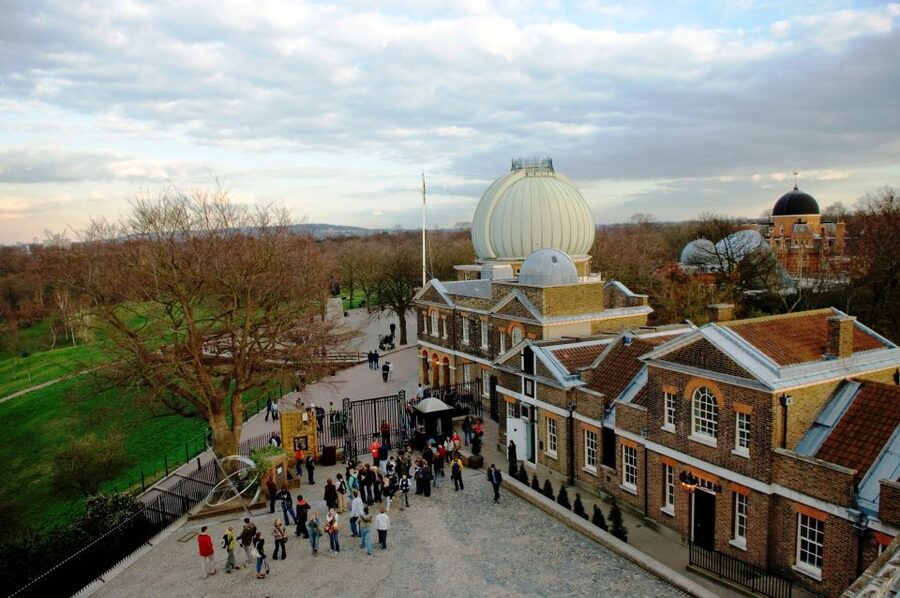
Begin at the Royal Observatory on Blackheath Avenue, high in Greenwich Royal Park. The approach is part of the outing. As you walk uphill, you get wide views toward the River Thames and the City of London, and the setting feels far removed from central London even though the capital is right in front of you.
The climb is not extreme, but it is more than a casual stroll. Several people have found the hill harder than expected, so give yourself time and wear comfortable shoes. The walk also matters for wheelchair users and anyone with limited stamina. The attraction is wheelchair accessible, but the route through the park should still be considered when planning your day.
Inside, pick up or use the downloadable audio guide. It is offered in eight languages, which makes the visit easier if you want more context than the labels provide. One practical warning: mobile reception and Wi-Fi can be weak at the site, so it is wise to prepare the guide before you need it.
More Museum Tours in London
- Tower of London and Crown Jewels Exhibition Ticket
★ 4.5 · 6,677 reviews - London: Chelsea Football Club Stadium and Museum Tour
★ 4.8 · 4,576 reviews - Chelsea FC Stadium Tours and Museum
★ 5.0 · 1,908 reviews
Put one foot in each hemisphere
The Meridian Courtyard is the Observatory’s most famous photo stop. The Prime Meridian Line marks longitude zero, the point used as the starting line for measuring east and west. Put one foot on either side and you are, at least for the photograph, in both hemispheres at once.
The line itself takes only a moment, but the idea behind it gives the visit purpose. Greenwich Mean Time became a worldwide reference point for clocks and navigation, and the Observatory helped set that standard. You are not just posing beside a painted stripe. You are standing at the place connected with a system that shaped modern travel, maps, shipping, and communication.
It can be busy around the line, especially when several people want the same photograph. Be ready to take your turn and move on. The Observatory has far more substance than this one picture, so do not let the Meridian become your entire visit.
Follow the Astronomers Royal through Flamsteed House
Flamsteed House is the oldest part of the Observatory and the place where you follow the work of the Astronomers Royal. The building connects the grand idea of Greenwich Mean Time with the daily work of observing the sky, recording measurements, and improving instruments.
The Octagon Room is one of the major highlights. Designed by Sir Christopher Wren, it is one of the best-preserved Wren interiors in London. The room is elegant rather than enormous, and its value comes from the details: the proportions, the windows, and the sense that astronomers once worked in a serious but surprisingly refined setting.
The displays introduce important figures linked with the Observatory, including John Harrison, Isaac Newton, Edmond Halley, James Bradley, Annie Maunder, George Airy, and Albert Einstein. You will not get an equally detailed biography of each person, but together they show how astronomy grew through better clocks, more exact observations, and new theories.
See the clocks that solved a major navigation problem

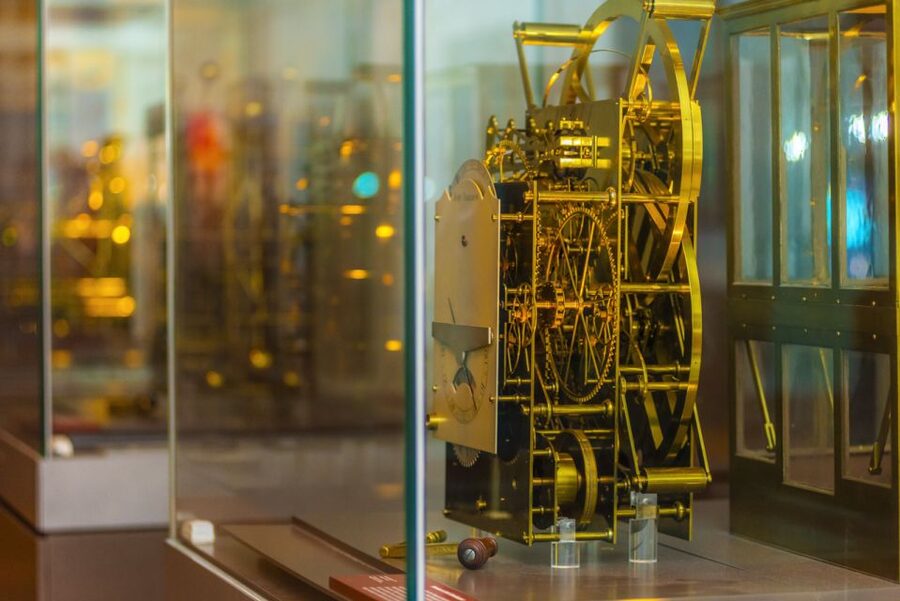
John Harrison’s clocks are among the most important objects at the Observatory. Before reliable marine clocks, sailors had great difficulty calculating their exact position east or west at sea. Harrison’s inventions made accurate timekeeping possible on long voyages, helping solve one of navigation’s great technical problems.
This is one of the places where the pass offers real value. You can see the machines rather than just read a short panel about them. The clocks are finely made, and the audio guide helps explain why precision mattered so much. If you like engineering, science, or the practical side of history, allow plenty of time here.
Outside Flamsteed House, look for the Shepherd Gate Clock. It was the first clock to show Greenwich Mean Time publicly. Above the building, the bright red Time Ball still operates. First used in 1833, it provided a visual time signal for people on the river and in the surrounding area.
These details reward a slower visit. The Observatory is not a quick photo attraction, and rushing through it can leave you with the Meridian Line but miss the reason Greenwich became important.
A few more museum visits around London worth comparing
- London: British Museum Guided Tour
★ 4.3 · 1,182 reviews - Official tickets: Moco Modern & Contemporary Art Museum
★ 4.5 · 1,157 reviews - British Museum London Guided Tour Semi-Private 8ppl Max
★ 5.0 · 984 reviews - London: Jack the Ripper Museum Tickets
★ 4.2 · 894 reviews
Look into the Great Equatorial Telescope

The huge onion dome is one of Greenwich’s most recognizable features. Inside sits the Great Equatorial Telescope, an instrument that gave astronomers new views of the universe more than a century ago.
The telescope makes the Observatory feel less like a historic house and more like a working place of scientific inquiry. You see the size and ambition of the equipment, along with the practical difficulties of aiming a large instrument at the sky. The dome itself is part of the appeal.
The Observatory is strongest for adults and older children who enjoy science, time, navigation, and historic technology. Younger children may appreciate the Meridian photo and the large telescope, but the visit has fewer hands-on tasks than some family attractions. If your children need constant activity, keep the Observatory portion focused and leave room for the more visual Cutty Sark.
Walk downhill to Cutty Sark
From the Observatory, head downhill toward King William Walk and Cutty Sark. The sites are near one another, but Greenwich feels larger once you walk between them. Build in time for the descent, a pause in the park, or a quick meal in the area.
Cutty Sark is the only surviving tea clipper, launched in 1869 for the China tea trade. The ship’s design reflects the speed race of the period, when quick passage times mattered commercially. Her original wooden planks and iron frames have been carefully conserved, allowing you to see both the graceful shape of the ship and the tough structure that kept her afloat.
The ship has been raised more than three meters above the ground as part of a major conservation project. That gives you a rare view from underneath. Look up at the hull and you can understand the clean lines that helped make this vessel a celebrated long-distance sailor.
Take the wheel and explore life at sea
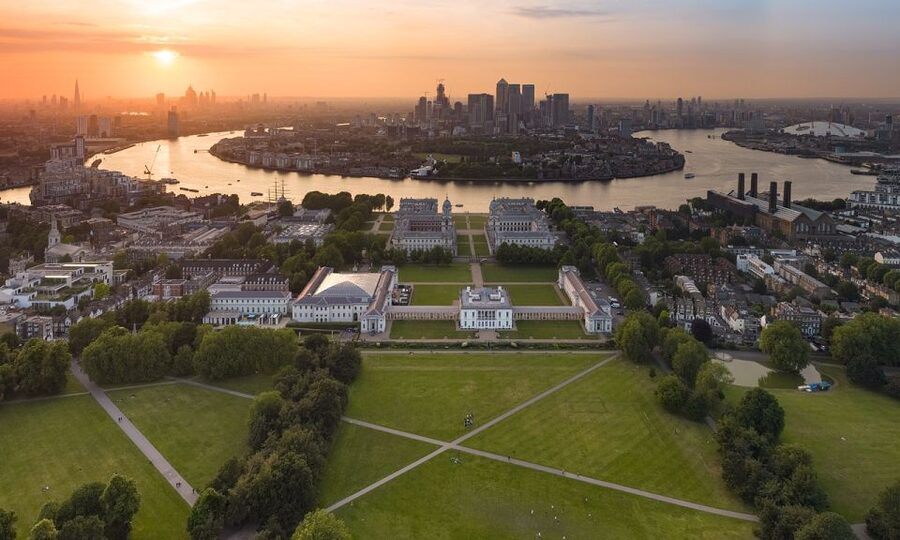
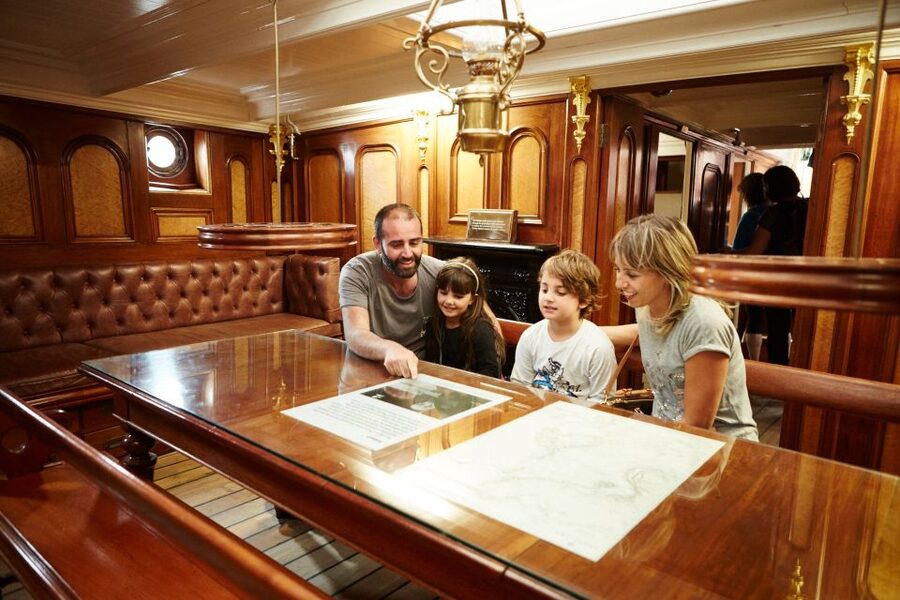
Cutty Sark is the more immediately entertaining half of the pass. You can walk the main deck, visit the sailors’ quarters, and take the helm at the ship’s wheel. The layout helps you picture the difference between the ship’s public working areas and the cramped spaces where the crew lived.
The deck is also the place for the best river views. Look across the Thames and back toward Greenwich, then up at the masts and 11 miles of rigging. The scale is impressive, and the ship feels more understandable when you see how much equipment had to be managed by hand.
I would make Cutty Sark a priority if you have children or only a few hours. It has more obvious visual appeal than the Observatory, and you can see the main features in less time. It is also the safer first stop if you want to guarantee entry before spending hours at the other sites.
That advice comes from a real timing problem. The Observatory, Queen’s House, and Maritime Museum can absorb most of a day. If you visit them first, you may reach Cutty Sark too late for admission. All four sites open at 10 AM and close at 5 PM, with last entry at 4 PM.
Add The Queen’s House for art and architecture
The Queen’s House sits between the Observatory and Cutty Sark. Designed by Inigo Jones, it is an important piece of 17th-century architecture and a much quieter contrast to the ship and the scientific displays.
Inside, you will find art, royal connections, and carefully designed rooms. The focus is not maritime technology or astronomy, so it may appeal more to you if you enjoy paintings and architecture. If art galleries are not your main interest, a shorter visit still makes sense because the building is close and admission is free.
Do not treat it as a required long stop. The Queen’s House is included in your day by location rather than by the paid pass itself. Special exhibitions and guided tours may cost extra, but general entry is free.
Leave time for the National Maritime Museum
The National Maritime Museum is described as the largest museum of its kind in the world. Its subject is broad: exploration, seafaring, navigation, trade, and the people whose work at sea helped shape the modern world.
This is the place where the story widens beyond one ship. Cutty Sark shows you one vessel and its crew. The National Maritime Museum gives you the larger setting, explaining how sea travel affected Britain and the wider world.
You can enter the general museum without an extra charge. Special exhibitions and guided tours are not included, so check the details if a particular temporary display interests you. Since the museum is large, do not try to see every room in a single hurried sweep. Choose the areas that match your interests and keep enough energy for the other sites.
Is the $40 pass good value?
At $40 per person, the pass is mainly paying for admission to the Royal Observatory and Cutty Sark. The National Maritime Museum and The Queen’s House are free in their standard form, so the value depends on how much you want to see at the two paid attractions.
For a visitor who plans to visit both, the pass is convenient and can save you from arranging separate tickets. It also turns Greenwich into a clear six-hour plan. You can start with science and time, walk downhill to maritime history, then add art and a larger museum as your energy allows.
The value is weaker if you only want one paid attraction. The Observatory alone can fill much of your visit, especially if you stop at the clocks, Flamsteed House, telescope, and historic rooms. Likewise, Cutty Sark can be a satisfying shorter visit by itself, followed by the free museums.
I would not buy the pass simply because it includes four names. I would buy it if you specifically want both the Observatory and Cutty Sark. If you are undecided, ask yourself which one matters more. The Observatory suits science, astronomy, clocks, and grand views. Cutty Sark suits ships, design, family interest, and a more physical visit.
A practical plan for your six hours
Here is a sensible order if both paid attractions are priorities:
- Arrive close to 10 AM and go first to Cutty Sark if you want to guarantee that visit.
- Walk to the Royal Observatory and allow time for the Meridian Courtyard, Flamsteed House, clocks, Octagon Room, Time Ball, and telescope.
- Stop for food or a drink in Greenwich, since meals are not included.
- Visit The Queen’s House and the National Maritime Museum with the time you have left.
- Keep an eye on the 4 PM last-entry time, not just the 5 PM closing time.
An alternative is to begin at the Observatory while your energy is fresh, then go downhill through The Queen’s House to Cutty Sark. This works well if astronomy is your main interest, but it creates the risk of reaching the ship too late. The choice depends on which attraction you would regret missing.
You should also expect plenty of walking. The park, hill, museum buildings, and route between the sites add up. The setting is beautiful, but this is not a sit-down tour with a guide leading you from door to door.
Who should book the Greenwich day pass?
I recommend it for first-time visitors who want a full Greenwich day with a mix of science, architecture, ships, and city views. It is especially good for families with older children, couples with different interests, and anyone who prefers to explore at a personal pace with an audio guide.
It is also useful if you dislike planning each admission separately. The pass gives your day a simple shape, and the nearby free museums provide flexibility if you finish one attraction early.
I would be more cautious if you have limited mobility, very young children, or only a few hours. The pass is wheelchair accessible, but the walk up through the park deserves attention. For a short visit, choose either the Observatory or Cutty Sark rather than trying to force all four places into a rushed schedule.
Should you book it?
Book the pass if you want both the Royal Observatory and Cutty Sark, and set aside most of a day. The strongest parts are the Prime Meridian, Harrison’s clocks, the Great Equatorial Telescope, and the chance to walk aboard a genuine 19th-century clipper.
Skip the pass if you mainly want the free museums or if you would rather explore one attraction slowly. The smartest plan for most people is to protect time for Cutty Sark and the Observatory, then use The Queen’s House and the National Maritime Museum as flexible extras. That gives you the best balance of memorable sights, useful history, and value for the $40 cost.
FAQ
How long does the Royal Museums Greenwich day pass last?
The stated duration is six hours. Since the sites open at 10 AM and close at 5 PM, with last entry at 4 PM, plan your route carefully.
What attractions are included?
The pass includes entrance to the Royal Observatory and Cutty Sark. It also provides access to The Queen’s House and the National Maritime Museum, except for special exhibitions and guided tours.
Are The Queen’s House and National Maritime Museum free?
General entry to both is free. Special exhibitions and guided tours may require an additional charge.
Where does the visit begin?
The Royal Observatory is on Blackheath Avenue in Greenwich Royal Park, London SE10 8XJ. Cutty Sark is on King William Walk, London SE10 9HT.
Is an audio guide included?
Yes. A downloadable multilingual interactive guide is available in English, Spanish, Chinese, French, German, Italian, Portuguese, and Korean.
Is the experience wheelchair accessible?
Yes, the activity is listed as wheelchair accessible. The walk through Greenwich Royal Park includes an uphill route to the Observatory, so consider that when planning your visit.
Can I cancel the booking?
You can cancel up to 24 hours in advance for a full refund. A reserve now and pay later option is also available.
Just added around London
- Westminster and National Gallery 3.5-Hour Tour in Italian★ 4.9 · 28 reviews
- British Museum & Camden Town – Private Tour in Italian★ 4.8 · 26 reviews
- London: British Museum Highlights Guided Small Group Tour★ 4.9 · 113 reviews
- London: Westminster Abbey & Jubilee Galleries Guided Tour★ 4.9 · 56 reviews
- London: Sherlock Holmes Museum & Westminster Walking Tour★ 4.4 · 13 reviews
- London: Tickets for Moco Modern & Contemporary Art Museum★ 4.7 · 391 reviews
- London: The Courtauld Gallery at Somerset House Entry Ticket★ 4.6 · 126 reviews
- London: Twist Museum Ticket★ 4.4 · 66 reviews
Museum Tours in London, compared.
Tower of London and Crown Jewels Exhibition Ticket
Read our review →
Chelsea Football Club Stadium and Museum Tour
Read our review →

Official tickets: Moco Modern & Contemporary Art Museum
Read our review →
British Museum London Guided Tour Semi-Private 8ppl Max
Read our review →
British Museum Guided Tour with Entrance Tickets
Read our review →Browse the lists this tour appears in