
Review · FLORENCE
Leonardo Interactive Museum® Entrance Ticket
Leonardo’s drawings can look like clever sketches on a page. Here, many become full-size working machines you can touch, turn, test, and puzzle over. I like the bridge-building stations and the flying-machine displays best because they make Leonardo’s ideas easier to grasp than a wall of text ever could.
I also like the compact layout and the clear descriptions in six languages. It is easy to fit into a busy Florence day, and the cool, air-conditioned rooms offer a welcome break in hot weather. The catch is that the museum is small, and crowding can make the hands-on stations hard to reach.
Key points before you book
- Working replicas based on Leonardo’s drawings: Test machines connected to flight, mechanics, water, earth, and fire.
- Hands-on for children and adults: Build models, solve mechanical puzzles, and try selected inventions yourself.
- More than engineering: See sections on anatomical studies and high-resolution reproductions of Leonardo’s major paintings.
- Compact visit: Plan on about one hour to one and a half hours, though some families spend closer to two hours.
- Useful multilingual information: Exhibits and descriptions are available in Italian, English, French, German, Spanish, and Russian.
- Best during a quieter time: Timed entry helps control numbers, but the rooms can still become noisy and crowded.
Leonardo’s ideas become machines you can touch
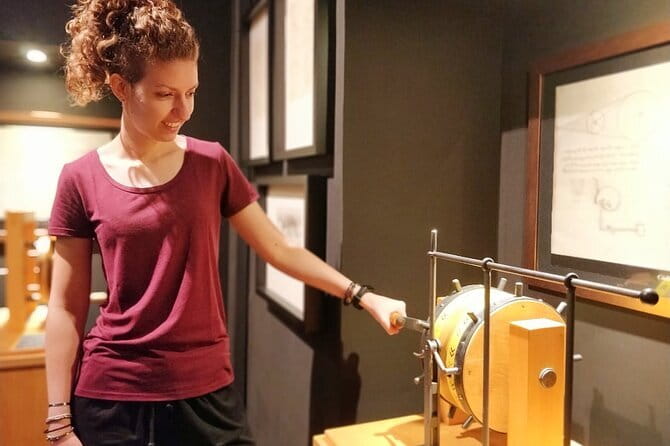
The main appeal here is simple: you do not just look at Leonardo da Vinci’s inventions. You get a chance to understand how they work.
The museum is organized around four forces and materials: earth, water, air, and fire. The divisions give the collection a clear theme, though you should not expect a carefully staged chronological biography. This is an exhibition of ideas and mechanisms more than a formal museum of Leonardo’s life.
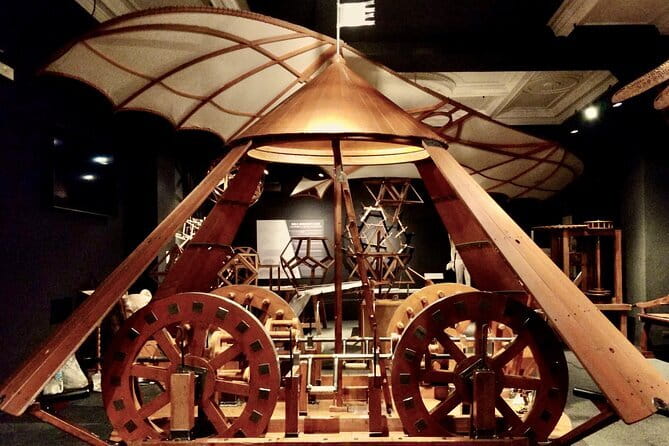
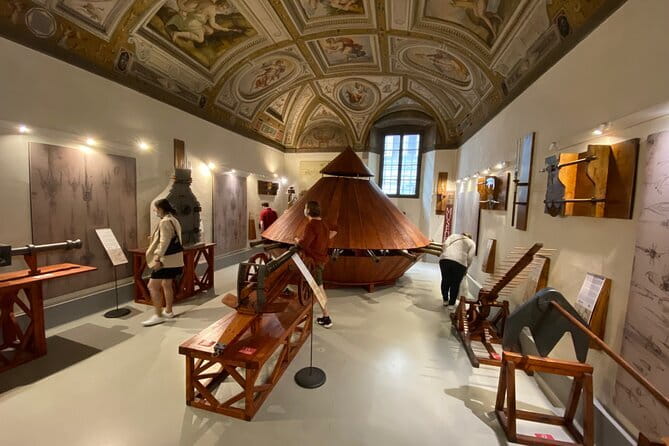
Many machines were built from Leonardo’s designs, with some made to scale where possible. That detail matters. A sketch of a bearing, bridge, or flying device can seem abstract, especially to a child. A physical model shows what moves, what supports weight, and where an idea might fail.
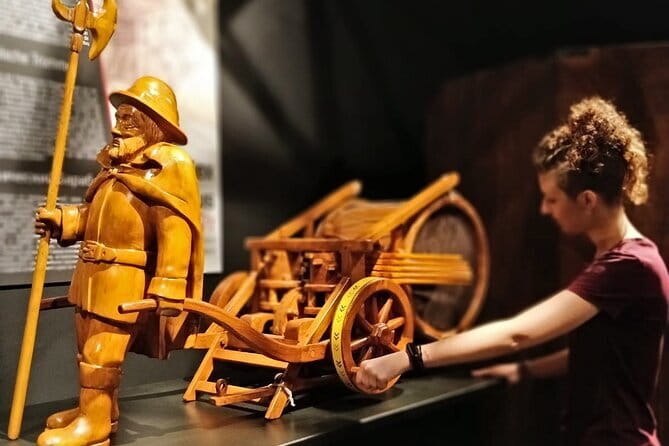
You may be able to turn wheels, operate levers, examine gears, and try model-building stations. The exact condition of each interactive piece can vary. Some machines have clearly seen heavy use, and not every invention will feel equally smooth or active.
That is part of the practical tradeoff. The museum is designed to be handled, not simply admired behind glass. A popular hands-on exhibit can become worn, crowded, or temporarily less responsive. Still, the chance to test the mechanism is the reason to come.
More Museum Tours in Florence
- Florence: Skip-The-Line Uffizi Gallery Timed Entry Ticket
★ 4.5 · 27,832 reviews - Florence: Leonardo Interactive Museum Entry Ticket
★ 4.5 · 12,957 reviews - Florence Accademia Gallery Tour with Entrance Ticket Included
★ 4.5 · 6,148 reviews
Four sections built around earth, water, air, and fire
The four-part arrangement is a useful way to approach the exhibition. It connects Leonardo’s engineering to natural forces rather than placing a long list of unrelated inventions in front of you.
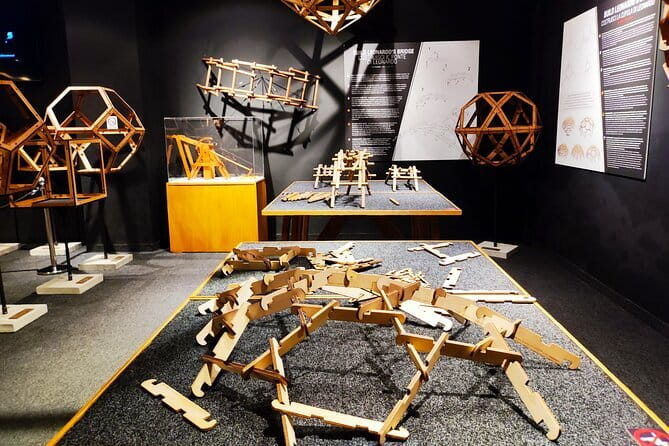
The earth section deals with machines and structures that depend on weight, balance, construction, and movement across land. This is where the logic of bridges and mechanical devices becomes especially easy to see.
The bridge-building stations are a highlight for families. You can work with others to put together a bridge or a three-dimensional model, then see how a few simple pieces can create a strong structure. It is a small lesson in engineering, but a memorable one because your hands do the work.
The water section explores the force and movement of water. Leonardo’s studies of channels, flow, and water-powered mechanisms show how closely his art, science, and observation were linked.
The air section is likely to catch the eye first, especially if you arrive with children. Flying machines and other attempts to understand flight reveal both Leonardo’s imagination and the limits of his materials. Seeing a replica in front of you helps you ask a better question than simply Was he right? You begin to see which parts of the design anticipate modern engineering and which parts needed much more development.
The fire section completes the broad picture with machines connected to force, heat, and mechanical action. You do not need an engineering background to enjoy this area. The labels and models are meant to give you a starting point, and the physical design does much of the explaining.
A hands-on visit that works best with children
This is one of Florence’s stronger choices for families who need a break from paintings and churches.
Children can touch selected machines, try puzzles, build models, and see cause and effect immediately. The experience is especially suitable for school-age children and teenagers, but younger children can also enjoy the moving parts with close supervision.
I would not treat the museum as a place where children can wander without attention. The rules require children to be supervised, and anyone who risks damaging the exhibits or disturbs other people can be asked to leave.
Adults who enjoy engineering, design, or the practical side of history should have plenty to examine. If you already know Leonardo’s mechanical work well, some displays may add little new information. The pleasure then comes less from discovery and more from seeing familiar drawings made into physical objects.
The museum can also work well for a mixed-age group. Grandparents, parents, and children can tackle a model together rather than splitting up according to age. That shared activity is a real strength, since everyone has something to do.
Leonardo’s anatomy and paintings add needed balance
The machines are the main reason to visit, but the museum is not limited to engineering.
A separate section presents some of Leonardo’s anatomical studies. These drawings show his close attention to the human body and remind you that his curiosity went far beyond machines. They also help connect the practical models to the artist who made them.
A gallery displays reproductions of important Leonardo paintings using high-resolution backlight technology. These are not the original works, so you should not compare this visit with seeing an original masterpiece in a major gallery. Still, the reproductions give the exhibition a broader sense of Leonardo’s work.
This balance is useful. If you only see the machines, you may leave thinking of Leonardo as an inventor who also happened to paint. The anatomy drawings and painting gallery show a person who studied the world from many angles, with art and observation working together.
The reproduced works are particularly helpful if you are already visiting Florence for its art. They give you a short look at Leonardo’s artistic side without asking you to spend several hours in a large gallery.
A few more museum visits around Florence worth comparing
- Florence: Uffizi Gallery Timed Entry Ticket & Audio Guide
★ 4.2 · 2,794 reviews - Florence: Accademia Gallery Guided Tour with Entry Ticket
★ 4.6 · 2,253 reviews - Florence: Uffizi Gallery Small-Group Guided Tour with Ticket
★ 4.7 · 2,003 reviews - Florence: Accademia Gallery & David Skip-the-Line Ticket
★ 4.6 · 1,905 reviews
How long to allow, and why the museum’s size matters
The stated visit time is about one hour to one and a half hours. That is a sensible plan if you want to see the main displays and try several machines.
Families who stop at most of the interactive stations may need closer to 90 minutes or even two hours. Your pace will depend on how crowded the rooms are and how long you wait to use each exhibit.
The museum is compact. That is good news if you have a full Florence schedule, but it also means the attraction can feel smaller than photographs suggest. Do not book this expecting a vast science center or a full-day museum.
A short visit can be a benefit. You can place it between major sights, use it as a cooling stop, or bring children here when everyone needs something more active than another church interior.
The small footprint has one drawback: when several groups arrive together, there is not much spare room around the displays. A timed entry may limit the number of people, but it does not guarantee a quiet visit. Crowding and noise can make it difficult to reach a machine or listen to an audio explanation.
If you want to read every label and test every mechanism, allow extra time and accept that you may need to wait. If you are mainly looking for a lively introduction to Leonardo, one hour may be enough.
Information in six languages, with no guide required

You can visit independently, with no guided tour included. That suits me because I can spend more time at the machines that interest me and move quickly past displays that feel familiar.
Written descriptions are available in Italian, English, French, German, Spanish, and Russian. This makes the museum easier to use for international families and mixed-language groups.
Multimedia displays provide more information about Leonardo’s life and work. Audio or multimedia material may be harder to follow when the rooms are noisy, so you may find it easier to read the labels first and use the extra material when the surrounding area is calmer.
There is no guide to connect the exhibits into a single story. That gives you freedom, but it also means you need to create your own order. The exhibition is not arranged as a clear timeline of Leonardo’s life, so visitors who want a traditional historical narrative may find it less satisfying.
I suggest giving yourself a simple focus before entering. You might look for how Leonardo studied flight, how he used balance and leverage, or how his observations of nature influenced his machines. That small goal can make the self-led visit feel more purposeful.
The practical value of the $11.95 admission
At $11.95 per person, the ticket is reasonably priced for Florence, especially if you are visiting with children and want an activity that occupies about 60 to 90 minutes.
The value depends on how much you use the interactive displays. If you only make a quick circuit and avoid the machines because of crowds, the price feels less attractive. If you build models, test mechanisms, read the explanations, and spend 90 minutes inside, it becomes a better buy.
Prebooking gives you a reserved admission and skip-the-line entry without added commissions or extra costs. That matters in Florence, where even a modest attraction can fit awkwardly into a packed day. It also protects your planned visit during busy periods.
There is free admission for children under five, which helps families. Food, drinks, and chewing gum are not allowed in the exhibit areas, so plan snacks before or after your visit.
The museum also has bathrooms and a shop selling books and souvenirs. The shop is a useful place to browse if you want a book about Leonardo’s machines or a small reminder of the visit, though you should not treat it as part of the admission value.
Finding the entrance and planning your timing
The museum is near public transportation, making it practical to reach within central Florence. Check the exact meeting and entrance details carefully before setting out. Confusion can arise if the ticket information points you toward one nearby location while the actual museum entrance is elsewhere.
I would not leave this attraction to the last few minutes before another booking. Give yourself time to confirm the address, reach the entrance, and pass through admission.
Because the museum is popular, booking about two weeks ahead is common. You may find openings closer to your date, but advance booking is sensible if your Florence schedule is tight.
The rooms are fully air-conditioned. In summer, this is more than a minor comfort. The museum can serve as a useful midday pause between outdoor sights, though the cool rooms may not compensate for a crowded exhibit area.
Free cancellation is available if you cancel at least 24 hours before the scheduled start time. Changes or cancellations made inside that window are not accepted for a refund.
Who will enjoy it most, and who may want something else
I would recommend this experience to:
- Families with school-age children and teenagers
- Adults interested in machines, design, or science
- Visitors who want a short break from traditional art museums
- Leonardo fans who want to see physical versions of his ideas
- People who enjoy self-guided attractions
- Mixed-age groups looking for an activity everyone can share
You may want to skip it if you are looking only for original artworks. The paintings are reproduced, and the main attraction is the engineering display.
You may also be disappointed if you expect a large museum with a formal chronological route. The exhibition is compact and can be difficult to follow as a biography of Leonardo. Its strength is the direct, hands-on look at his designs.
Crowds are the biggest variable. At a quiet moment, the museum can be playful and absorbing. At a busy moment, you may spend much of your time waiting, squeezing around other people, or trying to read labels over someone’s shoulder.
Should you book the Leonardo Interactive Museum?
Book it if you want to see Leonardo’s ideas in action, especially with children. The bridge-building, model-making, and working mechanisms give the museum a clear purpose, and the price is fair for a compact Florence activity.
Go with realistic expectations. This is not a major gallery, the rooms can become noisy, and some interactive machines may show signs of heavy use. But if you enjoy learning by trying things yourself, the visit offers more than a collection of static displays.
For most families, curious adults, and Leonardo enthusiasts, I would make room for it. Choose a quieter time if possible, confirm the exact entrance, and allow at least 90 minutes if you want to use the machines rather than simply walk through.
FAQ
How long does the Leonardo Interactive Museum visit take?
The expected visit lasts about one hour to one hour and 30 minutes. If you want to try most of the interactive stations and build models, you may prefer to allow up to two hours.
Is the museum suitable for children?
Yes. The exhibition is designed for children and adults, with hands-on machines, puzzles, and model-building activities. Children must be supervised at all times.
Are the exhibits explained in English?
Yes. Exhibit descriptions are offered in Italian, English, French, German, Spanish, and Russian. Multimedia displays also provide further information about Leonardo’s life and work.
Is a guided tour included?
No. This is a self-led admission ticket, so you explore the museum at your own pace without a guide.
Are children under five charged admission?
No. Children under five receive free admission.
Can I cancel the ticket for a refund?
Yes, if you cancel at least 24 hours before the experience start time. Cancellations or changes made less than 24 hours before the start time are not accepted for a refund.
Just added around Florence
- Timed Entry Ticket to the Uffizi Gallery★ 4.5 · 498 reviews
- Florence: Accademia Gallery Entry Ticket with Audio Guide★ 4.1 · 88 reviews
- Florence: Skip-the-Line Tour of Uffizi & Accademia Galleries★ 4.4 · 14 reviews
- Florence: Skip-the-Line Accademia Gallery Entry Tickets★ 4.3 · 44 reviews
- Florence: Walking Tour with Skip-the-Line Accademia Gallery★ 4.6 · 148 reviews
- Florence: David’s Accademia Gallery Guided Tour★ 4.2 · 207 reviews
- Florence: Uffizi Gallery Private Tour w/ Skip-the-Line Entry★ 4.9 · 24 reviews
- Florence: 2-Hour Private Guided Visit to the Uffizi Gallery★ 4.8 · 15 reviews
Museum Tours in Florence, compared.
Skip-The-Line Uffizi Gallery Timed Entry Ticket
Read our review →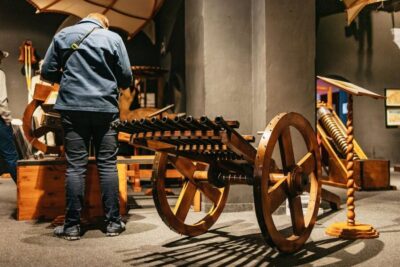
Florence Accademia Gallery Tour with Entrance Ticket Included
Read our review →
Uffizi Gallery: Renaissance Masterpieces Guided Tour
Read our review →
Uffizi Gallery Timed Entry Ticket & Audio Guide
Read our review →
Browse the lists this tour appears in