

Review · FLORENCE
Florence: Timed Entrance Ticket to San Marco Museum
San Marco Museum gives you something Florence’s biggest museums often cannot: quiet. Inside the 15th-century Dominican convent, Fra Angelico’s religious paintings and frescoes appear in the very rooms where friars once lived, prayed, and worked. You also see the cell of Girolamo Savonarola, the fiery preacher who challenged the corruption of the clergy.
I like the intimate scale and the chance to see a working Dominican monastery rather than only a grand palace turned museum. I also like the timed entry, which lets you skip the ticket line and spend a calm hour or two with some of Florence’s finest religious art. The main drawback is that this ticket includes no guide or audio guide, and some displays may have limited English information.
Key points to know before you go

- Fra Angelico’s Annunciation: This famous painting alone can justify the visit for anyone interested in Renaissance art.
- A living Dominican convent: Monks still occupy parts of the complex, giving the building a quiet, working-monastery feel.
- Savonarola’s cell: See the small room connected with Florence’s controversial preacher and reformer.
- Michelozzo’s architecture: The convent was renovated under Cosimo de’ Medici by one of the Renaissance’s leading architects.
- Timed admission: Your chosen date and time are binding, and you can be refused entry if you arrive outside the slot.
- A low-cost museum stop: At $15 per person, this is a reasonable addition to a Florence art itinerary, especially if you want something quieter than the Uffizi or Accademia.
Why San Marco feels different from Florence’s major museums

Florence is packed with famous art, but the setting at San Marco changes how you see it. This is not simply a gallery arranged by period and painter. The convent was built for Dominican religious life, and much of its art was made for prayer, instruction, and contemplation.
That purpose matters. Fra Angelico’s images are not isolated decorations placed on white gallery walls. His frescoes belong to corridors, cells, and devotional spaces. You can still sense how the paintings guided the daily life of the friars.
The building includes a church and a 15th-century Dominican convent. The convent is regarded as one of the finest examples of Florentine architecture from its period. Cosimo I de’ Medici commissioned the work, and Michelozzo carried out its renovation. Even if architecture is not your main interest, the structure gives the museum its character.
I find San Marco especially useful as a break from Florence’s grandest sights. The Uffizi and Accademia can feel crowded and demanding. San Marco asks you to slow down. The art is important, but the rooms, stairways, cloisters, and small living spaces are part of the visit.
More Museum Tours in Florence
- Florence: Skip-The-Line Uffizi Gallery Timed Entry Ticket
★ 4.5 · 27,832 reviews - Florence: Leonardo Interactive Museum Entry Ticket
★ 4.5 · 12,957 reviews - Florence Accademia Gallery Tour with Entrance Ticket Included
★ 4.5 · 6,148 reviews
Arriving at Piazza San Marco
Your starting point is the ticket office inside the museum at Piazza San Marco 3. The piazza gives you a chance to look at the exterior before entering. The building is stately rather than flashy, and its broad facade hints at the convent behind it.
The timed ticket is meant to help you skip the ticket line. You still need to arrive at the correct place and present your booking, so do not treat the ticket as a pass to wander in at any time. The date and time slot are binding once booked. Arriving late can mean refusal at the door.
This is one of the few practical details that deserves real attention. Florence sightseeing often involves fixed reservations, and a missed slot can spoil a carefully planned day. Check the exact time before you book, then leave enough room for getting across the city.
The ticket is valid for one day, but the selected entry time controls when you enter. In plain terms, you have flexibility around the visit once you are inside, but not around the first admission.
The cloister of Saint Anthony

The visit leads you into the elegant Cloister of Saint Anthony. Cloisters are among the best spaces in Florence for understanding monastic architecture. Their open central court, covered walkways, and restrained decoration create a sense of order that is very different from the noise of the streets outside.
Pay attention to the old doors and the frescoes placed around the convent. These are not grand scenes designed only for wealthy patrons. Many were made to support a religious community and help communicate biblical stories and Christian ideas.
The cloister also helps you read the building as a place of work. The convent was not a theatrical backdrop for art. It had practical areas, living quarters, kitchens, meeting spaces, and rooms for prayer. That everyday purpose remains visible as you move through the complex.
You may find this part of the visit more rewarding if you resist the urge to hurry toward the famous paintings. The architecture provides the setting that makes the later frescoes easier to understand.
Fra Angelico’s frescoes and the power of small rooms
The central artistic reason to visit is Beato Angelico, often called Fra Angelico. He was a Dominican friar and one of the leading painters of the Florentine Renaissance. His work at San Marco is closely tied to the convent, which makes the experience different from seeing a single altarpiece in a large museum.
Fra Angelico’s frescoes appear throughout the convent, including in spaces associated with the friars. Their religious subjects are clear, but the art is not cold or merely instructional. The paintings use simple compositions, luminous color, and carefully placed figures to create a calm devotional mood.
The Annunciation is the essential stop. It is one of the museum’s best-known works, and the painting is often considered worth the visit by itself. Give it time. Look at the restrained architecture, the quiet meeting between Mary and the angel, and the way the scene invites stillness rather than spectacle.
You will also see an older hall filled with works by Fra Angelico. This gives you a chance to compare paintings and see how his approach works across different subjects. The museum’s scale makes this easier than a crowded gallery where you have to compete for a quick look.
The setting is austere. That is part of the appeal, but it will not suit everyone. If you want a museum packed with famous secular paintings, elaborate decoration, and long labels, San Marco may feel restrained. If you appreciate religious art in its original setting, the quiet rooms are a major strength.
A few more museum visits around Florence worth comparing
- Florence: Uffizi Gallery Timed Entry Ticket & Audio Guide
★ 4.2 · 2,794 reviews - Florence: Accademia Gallery Guided Tour with Entry Ticket
★ 4.6 · 2,253 reviews - Florence: Uffizi Gallery Small-Group Guided Tour with Ticket
★ 4.7 · 2,003 reviews - Florence: Accademia Gallery & David Skip-the-Line Ticket
★ 4.6 · 1,905 reviews
Savonarola’s cell and Florence’s religious conflict
One of the museum’s most memorable stops is the cell where Girolamo Savonarola lived. Savonarola was a Dominican friar and a passionate preacher who attacked the corruption and moral decline he saw in the clergy and Florentine society.
His story ended brutally. He was hanged and burned at the stake in Piazza della Signoria. Seeing the modest cell connected with such a forceful public figure creates a sharp contrast. The room is small and plain, while Savonarola’s influence reached far beyond the convent.
The cell is valuable because it adds human and political context to the art. Florence’s Renaissance was not only a period of artistic innovation and Medici wealth. It was also marked by religious arguments, struggles over power, and fierce disagreements about how people should live.
Do not expect a dramatic reconstruction. The value is in the connection between the room and the person who occupied it. The simple space works best if you already know a little about Savonarola, though the setting itself gives you a useful reason to learn more.
The Great Refectory, kitchen, and service areas
The route continues into the Great Refectory, the old kitchen, and other service areas. These parts of the convent help you see what daily life required behind the devotional rooms.
The Great Refectory was a communal dining space, and its art reflects the religious purpose of the building. You will see paintings by Fra Bartolomeo, another important painter and Dominican monk who lived at San Marco in the early 16th century.
Fra Bartolomeo gives the visit another artistic angle. Fra Angelico’s work is the main draw, but the convent was home to more than one major painter. Seeing their work within the same religious environment helps you understand San Marco as a center of Dominican art, not a single-artist museum.
The old kitchen and service areas are useful because they keep the visit grounded. Museums can make the past seem polished and abstract. Here, the work of feeding and maintaining a religious community remains part of the story.
These rooms may not hold the same instant appeal as the Annunciation or the frescoed cells. Still, I recommend keeping them in your route. They take little extra time and help explain how the convent functioned.
How much time should you allow?

The ticket is valid for one day, but the supplied information does not set a fixed visit length. Plan enough time to move through the cloister, view Fra Angelico’s work, see Savonarola’s cell, and visit the refectory and service areas without rushing.
For most people, this works well as a focused museum visit rather than a full-day attraction. You can pair it with other sights in central Florence, but avoid placing it between two tightly timed reservations. The exact entry slot matters, and you will enjoy the museum more if you arrive unhurried.
The setting rewards close looking. If you rush in for the famous painting and leave immediately, you will miss much of what makes San Marco special. The old doors, corridors, small cells, and practical rooms are not filler. They are the reason the art carries such a strong sense of place.
Information, language, and the lack of a guide
This is a self-guided ticket. A guided tour is not included, and the activity does not provide an audio guide. That keeps the price down, but it also means you need to supply your own background if you want detailed explanations.
English information is available in parts of the museum, though not every exhibition area necessarily has both English and Italian text. Some labels may be only in Italian. You can still appreciate the paintings without reading every label, but art lovers who want detailed historical notes should prepare ahead.
One visitor praised a guide named Sabine for a separate guided experience, but that should not be confused with this ticket. The product described here is timed admission without a guide. If personal explanation is important to you, look for a guided option rather than assuming one is included.
I see the lack of commentary as a trade-off rather than a fatal problem. San Marco is fairly easy to approach at your own pace, and silence suits the convent. Still, a little preparation about Fra Angelico, Fra Bartolomeo, and Savonarola will make the visit more rewarding.
Is the $15 ticket good value?
At $15 per person, San Marco is reasonably priced for Florence. You are paying for timed access to a significant Renaissance site, not just a small collection of paintings. The architecture, cloister, frescoes, former monastic rooms, and Savonarola connection are all part of the experience.
The value is strongest for people who care about Renaissance religious art or want a quieter stop between Florence’s major attractions. The price is less compelling if you are looking only for a quick checklist sight, since the museum’s appeal depends on taking time with the setting.
The timed entry can also have practical value. Advance booking is not always essential when the museum is quiet, but you cannot count on arriving at any hour with this ticket. The reservation gives you a planned entrance and the ability to skip the ticket line, which is useful during a busy Florence day.
The booking also includes a 10 percent discount at the Hard Rock Shop and the Hard Rock Cafe on Via dei Brunelleschi, 1, at Piazza della Repubblica. The shop discount excludes limited-edition and charity items, while the restaurant discount applies to the à la carte menu and excludes alcohol. These extras are not a reason to buy the museum ticket, but they are included.
Free cancellation is available up to 24 hours in advance, and you can reserve now and pay later. Those terms help if your Florence schedule is still changing, but remember that once your booking is set, the chosen date and time slot are binding.
Access and who will enjoy San Marco most
The museum is wheelchair accessible, which is important when planning a Florence itinerary around historic buildings. The supplied details do not provide a full description of every route or facility, so confirm any specific access needs before booking.
I would recommend San Marco to:
- People who want Fra Angelico’s frescoes in their original religious setting.
- Visitors who prefer a quiet, intimate museum to Florence’s biggest crowds.
- Architecture lovers interested in Renaissance convent design.
- Anyone curious about Savonarola and Florence’s religious conflicts.
- Repeat visitors looking for a less obvious stop.
- Art-minded families who can take their time with a small collection.
I would be more cautious about recommending it to someone who wants a guided introduction, extensive English interpretation, or a large range of secular masterpieces. The museum is focused and contemplative. That is its strength, but also its limit.
My verdict: book it if the setting matters to you
Book this ticket if you want to see Fra Angelico’s Annunciation, walk through a real Dominican convent, and experience Florence at a slower pace. The working-monastery atmosphere, the quiet cloister, and the small rooms make San Marco feel personal in a way the city’s grand museums often do not.
Skip it if your schedule is packed, religious art does not interest you, or you need a guide to explain every room. The absence of an audio guide and the occasional lack of English labels may frustrate some visitors.
For $15, though, San Marco is an easy recommendation for art lovers and anyone making a second or third visit to Florence. Plan your time slot carefully, do a little reading before you arrive, and let the convent reveal itself room by room.
FAQ
Where does the San Marco Museum visit begin?
The visit begins at the ticket office inside the museum at Piazza San Marco 3, 50121 Florence.
Is a guided tour included?
No. The ticket includes timed entrance only. A guided tour is not included.
Is an audio guide available?
The activity does not include an audio guide, and information in the museum may not always be available in both English and Italian.
What are the main things to see?
You can see Fra Angelico’s works, the Cloister of Saint Anthony, the Dominican convent, Savonarola’s former cell, the Great Refectory, the old kitchen, service areas, and paintings by Fra Bartolomeo.
Can I enter at any time during the day?
No. You must enter during the date and time slot selected when booking. The chosen slot is binding, and entry may be refused if you arrive outside it.
How long is the ticket valid?
The ticket is valid for one day, with the exact entry time determined by your booking.
Is the museum wheelchair accessible?
Yes. The activity information states that the museum is wheelchair accessible.
Can I cancel for a refund?
Yes. You can cancel up to 24 hours in advance for a full refund. You can also reserve now and pay later.
Just added around Florence
- Timed Entry Ticket to the Uffizi Gallery★ 4.5 · 498 reviews
- Florence: Accademia Gallery Entry Ticket with Audio Guide★ 4.1 · 88 reviews
- Florence: Skip-the-Line Tour of Uffizi & Accademia Galleries★ 4.4 · 14 reviews
- Florence: Skip-the-Line Accademia Gallery Entry Tickets★ 4.3 · 44 reviews
- Florence: Walking Tour with Skip-the-Line Accademia Gallery★ 4.6 · 148 reviews
- Florence: David’s Accademia Gallery Guided Tour★ 4.2 · 207 reviews
- Florence: Uffizi Gallery Private Tour w/ Skip-the-Line Entry★ 4.9 · 24 reviews
- Florence: 2-Hour Private Guided Visit to the Uffizi Gallery★ 4.8 · 15 reviews
Museum Tours in Florence, compared.
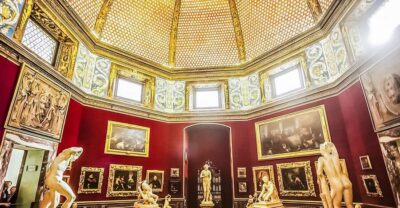
Skip-The-Line Uffizi Gallery Timed Entry Ticket
Read our review →
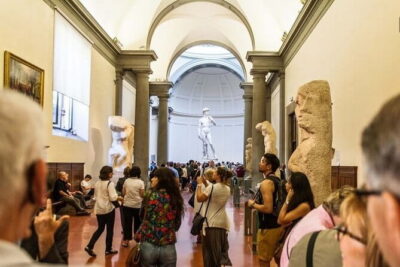
Florence Accademia Gallery Tour with Entrance Ticket Included
Read our review →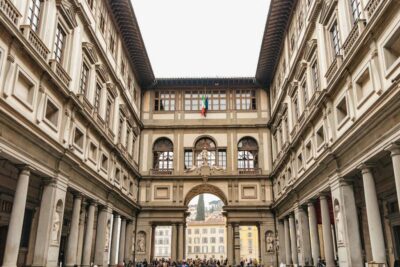
Uffizi Gallery: Renaissance Masterpieces Guided Tour
Read our review →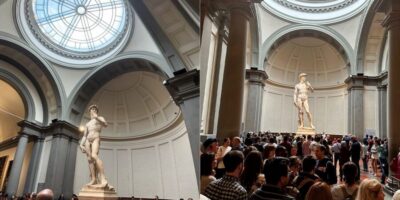
Uffizi Gallery Timed Entry Ticket & Audio Guide
Read our review →
Browse the lists this tour appears in