
Review · FLORENCE
Florence: Accademia Gallery Reserved Entry & Audio Guide
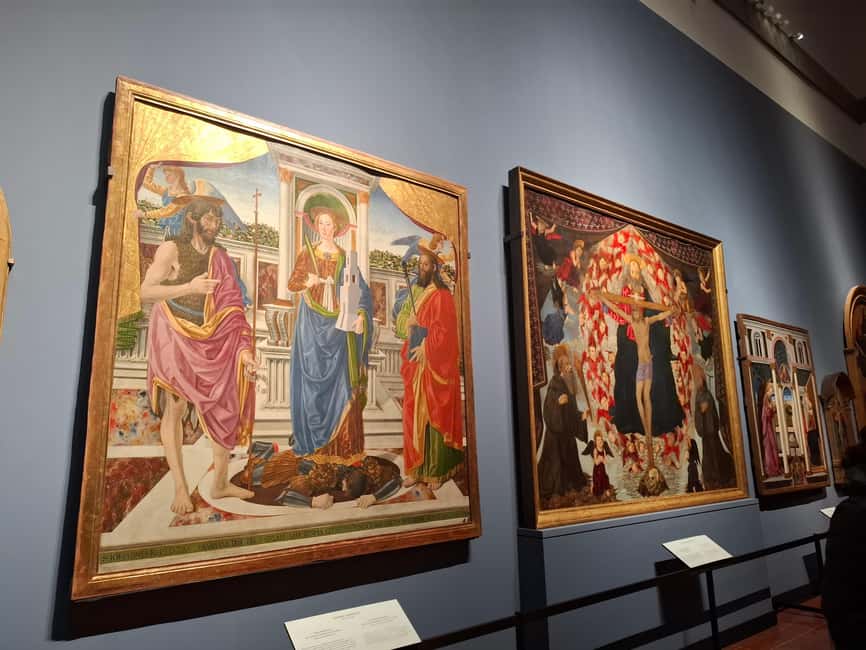
The main reason to book this experience is simple: you get reserved entry to see Michelangelo’s David without first joining the ticket office line. Inside, you can take your time with David, the unfinished Prigioni, San Matteo, and the Palestrina Pietà rather than rush through a crowded entry process.
I like the clear meeting point and the choice of an optional multilingual audio guide. I also like the freedom of a roughly two-hour visit with no full guided group pacing. The catch is that you must arrive early and protect your entry time. Miss it, and you may face the long regular queue.
Key points to know
- David is the centerpiece: See Michelangelo’s famous marble figure at close range inside the Accademia.
- Reserved access saves time: The ticket covers the reservation fee and lets you bypass the ticket office line.
- You explore independently: There is no need to keep pace with a large walking group.
- The audio guide is optional: Choose English, French, German, Italian, or Spanish commentary.
- Meet at a very specific corner: Find the assistant in blue with Caf Tour and Gray Line logos at Via Ricasoli and Piazza San Marco.
- Plan for museum rules: Bring identification, wear comfortable shoes, and carry no drink larger than a 0.5-liter bottle.
Why the Accademia is worth your Florence time
Florence has no shortage of famous art, but the Accademia earns its place on your schedule because one work makes the visit unforgettable: Michelangelo’s David. You do not see it from across a large church or behind a distant barrier. The gallery gives you a close view of the sculpture, which lets you study the details that reproductions flatten.
David represents the strength and spirit of the Florentine Republic. That political meaning matters. This is not just a beautiful nude figure carved in marble. It was made as an image of courage, watchfulness, and civic pride, and Florence adopted it as a symbol.
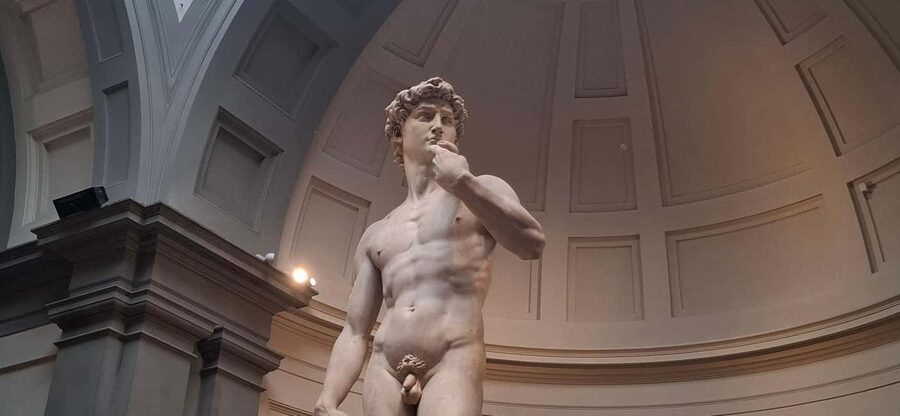
The sculpture also rewards a slow look. Notice the turn of the head, the tension in the hands, and the balance of the body. Michelangelo carved the figure from a single block of marble, an achievement that can feel almost impossible when you see the scale and fine detail in person.
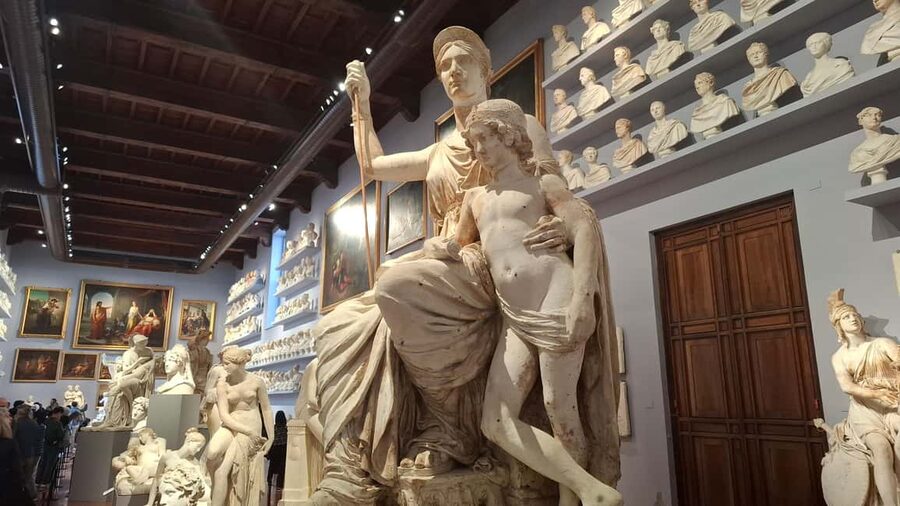
The Accademia itself is more compact than Florence’s largest museums. That makes it a sensible choice if you have limited time. You can see the major works in two hours without giving up an entire morning or afternoon.
More Museum Tours in Florence
- Florence: Skip-The-Line Uffizi Gallery Timed Entry Ticket
★ 4.5 · 27,832 reviews - Florence: Leonardo Interactive Museum Entry Ticket
★ 4.5 · 12,957 reviews - Florence Accademia Gallery Tour with Entrance Ticket Included
★ 4.5 · 6,148 reviews
Meeting the assistant at Via Ricasoli
Your visit begins at the corner of Via Ricasoli and Piazza San Marco, in front of the loggiato of the Accademia delle Belle Arti. Look for an assistant wearing blue clothing with Caf Tour and Gray Line logos.
This meeting point is close to the museum, but do not treat it as a place to arrive at the last second. The entrance process depends on collecting or receiving your reserved admission at the stated time. Arriving about 15 minutes early is the sensible move, especially if you are unfamiliar with Florence’s streets.
The clear clothing description helps. Florence’s center can feel confusing when several tour groups gather near a major sight, so check the corner carefully and keep your booking details ready. Bring your passport or ID card, since identification is listed among the required items.
The staff assistance is focused on getting you into the museum, not on providing a full live art lecture. That is useful if you want an efficient handoff and the freedom to set your own pace. If you prefer a guide talking throughout the visit, this is not that kind of experience.
Reserved entry and the value of your $48 ticket
The price is $48 per person. That is not the cheapest way to enter the Accademia, but it includes the admission ticket, the reservation fee, and multilingual assistance at the meeting point. If you choose the audio guide option, that is included as part of the selected package.
The main value is time and certainty. Florence’s most famous museums can develop long lines, and David is one of the city’s most sought-after sights. A reserved ticket lets you avoid the ticket office line and the queue for visitors without reservations.
That does not mean you should arrive late. Reserved access protects your place at the scheduled time, but it does not turn the appointment into an open-ended pass. One particularly useful warning is that missing the time slot can mean waiting for hours in the regular line.
For me, the ticket makes the most sense during busy periods, for a first visit to Florence, or for anyone planning a tight day around other reservations. If you are willing to risk a long wait or already have a different valid entry ticket, the $48 price may feel high. If seeing David is a top priority, the time saved can justify it.
The experience offers free cancellation up to 24 hours in advance and a reserve-now, pay-later option. Those terms are helpful when your Florence plans are still shifting.
Meeting David in the Tribune
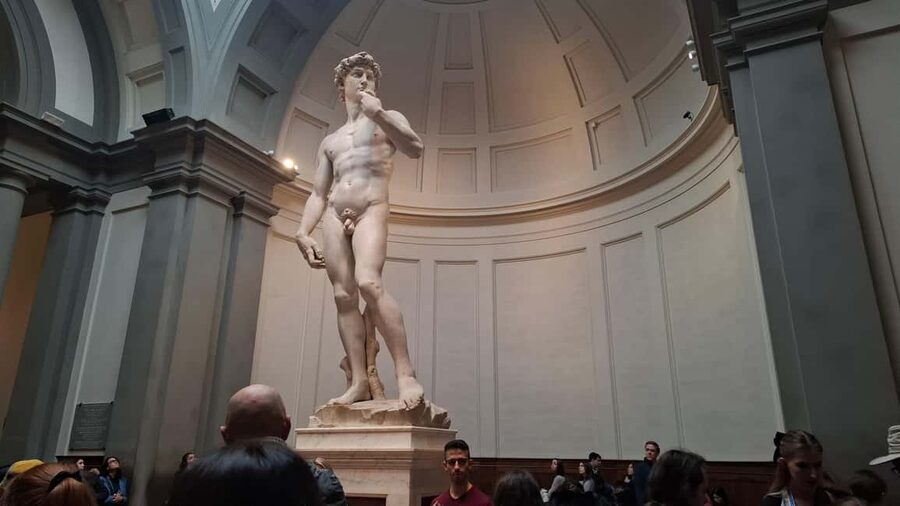
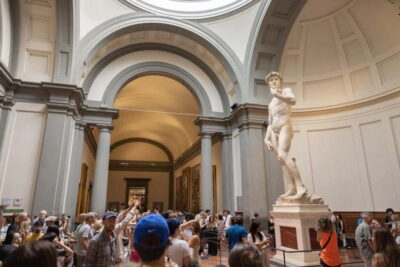
Once inside, make David your first major stop. The sculpture is displayed in the Tribune, a purpose-built space that gives you room to walk around and see it from several angles.
Take a moment before focusing on small details. From a distance, the figure’s proportions and stance create the first impression. Then look closer at the face, hands, feet, hair, and the subtle transitions in the marble. The sculpture’s power comes from the combination of physical strength and intense alertness.
You will also see why David is more than a standard Renaissance art stop. His expression is calm, but the body is ready for action. Florence’s civic message is built into that contrast: courage does not always look loud or aggressive.
Crowding can affect how long you can remain in one position. The reserved ticket gets you through the entry process more quickly, but it does not give you a private viewing room. Plan to move with the flow of the gallery and return to a favorite angle if space allows.
A useful approach is to spend your first few minutes simply looking, then use the audio guide for context. That keeps the visit from becoming a checklist of facts. David deserves your attention before you start listening to commentary.
More ways to see the David:
- Florence: Accademia Gallery Guided Tour
★ 4.6 · 4,156 reviews - Florence: Accademia Gallery Skip-the-Line Guided Tour
★ 4.8 · 3,044 reviews - Florence: Art Tour, Accademia Gallery and David
★ 4.5 · 2,407 reviews - Florence: Accademia Gallery Guided Tour with Entry Ticket
★ 4.6 · 2,253 reviews
Michelangelo’s unfinished figures
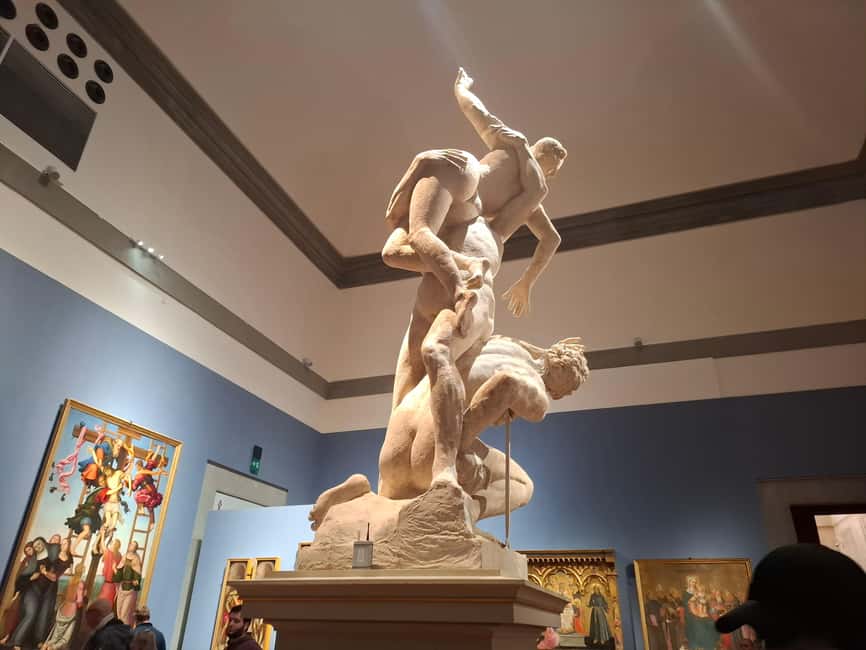
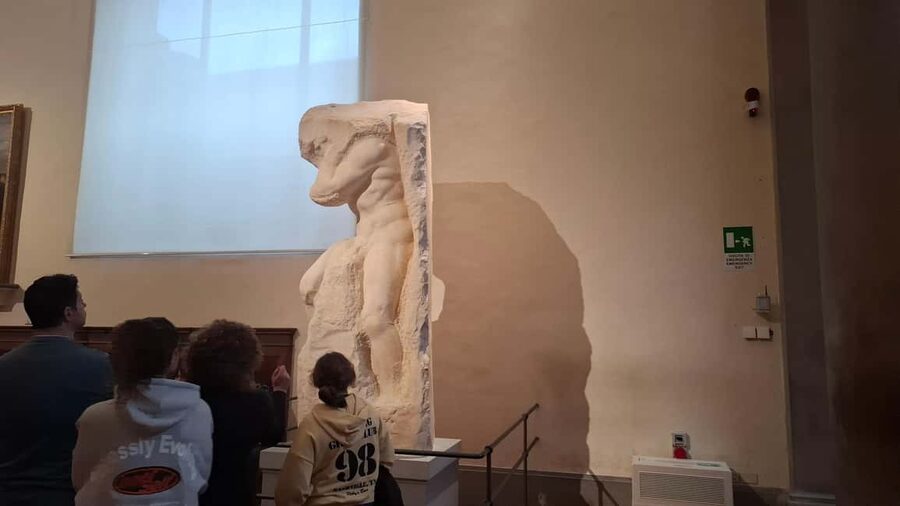
After David, seek out the Prigioni, also called the Slaves, and San Matteo. These works show a very different side of Michelangelo because they remain unfinished.
The rough marble around the figures is part of their visual force. Instead of seeing a fully smoothed body separated from its block, you see forms appearing to struggle free of the stone. That unfinished quality gives you a direct sense of carving as a physical process.
The Prigioni can be especially rewarding if you have already looked closely at David. David presents finished control. The unfinished figures reveal the marks, planes, and mass of the material. Together, the works help you understand Michelangelo as a sculptor, not only as the name attached to one famous statue.
San Matteo offers another chance to consider the relationship between figure and stone. You might find the unfinished works less immediately easy to read than David, but they are an important reason to stay beyond the central sculpture.
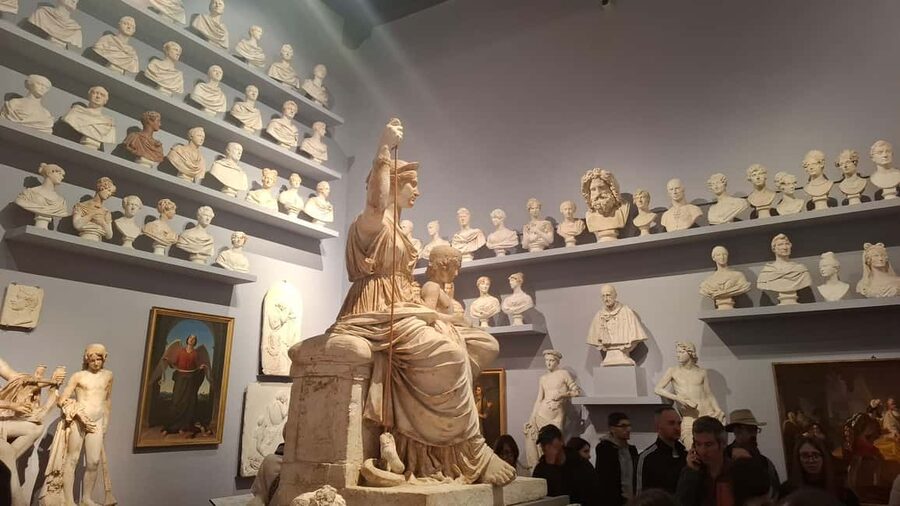
The museum also includes a room explaining the casting and production of monumental sculptures. That stop is useful because it gives you practical insight into how such works were made. It adds process to the usual focus on artistic genius.
The Palestrina Pietà and the rest of the gallery
The Palestrina Pietà brings a different mood to the visit. Its subject is moving, and its emotional weight contrasts with the watchful strength of David and the physical struggle of the Prigioni.
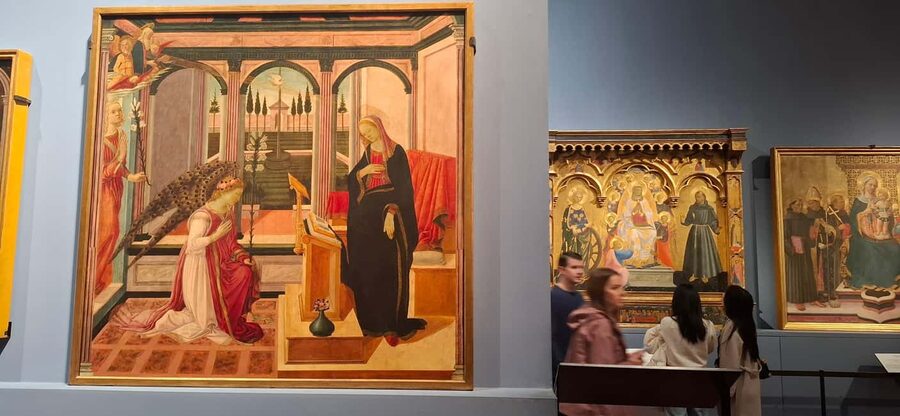
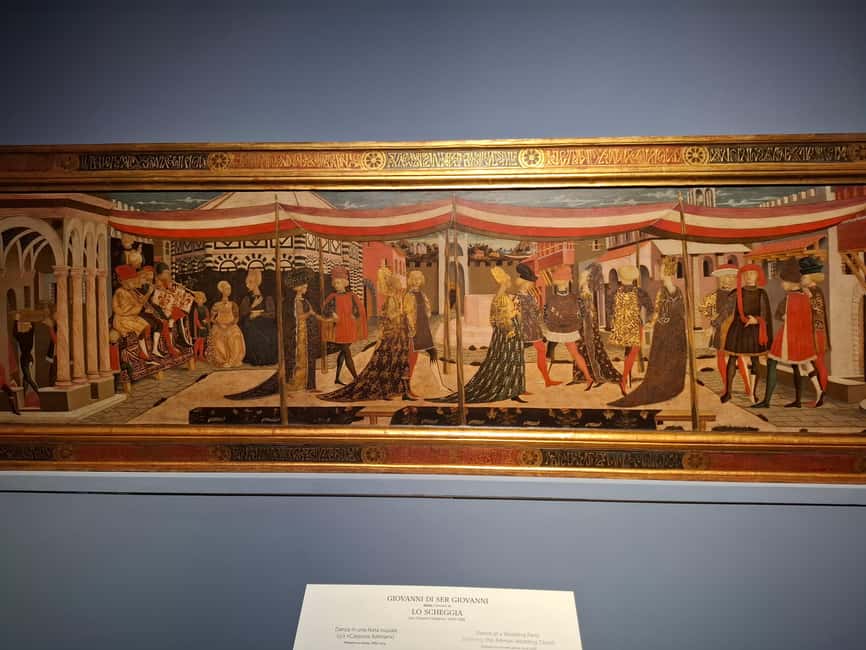
As you move through the gallery, give yourself time to look beyond the single most famous work. The Accademia contains important paintings and sculptures, and the Palestrina Pietà helps broaden your view of the collection.
The order in which you see the works can vary with crowd movement and museum flow. You are not tied to a guide’s route, so you can return to David, pause with the Pietà, or spend longer with the unfinished figures.
That freedom is one of the strongest features of this booking. A live group tour can give you a steady stream of explanation, but it also sets the pace. Here, you decide when a work deserves another minute.
Choosing the multilingual audio guide
The audio guide is optional, so consider how you normally visit museums. If you like context about the artist, the work, and Renaissance Florence, it can make the gallery more rewarding. Commentary is available in English, French, German, Italian, and Spanish.
The audio guide is especially useful for the unfinished sculptures. Without explanation, you may see rough marble and wonder whether the work is incomplete by accident or design. Background about Michelangelo’s methods and the pieces’ place in his work helps you look more carefully.
It also adds context to David’s civic meaning and the story of Renaissance Florence. You are not just looking at a famous statue. You are connecting the art to the city that displayed and claimed it.
The audio guide does not suit everyone. If you already know Michelangelo well, or if you prefer quiet looking, skip it and enjoy the gallery at your own pace. One practical point is that the audio guides are handed out easily at the visit, so choosing the option should not create a complicated extra step.
You can also use your own museum notes if that is your preference, but the supplied experience is designed to work without outside material.
How long to allow and what to bring
The stated duration is two hours. That gives you enough time for David, the major Michelangelo works, the sculpture process room, and selected paintings and sculptures, especially if you keep a steady pace.
Two hours may feel short if you want to examine every room in detail. It is a good length for a focused first visit, not a promise that you will study the entire collection slowly. If art is your main reason for visiting Florence, you may want to use all the available time.
Wear comfortable shoes. You will be standing and walking through the gallery, and a comfortable pair makes it easier to stay attentive rather than focus on tired feet.
The drink rule is strict: only a bottle of water no larger than 0.5 liters is permitted inside. Bottled or canned drinks can be taken away at security, and you cannot drink in the exhibition rooms. Do not bring a large bottle or count on carrying coffee through the museum.
Children under six cannot take part in this activity. Families with older children should consider whether the two-hour art visit suits their attention span, since the experience is built around looking and listening rather than entertainment.
Who should book this Accademia visit
I would recommend it to a first-time Florence visitor who wants to see David without gambling on a long queue. It also suits people who prefer independent museum visits but want help with admission and the option of recorded commentary.
It is a good match for:
- Art lovers who want close views of Michelangelo’s sculpture
- Visitors with only a few hours for the Accademia
- People who appreciate audio commentary in their own language
- Couples or small parties who do not want a full guided group route
- Anyone building a Florence day around fixed meal, train, or museum times
I would think twice if you want a personal art historian beside you for the entire visit. The meeting-point assistance gets you through the door, while the audio guide supplies the interpretation. It is not a private tour.
I would also skip it if you cannot commit to the scheduled entry time. The reserved ticket is valuable only if you use it as planned. Missing the appointment can erase the time-saving benefit.
Practical verdict on the experience
This is a focused, sensible way to visit one of Florence’s essential museums. The strongest features are the reserved entrance, the chance to see David up close, and the freedom to spend more time on the works that interest you.
The $48 cost is easiest to justify when the museum is busy or your schedule is tight. You are paying for admission, a reservation, and less uncertainty, not for a long guided tour or a private viewing.
If you arrive early, bring identification, follow the water rule, and give the unfinished Michelangelo sculptures more than a quick glance, you will get much more from the visit than a single photograph of David. Book it if David is high on your Florence list and you value a smooth entry. Skip it only if you already have reliable admission or prefer to take your chances in the regular queue.
FAQ
Where is the meeting point?
Meet at the corner of Via Ricasoli and Piazza San Marco, in front of the loggiato of the Accademia delle Belle Arti.
How do I identify the meeting-point assistant?
Look for an assistant wearing blue clothing with Caf Tour and Gray Line logos.
How long does the Accademia visit last?
The activity lasts two hours.
Does the ticket include reserved entry?
Yes. It includes a skip-the-line Accademia Gallery admission ticket and the reservation fee.
Is the audio guide included?
The audio guide is included only if you select the audio guide option when booking.
Which audio guide languages are available?
The audio guide is available in English, French, German, Italian, and Spanish.
What should I bring?
Bring your passport or ID card and wear comfortable shoes.
Can I bring a drink into the gallery?
Only a bottle of water no larger than 0.5 liters is permitted. Bottled or canned drinks can be taken away at security, and drinking is not allowed inside the exhibition rooms.
Are young children allowed to join?
The activity is not available for children under six years old.
More Audio-Guided Visits in Florence
- Uffizi Gallery Reserved Ticket & Digital Audio Guide App
★ 4.3 · 69 reviews - Florence: Accademia Gallery Skip-the-Line with Audio Guide
★ 4.2 · 18 reviews - Istanbul: Topkapi Palace & Harem Museum Ticket & Audio Guide
★ 4.1 · 3,977 reviews - Paris: Orsay Museum Entry Ticket and Digital Audio Guide App
★ 4.4 · 3,170 reviews
More Self-Guided Tours in Florence
- Florence: Uffizi Gallery Timed Entry Ticket & Audio Guide
★ 4.2 · 2,794 reviews - Florence: Accademia Gallery David Entry & Audio Guide App
★ 4.2 · 406 reviews - Florence: Accademia Gallery Entry Ticket with Audio Guide
★ 4.1 · 88 reviews - Florence: Uffizi Gallery entry ticket + audio guide
★ 3.6 · 74 reviews
Just added around Florence
- Timed Entry Ticket to the Uffizi Gallery★ 4.5 · 498 reviews
- Florence: Accademia Gallery Entry Ticket with Audio Guide★ 4.1 · 88 reviews
- Florence: Skip-the-Line Tour of Uffizi & Accademia Galleries★ 4.4 · 14 reviews
- Florence: Skip-the-Line Accademia Gallery Entry Tickets★ 4.3 · 44 reviews
- Florence: Walking Tour with Skip-the-Line Accademia Gallery★ 4.6 · 148 reviews
- Florence: David’s Accademia Gallery Guided Tour★ 4.2 · 207 reviews
- Florence: Uffizi Gallery Private Tour w/ Skip-the-Line Entry★ 4.9 · 24 reviews
- Florence: 2-Hour Private Guided Visit to the Uffizi Gallery★ 4.8 · 15 reviews
Museum Tours in Florence, compared.
Skip-The-Line Uffizi Gallery Timed Entry Ticket
Read our review →
Florence Accademia Gallery Tour with Entrance Ticket Included
Read our review →
Uffizi Gallery: Renaissance Masterpieces Guided Tour
Read our review →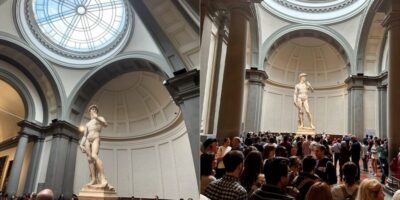
Uffizi Gallery Timed Entry Ticket & Audio Guide
Read our review →
Browse the lists this tour appears in