

Review · GREECE
Delphi Site & Museum with Multilingual 3D Audiovisual Tour
Delphi is the sort of ancient place that works best when you can pause, look closely, and let the setting do some of the talking. This self-guided visit gives you access to the Apollo temple, ancient theater, and archaeological museum, with audio, maps, and 3D reconstructions on your phone.
I like the convenience of having the ticket ready before you arrive, and I like the video clips that show how parts of Delphi may have looked in ancient times. You can also choose from eight languages, which is useful for families or groups who do not all want the same printed information.
The main catch is the technology. The app needs internet access, and it has been reported to freeze or feel hard to follow in strong sun. The explanations are also fairly short, so I would bring some background reading if you want more than the basic story.
Key points at a glance

- Theater and Apollo temple: Walk through Delphi’s best-known monuments and see the sacred center linked to Apollo and the oracle.
- Museum included: The ticket covers both the outdoor ruins and the indoor collection of Greek sculpture, objects, and architectural pieces.
- 3D and video content: Reconstruction clips help you picture buildings that now survive only in fragments.
- Eight audio languages: Choose English, Spanish, Chinese, Dutch, Greek, Italian, German, or French.
- Self-guided pace: Stop, replay, or skip sections as you like, without keeping up with a group.
- Phone preparation matters: Download the app before arrival, charge your phone, and bring mobile data or Wi-Fi.
What the Delphi experience actually gives you
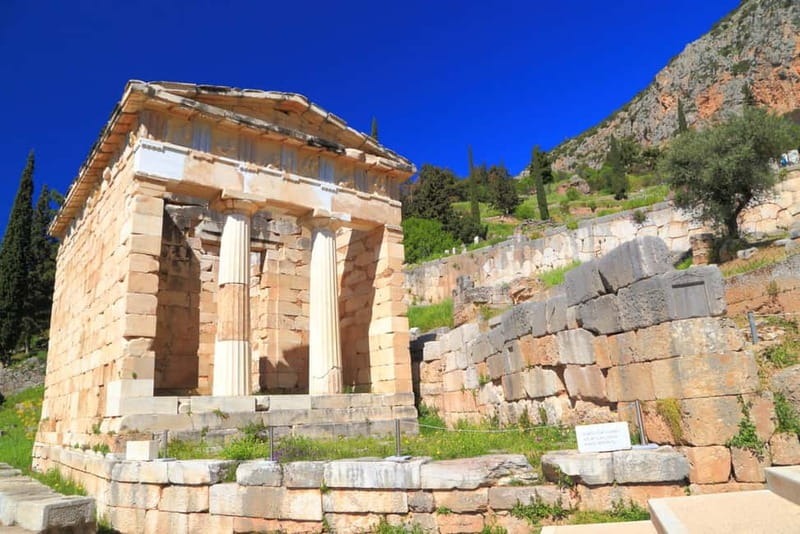
This is a one-day entry experience rather than a guided group excursion. You receive the ticket by email, then use your phone to enter the Delphi Archaeological Site and Museum. The audiovisual tour is included only when that option is selected, so check your booking carefully before paying.
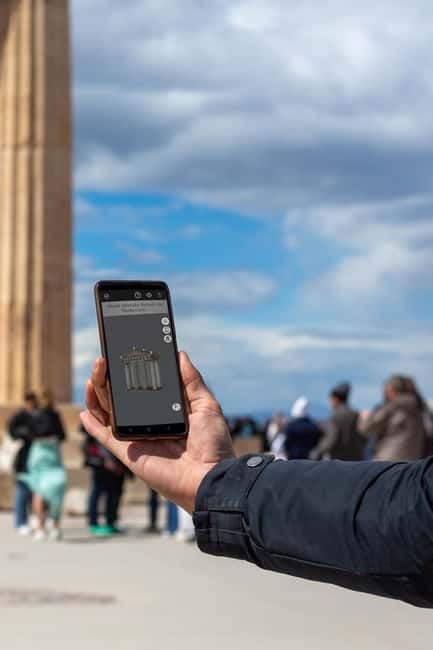
Once inside, you explore on your own. The app uses audio narration, interactive maps, 3D models, and video clips to add context to the stones around you. That format suits Delphi well because many buildings are incomplete. A bare foundation can be hard to read at first, while a reconstruction can show you the columns, roofline, or original shape that once occupied the space.
You should think of the app as a helpful layer, not a full personal guide. Some explanations last about two minutes and focus on the main historical facts. That is enough to orient you at major stops, but it may not answer detailed questions about construction methods, where the stone came from, or how long each building took to build.
The site and museum are covered by the same admission arrangement described here, giving you two different ways to understand Delphi. Outside, you deal with scale, slopes, ruins, and views. Inside, you see objects that bring daily life, religion, and ancient craftsmanship closer to eye level.
A few more museum visits around Greece worth comparing
- Athens: Acropolis, Parthenon & Acropolis Museum Guided Tour
★ 4.8 · 9,316 reviews - The Acropolis, Parthenon & Acropolis Museum Guided Tour
★ 4.7 · 8,493 reviews - Athens: Mythology of Delphi, Museum and Arachova Guided Tour
★ 4.7 · 5,102 reviews
Starting with the sanctuary of Apollo
The outdoor archaeological site is the heart of the visit. Delphi was connected with Apollo, and the sanctuary became famous as the home of the oracle. The Pythia, Apollo’s priestess, delivered prophetic answers that influenced rulers and ordinary people across the Greek world.
The audio tour uses these myths to give the ruins a sense of purpose. You are not simply walking past broken columns. You are standing in the place where ancient people came seeking guidance, often after long journeys and with serious questions about war, politics, family, or the future.
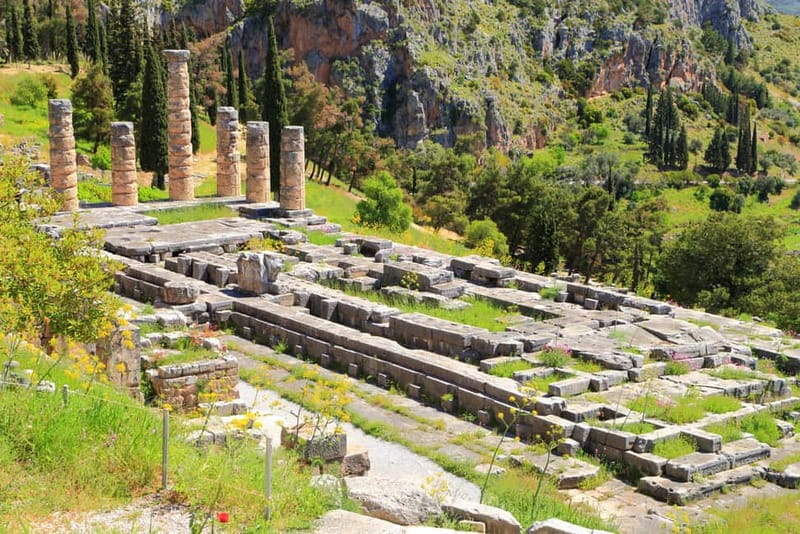
The Temple of Apollo is the central stop. What you see today is a ruined structure rather than a complete building, so the 3D material is especially useful here. Look from the stones to the phone screen, then back again. The contrast helps you understand how much of the temple has disappeared and how much can still be read from the surviving foundations and columns.
The tour does not appear to offer a long architectural lecture. If you are curious about engineering, quarrying, or building schedules, you may want to read about those subjects before arriving. The audio content is better at explaining what the site meant than at answering every technical question about how it was made.
Reaching the ancient theater
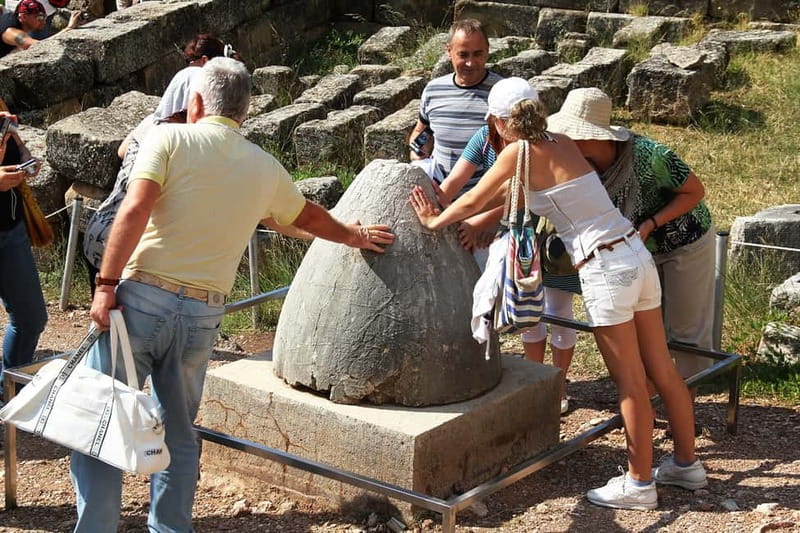
The theater is one of Delphi’s most memorable remains. Its curved seating and position above the sanctuary give you a clear sense of how performances and public events fit into the sacred setting.
The audiovisual material can help you picture the theater in use rather than as a quiet ruin. Use the map to locate it, since one of the practical weaknesses of the app is that some stops are not always easy to find. You may need to compare the screen with the physical path and take a moment to get your bearings.
The theater is also a good place to slow down. The experience is self-guided, so you are not pushed onward by a group or a live guide. You can listen again, study the 3D model, and take in the position of the theater before moving to the next point.
The site has uneven ground and is not suitable for wheelchair users. Comfortable shoes are important, and you should expect sun exposure. A hat, sunglasses, water, and light clothing will make the outdoor section easier, especially during hot weather.
Finding the oracle in the stories of Pythia
The story of Pythia gives Delphi much of its atmosphere. The audio narration presents the oracle as part of a world where religion, politics, myth, and public decisions were closely tied together.
You will hear about the mysteries and riddles associated with the oracle, but the short format means the treatment remains introductory. I like this approach for a first visit because it gives you a clear thread to follow. If you already know the myths well, some sections may feel familiar and brief.
The strongest use of the app is its ability to connect a physical point with a human story. A temple becomes a place where people asked for divine guidance. A theater becomes part of a sanctuary that was not only a collection of buildings, but also a center of worship and public life.
For the best result, do a little reading before you arrive. The audio tour and your own preparation work well together. The app supplies location-based explanation, while your background reading can fill in the social details that are only lightly covered.
Same city, a completely different collection:
- Athens: Acropolis, Parthenon & Acropolis Museum Guided Tour
★ 4.8 · 3,579 reviews - Acropolis monuments & Parthenon Walking Tour with Optional Acropolis Museum
★ 5.0 · 2,678 reviews - Athens All Included: Acropolis and Museum Guided Tour with Ticket
★ 4.5 · 2,673 reviews - Combo: Acropolis & Acropolis Museum with Optional Tours
★ 4.2 · 2,657 reviews
The museum’s sculptures and ancient objects

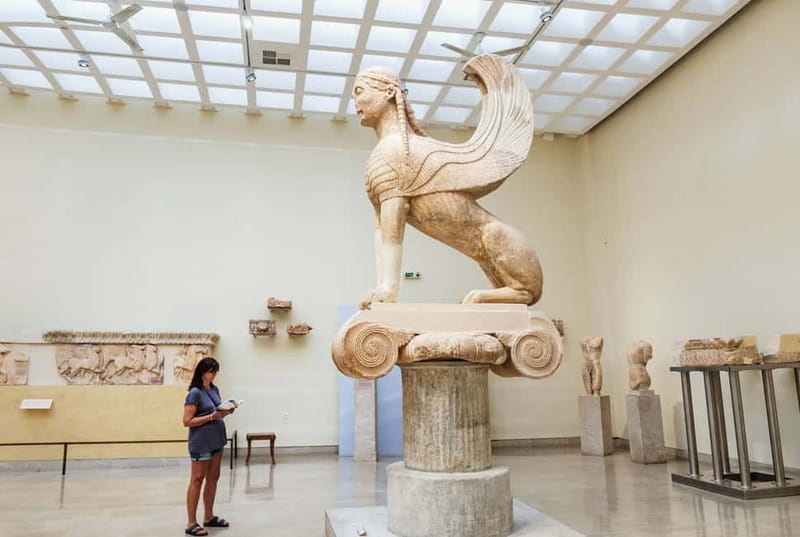
Do not treat the museum as an optional indoor extra. It is essential to the visit because many of the finest objects connected with Delphi are protected inside rather than left outdoors.
The collection includes Greek artifacts and treasures from the site. Here, you can look at sculpture, architectural details, and objects at close range. The museum helps explain what the sanctuary looked like when it was active, while the outdoor ruins show you the original setting.
The app’s video clips are particularly useful in the museum. They show how certain structures may have appeared in the past, giving you a visual bridge between the surviving artifact and the original building. This was one of the most successful parts of the format for me as a recommendation: reconstruction images can communicate quickly when a written label feels too spare.
Still, do not expect every object to receive a long, detailed explanation. Some audio stops may tell you little more than the nearby written signs. The Italian version has also been criticized for awkward translation, so language quality may vary. English, German, French, Spanish, Greek, Dutch, and Chinese are also available.
How well does the app work?
The app is the deciding factor in this experience. When it works, it adds sound, movement, and visual reconstruction without the cost of hiring a private guide. You can stop whenever you want and avoid listening to a long talk about objects that do not interest you.
Before leaving your hotel or accommodation, download the app using the instructions sent with your voucher. The app requires internet access, so confirm that you have mobile data or Wi-Fi. Charge your phone fully, since a day of navigation, audio, and video can use a fair amount of battery.
Bring your own earphones. They are not included, and using a phone speaker outdoors may be difficult in bright conditions or around other people. A portable battery is not listed as required, but keeping your phone powered is clearly important for this format.
The app has received mixed practical feedback. It may freeze, and some route points can be difficult to locate. Strong sunlight can also make a phone screen hard to read. If the technology fails, you can still use the printed signs at the site and museum, but the experience becomes much less distinctive.
Choosing the right time and pace
The ticket is valid for one day, with an entry time slot shown at booking. The instructions say the date and time cannot be changed, so choose carefully before you confirm.
The available information indicates that the timing system can be confusing. The stated guidance notes that starting outside the busiest period, roughly 10 a.m. to 2 p.m., may be easier. If you have flexibility, an earlier or later visit should also help with heat and light, though you should check the exact opening and entry details for your date.
The outdoor site is more demanding than the museum. Plan your energy accordingly. You may want to see the ruins first, then move indoors for shade and a closer look at the objects. The self-guided setup lets you divide the day in the way that suits you, but the ticket itself is valid for one day rather than offering a flexible multi-day visit.
There is no hotel pickup or drop-off. You arrange your own transport to Delphi, and the price does not cover personal expenses. Large bags, luggage, baby strollers, and pets are not allowed, so arrive with only what you need for the visit.
Is $42 a fair price?

At $42 per person, this is not the cheapest way to enter Delphi, especially for a family in which every person must pay the regular adult price. The ticket is for travelers over 25, while EU citizens under 25 and non-EU citizens under 18 may receive free admission at the ticket booth with suitable identification. Reduced-price tickets are not available online, so check your eligibility before buying.
The value depends on how much you want the phone content. If you only need entry, you may prefer to buy a ticket directly on site, provided tickets are available and the conditions suit your visit. If you want reconstructions, audio in your own language, and a ready-to-use booking, the added cost may make sense.
I see the best value here for an independent visitor who does not want a live guide but still wants more than bare ruins and museum labels. You avoid the cost of a private tour, and you can move at your own speed. The value is weaker if your phone connection is unreliable or if you expect long, expert explanations at every stop.
Who should choose this format?

This experience fits you well if you like to set your own pace, prefer listening in your own language, and want visual help understanding ruined buildings. It also works for couples or families who do not want to stay together every minute.
It is less suitable if you dislike using apps during sightseeing, have limited mobile data, or want to ask questions as you go. A live guide would offer more personal explanation, though that is not what this product provides.
You also need to be comfortable walking over uneven ground and handling sun exposure. The site is not suitable for wheelchair users, and strollers are not allowed. Bring water, good shoes, sunglasses, and a hat.
Simple ways to improve your visit
- Download before arrival: Do not wait at the entrance to install the app.
- Charge your phone: Audio, video, maps, and bright-screen use can drain the battery.
- Bring earphones: They are not supplied.
- Read a little first: This will help you get more from the brief audio sections.
- Use the map carefully: Some locations may take time to find.
- Allow time for both parts: The museum is not just a backup for bad weather. It gives meaning to the outdoor ruins.
- Check your ticket category: The online offer is for the regular adult price, and free admission rules require identification at the ticket booth.
FAQ
Is the entrance ticket included?
Yes. The experience includes entry to the Delphi Archaeological Site and Museum. The audiovisual guide is included only if you select that option.
What languages are available for the audio guide?
The audio guide is available in English, Spanish, Chinese, Dutch, Greek, Italian, German, and French.
Do I need internet access?
Yes. The app requires internet access, so you need mobile data or Wi-Fi during the visit.
Are earphones provided?
No. You need to bring your own earphones.
Can I change my date or time slot?
No. The travel date and entry time slot cannot be amended, and the activity is non-refundable.
Is the site suitable for wheelchair users?
No. This experience is not suitable for wheelchair users. Baby strollers, luggage, large bags, and pets are also not allowed.
Should you book Delphi with the audiovisual tour?
Book it if you want a flexible visit with a pre-arranged ticket, short explanations, and visual reconstructions of the temple, theater, and other ancient buildings. The museum access adds real value, and the choice of eight languages makes the format useful for many people.
Skip it if you mainly want simple admission, if you need detailed architectural analysis, or if you cannot rely on your phone connection. The safest approach is to prepare the app in advance, bring earphones and water, and treat the audio as a clear introduction rather than a full scholarly tour. For an independent visit to Delphi, that can be a fair trade at $42, provided the technology works for you.
Just added around Greece
- The Acropolis, Athens Walking City Tour and Acropolis Museum★ 5.0 · 442 reviews
- Ancient Athens tour: Acropolis, Parthenon and Acropolis Museum★ 5.0 · 256 reviews
- Athens: Acropolis Museum Ticket with Self-Guided Audio tour App★ 3.5 · 40 reviews
- Family Acropolis & Acropolis Museum Tour inspiredby Percy Jackson★ 4.5 · 40 reviews
- Acropolis of Athens, Parthenon and Acropolis Museum private tour with dinner★ 5.0 · 77 reviews
- Shore Excursion: Acropolis, Athens City tour and The New Acropolis Museum★ 4.5 · 30 reviews
- Athens National Archaeological Museum E-Ticket with Audio Guide★ 3.0 · 57 reviews
- Private Tour: Half day Athens Sightseeing and Acropolis Museum★ 4.5 · 28 reviews
Museum Tours in Greece, compared.

Acropolis, Parthenon & Acropolis Museum Guided Tour
Read our review →
The Acropolis, Parthenon & Acropolis Museum Guided Tour
Read our review →Acropolis, Parthenon & Acropolis Museum Guided Tour
Read our review →
Acropolis monuments & Parthenon Walking Tour with Optional Acropolis Museum
Read our review →
Athens All Included: Acropolis and Museum Guided Tour with Ticket
Read our review →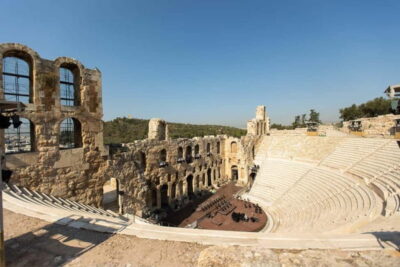
Combo: Acropolis & Acropolis Museum with Optional Tours
Read our review →
Acropolis Museum Ticket with optional Audio Guide
Read our review →
Small-Group Delphi, Museum & Arachova Day Trip
Read our review →Browse the lists this tour appears in