
Review · THE NETHERLANDS
The Hague: Escher in The Palace Museum Ticket
M.C. Escher’s art is made for a museum like this: you walk through a former royal palace and watch birds become patterns, staircases loop forever, and solid shapes turn into something else. The centerpiece is Metamorphosis III, a 7-meter woodcut shown in a way that lets you follow Escher’s ideas across time and space.
I like two things right away. First, the collection is broad, with more than 130 prints showing how Escher developed, not just his famous impossible buildings. Second, the hands-on section, Looking as Escher Does, gives children and adults something to do besides read labels and nod thoughtfully.
The main consideration is that the palace rooms can feel small and dim, especially around the video presentation. A visit can work in about an hour, but I would allow closer to two hours if you want to read the background material, use the audio guide, and try the interactive displays without rushing.
Key points to know before you go
- Metamorphosis III is the major showpiece: Follow Escher’s enormous 7-meter woodcut as images shift between patterns, creatures, architecture, and time.
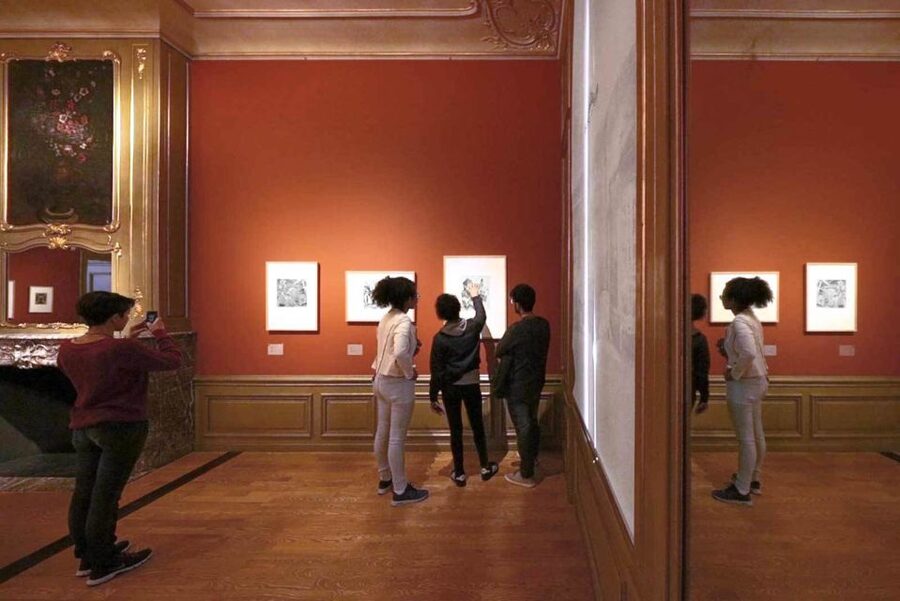
- The setting is part of the visit: The exhibition fills Queen Mother Emma’s former Winter Palace, one of The Hague’s best-preserved royal interiors open to the public.
- The collection goes beyond optical tricks: You will see Escher’s tessellations and impossible scenes, along with earlier and less familiar work.
- The second-floor activities make the museum family-friendly: Puzzles for your eyes and hands explain Escher’s visual ideas in a direct way.
- The $15 ticket is good value for a flexible stop: The ticket is valid for 365 days, subject to available starting times, and the audio guide is included.
- Travel light: Large bags and luggage are not allowed inside, so make arrangements before arriving at Lange Voorhout 74.
Escher’s impossible world inside a real palace
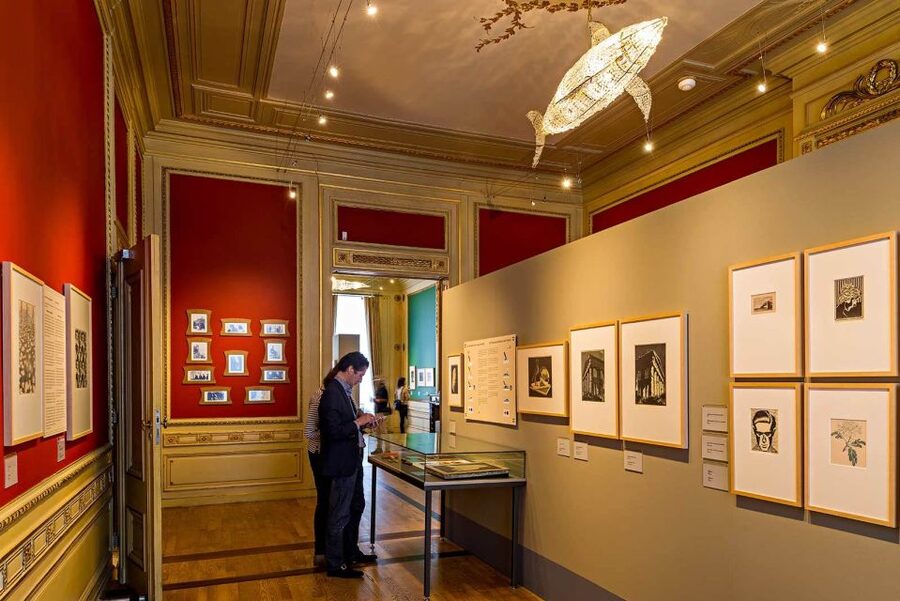
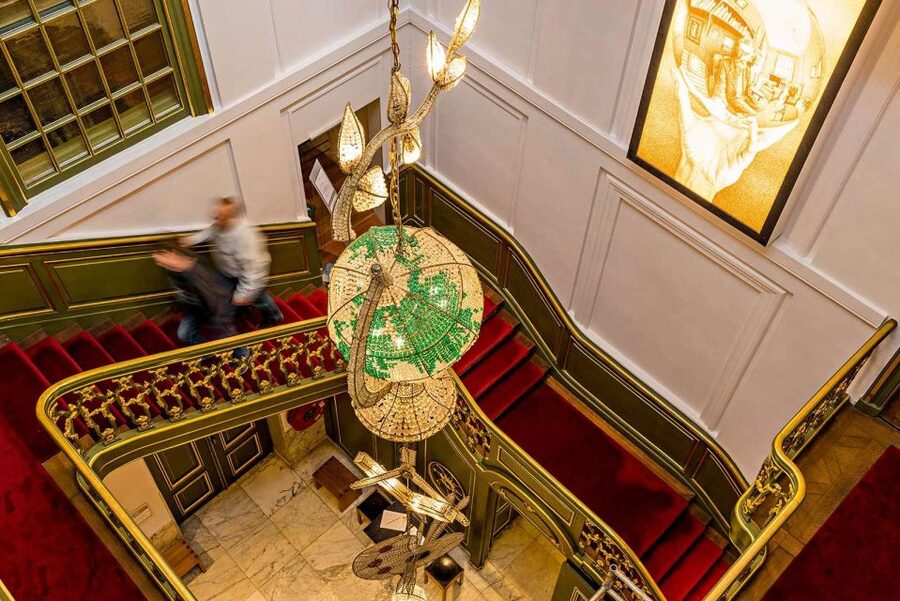
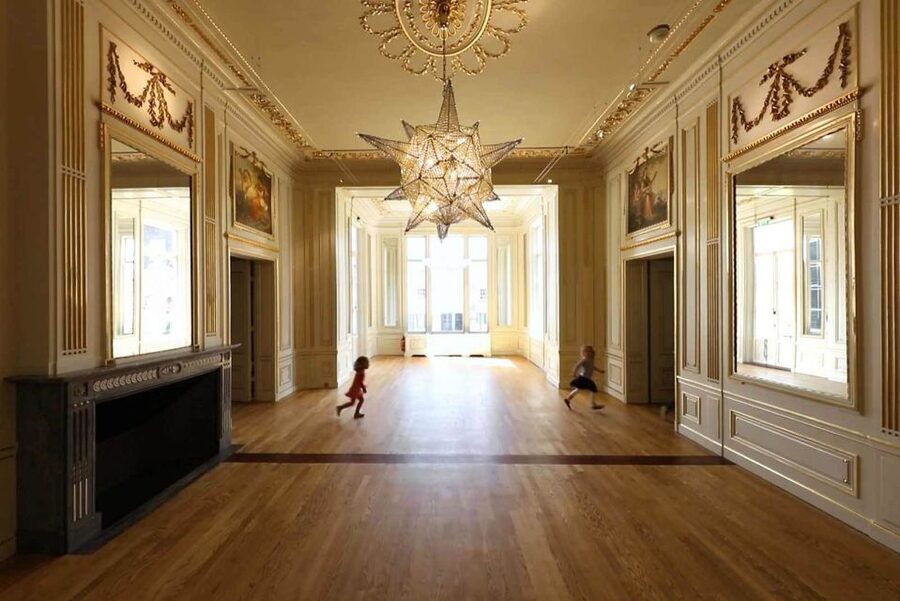
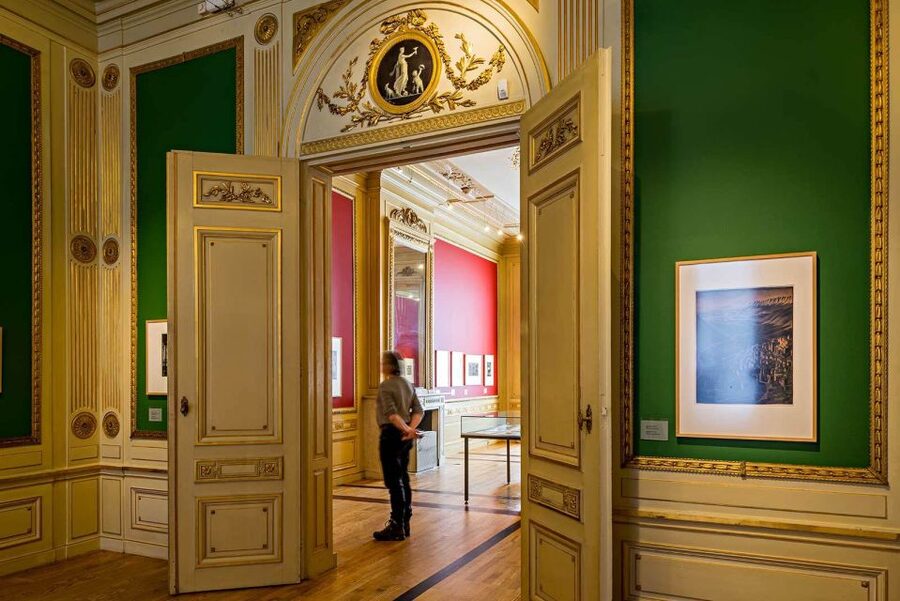
Escher in Het Paleis works because the building gives the art a graceful counterpoint. The museum occupies the former Winter Palace of Queen Mother Emma of the Netherlands, and the original royal atmosphere remains visible. You are not entering a plain gallery box. Ceilings, floors, chandeliers, and rooms all contribute to the visit.
That contrast matters. Escher’s prints can feel coldly mathematical at first glance, but the palace rooms remind you that the work was made by a human artist with a particular life and working process. You move between royal surroundings and images that challenge the rules of space.
I especially like the way the museum presents Escher as more than the artist of impossible staircases. His familiar visual tricks are here, but the collection also follows his changing interests. You can see intricate designs, repeating forms, early work, and studies that explain how his best-known ideas developed.
The museum displays more than 130 prints, which is enough to give you a real sense of the artist’s range. If you already know Day and Night or Ascending and Descending, you can see those works in context. If Escher is new to you, the progression helps you understand why his pictures became so widely recognized.
More palace museums in the Netherlands:
- Istanbul: Topkapi Palace & Harem Museum Ticket & Audio Guide
★ 4.1 · 3,977 reviews - Venice’s Best: Basilica, Doge’s Palace, Gondola & History Gallery
★ 4.5 · 2,478 reviews - Royal Palace & Prado Museum Skip the Line Guided Tour
★ 4.5 · 1,347 reviews
Following Metamorphosis III across seven meters
The largest work deserves your time. Metamorphosis III stretches for 7 meters and is displayed in an unusual format rather than treated like a standard framed print. As you follow it, forms change and connect, making time and space feel like one continuous movement.
This is the kind of work that rewards patience. Do not glance at it and move on. Start at one end, follow the transformations, and notice how Escher links small repeating patterns to larger images. The work gives you a clear example of the ideas that appear in smaller prints throughout the museum.
You will also encounter famous images such as Day and Night, where the Dutch countryside changes into a flock of birds. Ascending and Descending shows rows of people walking endlessly up and down a staircase. The joke is simple to describe, but the effect is stronger when you stand in front of the original print and look for the point where ordinary space stops making sense.
The museum is useful for this kind of close looking. Escher’s prints are full of fine detail, and the exhibition gives you a chance to compare repeated motifs and visual structures. I would not treat the visit as a quick list of famous pictures. The pleasure comes from spotting how one idea returns in a new form.
Seeing Escher’s development, not just his greatest hits
A good art museum helps you understand the road to the famous works. This collection does that by showing different sides of Escher’s career and interests. You will find the celebrated tessellations and optical illusions, but also works that may be less familiar.
That broader view is one of the best reasons to visit even if you already know Escher from posters, books, or school lessons. His art did not appear fully formed. The exhibition shows how themes were revisited and reshaped as he explored pattern, geometry, nature, and impossible space.
The displays also connect the art to Escher’s life and ideas. A video introduction helps set the tone, and information about his interest in mathematics explains why his pictures feel so precise. You do not need a technical background to follow it. The basic point is easy to grasp: Escher used mathematical structures as a tool for making art that feels playful, unsettling, and strangely logical.
I like that the museum does not reduce him to a novelty artist. The optical effects attract attention, but the collection gives you enough context to see the care behind them. Graphic designers, students, and anyone interested in pattern will find plenty to study. So will families who simply enjoy the surprise of seeing a picture refuse to behave.
Looking as Escher Does on the upper floor
Set aside time for the interactive exhibition Looking as Escher Does. This section asks you to test Escher’s ideas with your eyes and hands, rather than only reading about them on a wall.
The hands-on puzzles are a strong part of the visit for children. A free treasure hunt adds another reason for younger visitors to keep looking closely. Adults may find themselves taking the puzzles just as seriously, especially after spending time with Escher’s repeating forms and visual reversals.
The interactive area also gives the museum a change of pace. The galleries require quiet attention, while this section lets you experiment. That makes the overall visit work well for families with different interests. One person can focus on the art’s detail, while another explores how optical effects are built.
Do not assume the hands-on material is only for children. Escher’s work can be difficult to explain in words. A puzzle or visual test can make the basic idea clear in a few seconds. You may leave with a better understanding of how repetition, perspective, and visual expectation shape his images.
The museum’s chandeliers deserve attention too. They are not just practical lighting. Their designs connect with the building’s decorative character and give you another detail to notice as you move through the rooms. Look up occasionally. Escher is not the only thing competing for your eyes.
A few more museum visits around the Netherlands worth comparing
- Amsterdam: Van Gogh Museum Ticket
★ 4.7 · 52,054 reviews - Moco Museum Amsterdam Entrance Tickets with Banksy & More
★ 4.4 · 10,088 reviews - Amsterdam: The Upside Down Museum Entrance Ticket
★ 4.4 · 9,506 reviews - Amsterdam: Red Light Secrets Museum Entry Ticket
★ 4.2 · 5,722 reviews
How much time to allow
You can make a short visit in about an hour if you mainly want to see the major works. That is enough for a quick look at the collection and the interactive displays, but it will feel hurried if you want to read the text and listen to the audio guide.
I would plan on 90 minutes to two hours. That gives you time to:
- Watch the introductory material.
- Follow Metamorphosis III carefully.
- Study the famous prints and less familiar pieces.
- Use the audio guide.
- Spend time with the eye and hand puzzles.
- Look at the palace details and chandeliers.
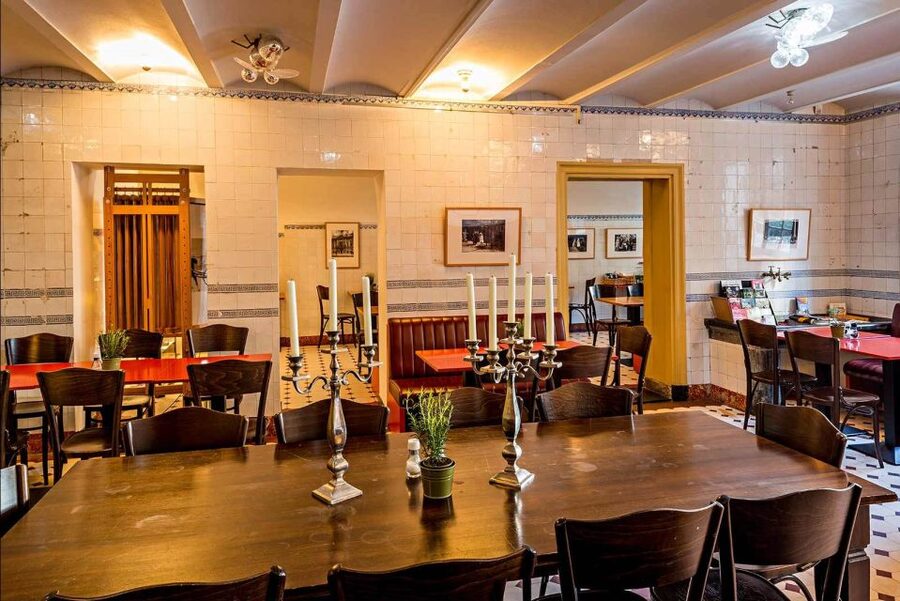
- Visit the museum café in the former palace kitchen.
The building includes several floors of material, though the exact pace depends on how closely you study each room. Some spaces are relatively small, and the museum can feel darker than a modern gallery. The lighting helps protect the atmosphere and the art, but it may not be ideal if you prefer bright, open exhibition halls.
The video presentation area can also feel close and stuffy when several people are watching at once. If that bothers you, move at your own pace and return to other rooms before continuing. You do not need to treat the museum as a fixed guided route.
Audio guide, family features, and the café
An audio guide is included in English, Dutch, German, French, Chinese, Japanese, Ukrainian, and Korean. That is useful if you want more explanation than the wall text provides, or if you are interested in Escher’s life and artistic development.
The family features are unusually practical. Children up to age six enter free when accompanied by a paying adult, and the treasure hunt gives them a clear reason to pay attention. The interactive puzzles are the main attraction for younger visitors, but the famous images also work well as a shared family conversation starter.
The museum café occupies the former palace kitchen. It gives you a chance to rest in a room connected to the building’s past rather than simply stepping out to a generic café. The available information does not specify the menu, so I would treat it as a convenient break rather than plan your entire meal around it.
A reasonably priced souvenir shop is also available. If Escher’s patterns appeal to you, the shop can be a pleasant final stop, though the main value of the visit is in seeing the original prints and the way they are arranged in the palace.
Getting there and handling your ticket
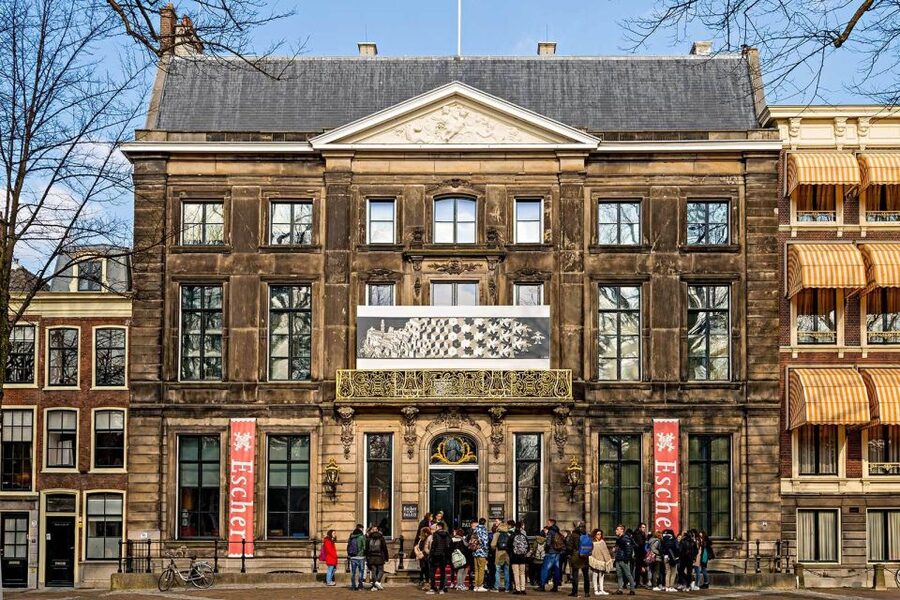
The museum is at Lange Voorhout 74 in The Hague, in a central area close to other sights. From The Hague Central Station, take tram 9 to Korte Voorhout or tram 17 to Kneuterdijk.
The online ticket costs about $15 per person. For a museum with more than 130 prints, a major seven-meter work, a royal interior, an audio guide, and interactive displays, that is a fair price. It is especially good value if you are interested in art, design, mathematics, or Dutch cultural history.
The ticket information gives it a validity of 365 days, with availability and starting times to check when booking. That flexibility is useful if you are building a day in The Hague around weather, train times, or another museum.
You can cancel up to 24 hours before the visit for a full refund, and reserve now while paying later. Those terms make the ticket less risky if your schedule is still changing. A guided tour is not included. A private guide for a group of up to 20 people costs EUR 60 per guide and must be reserved in advance.
Pack lightly. Luggage and large bags are not allowed inside, so do not arrive with a large suitcase expecting to carry it through the galleries. This is an easy museum to combine with a walk around the nearby area, but plan your bag situation before you leave the station.
Who will enjoy Escher in Het Paleis most
I would recommend this museum to anyone who already likes Escher, but you do not need to be an enthusiast. The exhibition explains enough of his ideas to make the work accessible, while the original prints reward people who already know the famous images.
It is a particularly good choice for:
- Families looking for an art museum with things to do.
- Graphic design, illustration, and architecture students.
- Visitors interested in mathematics and visual pattern.
- People who enjoy historic interiors as much as paintings and prints.
- Anyone planning an easy cultural day trip from Amsterdam.
- Escher fans who want to see the artist’s development rather than only reproductions.
The museum may be less satisfying if you want a large, airy gallery or a long guided tour included with admission. The rooms are not huge, and some areas can feel dim or crowded. Still, the manageable size is also an advantage. You can see a great deal without spending an entire day on one collection.
Should you book this museum ticket?
Book it if Escher’s repeating patterns, impossible architecture, or optical puzzles appeal to you. The combination of original prints, a preserved royal interior, Metamorphosis III, and hands-on exhibits gives you more than a quick display of famous posters.
I would also book it for a family day in The Hague, especially with children old enough to enjoy the treasure hunt. Go at a relaxed pace, look beyond the best-known images, and save time for the upper-floor interactive area.
Skip it only if you strongly dislike small museum rooms, dim lighting, or art that asks you to stand and look closely. For most visitors, the $15 admission is a sensible cultural stop, and the flexible ticket terms make it easy to fit into a changing schedule.
FAQ
Where is Escher in Het Paleis located?
The museum is at Het Paleis, Lange Voorhout 74, in The Hague. From The Hague Central Station, take tram 9 to Korte Voorhout or tram 17 to Kneuterdijk.
What does the admission ticket include?
The ticket includes admission to Escher in Het Paleis. An audio guide is included in English, Dutch, German, French, Chinese, Japanese, Ukrainian, and Korean.
How long is the ticket valid?
The ticket is valid for 365 days, subject to available starting times. Check availability when choosing your visit.
Is the museum suitable for children?
Yes. Children up to six years old enter free when accompanied by a paying adult. The museum also offers a free treasure hunt and interactive puzzles for children and adults.
Is a guided tour included?
No. A guided tour is separate and costs EUR 60 per guide for a maximum of 20 people. It must be reserved in advance.
Are large bags allowed inside?
No. Luggage and large bags are not allowed inside the museum, so arrange storage before arriving with bulky belongings.
Just added around the Netherlands
- Van Gogh Museum Tour excluding Entrance Tickets★ 5.0 · 16 reviews
- Van Gogh Museum Entry Ticket and Guided Tour★ 4.5 · 48 reviews
- Van Gogh Museum with Audio Guide★ 3.5 · 80 reviews
- Amsterdam: Explore the Van Gogh Museum & His Masterpieces★ 3.5 · 64 reviews
- Van Gogh Museum Skip the Queue with Audio Guide★ 4.0 · 261 reviews
- Amsterdam Van Gogh Museum with Audio or Guided Tour★ 4.0 · 266 reviews
- Van Gogh Museum, Rijks Museum & Walking Tour – Private Day Tour★ 5.0 · 17 reviews
- Van Gogh Museum Amsterdam Small Group Guided Tour★ 5.0 · 357 reviews
Museum Tours in the Netherlands, compared.
Moco Museum Amsterdam Entrance Tickets with Banksy & More
Read our review →

Amsterdam’s Weirdest Museum: Ripley’s Believe It or Not!
Read our review →

Browse the lists this tour appears in