
Review · NAPLES
Naples: City and Lapis Museum Tour with an Archaeologist
Naples keeps a second city below its streets. On this two-hour walk, you move from Piazza San Gaetano into old churches, then 40 meters underground through Greek cisterns, Roman water tanks, medieval passages, and World War II shelters. The past is stacked here, one layer below another.
I like the way the tour connects ordinary street life with what lies beneath it. I also like the small group limit of 10 and the presence of a professional archaeologist, since the underground route makes more sense when someone explains how each space was used. Guides such as Riccardo and Theresa have earned especially strong praise for their clear, lively explanations.
The main thing to consider is access. This is not suitable for wheelchair users, and the route includes a long descent into dark underground spaces. Two hours goes quickly, so this is best for you if you want focused history rather than a slow, relaxed city walk.
Key things to know before going
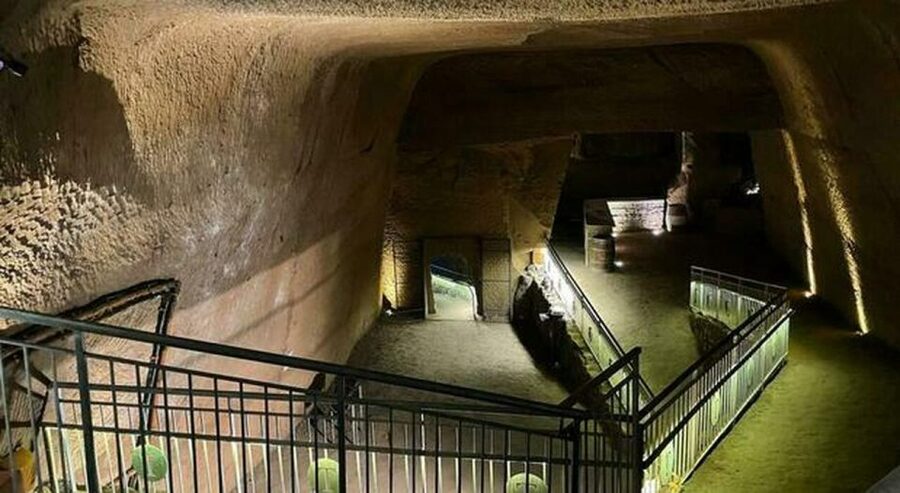
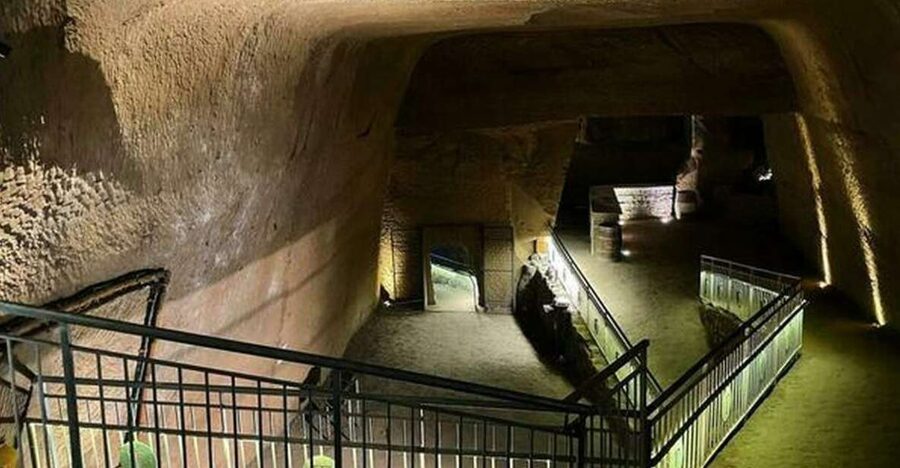
- Forty meters below Naples: The route descends from the city center into Greek cisterns, Roman water tanks, and wartime shelters.
- A professional archaeologist leads the way: You get context for the construction, water systems, religious sites, and wartime use.
- The route begins at Piazza San Gaetano: You first see Naples above ground along Via dei Tribunali before entering the underground path.
- Ancient and modern history meet: The same tunnels served water collection, a medieval secret passage, and an air-raid retreat in 1943.
- Small groups make questions easier: The tour accepts no more than 10 people and runs in English or Italian.
- Wear practical shoes: Expect stairs, underground passageways, and a route that is not accessible to wheelchair users.
Why Naples makes sense from below
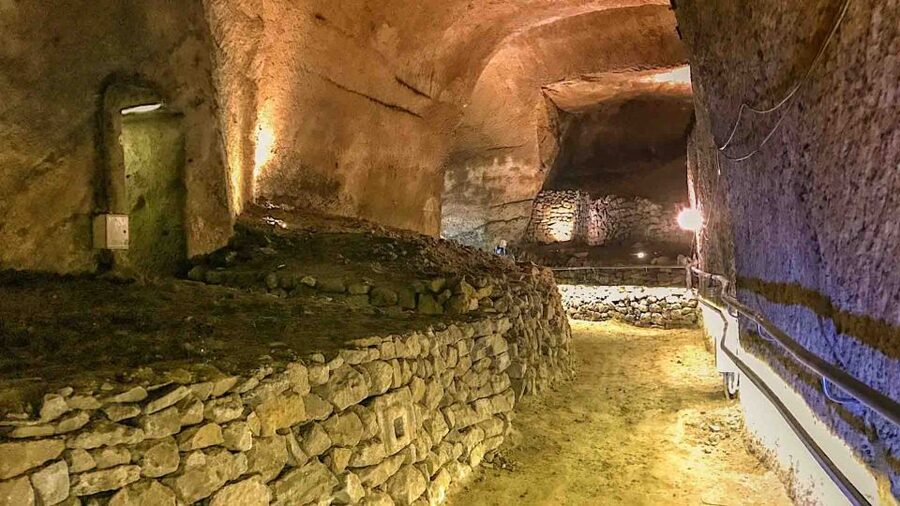
Naples is one of Italy’s oldest cities, and its underground spaces explain why the surface can feel so layered and crowded. Below the streets are Greek cisterns, Roman aqueducts, and passages cut into the hard stone. Some parts are empty, some preserve old water systems, and others became shelters during the Second World War.
The unusual part is that this is not a separate archaeological park outside the city. You begin in the middle of Naples, at Piazza San Gaetano, then move downward through places that connect directly to the streets and churches around you.
The underground route forms part of the LAPIS Museum path. It reaches roughly 40 meters below the crowds and passes through spaces used for very different purposes over time. First came water collection and storage. Later, parts of the route served as a medieval secret passage. In 1943, the tunnels offered protection from air raids.
That change in purpose is the heart of the experience. You are not simply looking at old stone. You are following how people adapted the same underground spaces as the needs of Naples changed.
The description of the city’s underground says that 45 percent of it is practically empty. You should not read that as a promise of a giant open cavern at every turn. Instead, expect a route made up of cisterns, tunnels, chambers, and preserved rooms, with the guide explaining how they fit into the larger underground network.
More Museum Tours in Naples
- Naples: National Archaeological Museum Tour & Digital Guide
★ 4.2 · 177 reviews - Naples: National Archaeological Museum audio guide
★ 4.0 · 155 reviews - Capodimonte Museum in Naples
★ 4.0 · 115 reviews
Starting at Piazza San Gaetano and Via dei Tribunali
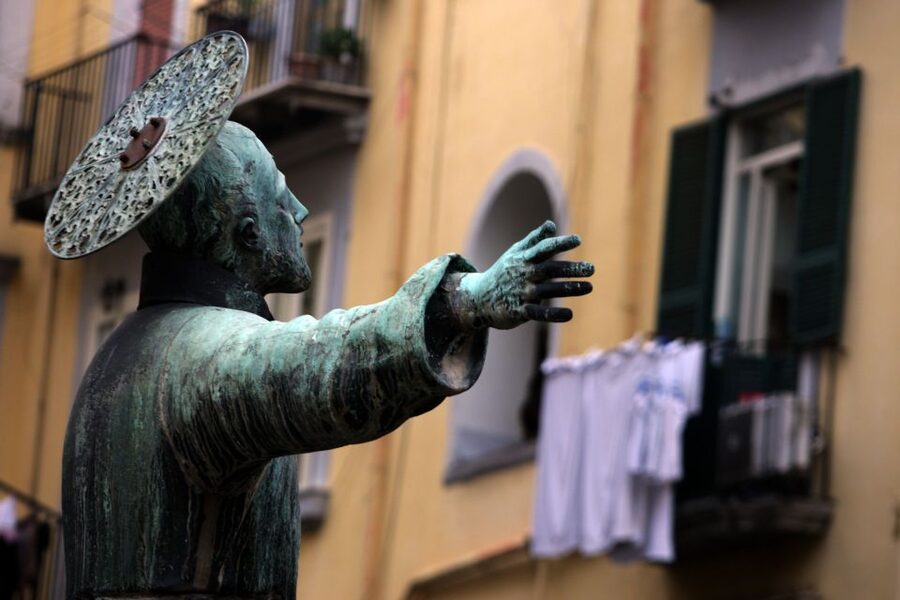
Meet at the foot of the statue in Piazza San Gaetano. Look for the guide holding a Grand Tour Experience sign. This is a busy, historic part of the city, so allow enough time to reach the square and locate the group without rushing.
Piazza San Gaetano was an ancient Greek and Roman square. Starting here gives the tour a useful sense of place before you go underground. You are standing on a site shaped by several periods of Naples, not simply gathering at a convenient meeting point.
From the piazza, the group walks along Via dei Tribunali. This is where the tour begins to link archaeology with present-day life. You see local streets and culture while learning about what the guide calls the underground cults of Naples.
I like this opening because it prevents the lower route from feeling cut off from the city above. The streets, churches, and remains are part of one story. You get a short walking introduction before the main underground visit, rather than stepping straight into a museum with no sense of its setting.
The group size matters here. With no more than 10 people, you should have a better chance of hearing explanations in the street and asking a question before the descent. The guide speaks English or Italian, and the booking information identifies a live guide rather than an audio system.
Basilica di San Lorenzo Maggiore and the glass floor
The next stop is Basilica di San Lorenzo Maggiore. This gothic church adds another layer to the route, since Naples often places later religious buildings over much older remains.
Inside, you can look through a glass floor at the remains of an earlier ancient mosaic. That view is brief but useful. It shows how archaeological evidence can survive directly beneath a functioning church, and it prepares you for the idea that much of Naples is built over earlier Naples.
This stop also helps break up the underground portion. You are not spending the full two hours in tunnels. The route moves between open city streets, church interiors, and below-ground chambers, giving the experience a clear rhythm.
The drawback is that this is a compact tour. The basilica and its remains form part of a guided route, not a long independent visit. If you want to study every architectural detail at leisure, you may prefer to return later on your own. Here, the guide keeps the group moving toward the LAPIS entrance.
The Church of Purgatory and the way down
The route continues to the Church of Purgatory. The key detail here is its connection to what lies below. The church was built on a pagan Roman temple dedicated to Diana, and Roman structures are still present.
You then enter through a doorbell in one of Naples’ oldest churches, Santa Maria Maggiore. That entrance is one of the tour’s memorable practical details. The route does not begin with a grand modern visitor center. It starts through an old church, then continues downward into the stone beneath it.
The descent is part of the story, but it is also the point where you should think about comfort. Bring comfortable shoes and wear clothing suited to the weather above ground, while remembering that the underground spaces may feel different from the streets. A camera is allowed and worth bringing, but you should also be ready for dim conditions and narrow passageways.
The tour information does not promise a fully even, step-free route. It specifically says the experience is not suitable for wheelchair users. If stairs or uneven surfaces are difficult for you, ask before booking rather than assuming that the museum entrance will solve the problem.
A few more museum visits around Naples worth comparing
- New York City: American Museum of Natural History Ticket
★ 4.5 · 15,447 reviews - Amsterdam: Van Gogh Museum Ticket and City Canal Cruise
★ 4.6 · 3,899 reviews - Cairo: Female-Guided Pyramids, Sphinx & Museum City Tour
★ 4.8 · 1,614 reviews - Beijing: Tianmen Square, Forbidden City & Royal Museum Tours
★ 4.6 · 1,288 reviews
Greek cisterns carved into the stone
As you continue down, you reach Greek cisterns cut into the tough stone. These spaces show how early Naples used the underground for practical needs. The route is not only about burial places or ruins. Water collection and storage are central to what you see.
The guide’s role is particularly valuable here. A chamber carved into rock can look simple at first. The archaeology explains the work behind it, the reason for its shape, and how it connected to the water system used by later residents.
For me, this is where the tour earns its price. Admission to the Roman Cistern Museum, the LAPIS Museum, and the WWII Shelters Museum is included, along with a local guide and professional archaeologist. At $53 per person, you are paying more than you would for a basic walk through the streets, but you are getting access to a connected underground route and specialist interpretation.
The value depends on your interests. If you mainly want Naples street food, shopping, or broad sightseeing, two hours underground may not be your best use of $53. If ancient engineering, old churches, and wartime history appeal to you, the combination is more convincing because you see several periods in one compact visit.
Roman water tanks and the lowest point
At the lowest point of the route, the path reaches tunnels and tanks used for collecting water in Roman times. This is the most direct connection to the Roman period and one of the clearest examples of the underground serving an everyday need.
The experience is physical as well as historical. You move through tunnels rather than simply looking at an object behind glass. That makes the route more memorable, but it also means you should expect a walking tour with a descent, not a standard indoor museum visit.
The underground spaces can also make it easier to understand the scale of old water systems. On the surface, an aqueduct or cistern may be reduced to a few stones and a label. Here, the route lets you follow the spaces themselves, while the archaeologist explains how they belonged to a larger network.
You should bring a credit card and cash, but food and drinks are not included. A packed lunch is listed among the suggested items, although the tour itself lasts only two hours. If you plan to eat before or after, Piazza Bellini, where the tour ends, gives you a useful point for continuing your day.
A medieval passage and a 1943 air-raid shelter
The same underground route took on a new role in medieval times as a secret passage used by the Templar Knights. The description does not suggest a theatrical reenactment, so expect historical explanation rather than actors or special effects.
Later, in 1943, the tunnels became an airplane retreat, meaning a shelter from air raids. This modern use gives the route more emotional weight. Ancient stone and Roman water systems are one thing. Seeing the same underground world used by people seeking safety during war brings the history much closer to modern life.
Many of the shelter’s bathrooms, kitchens, and personal memorabilia remain preserved. Those details can be more revealing than a grand monument. They show how people tried to make a temporary refuge function as a living space.
This section also keeps the tour from becoming narrowly classical. You are not only moving between Greek and Roman remains. The route continues through medieval and twentieth-century Naples, giving you a better sense of how the city reused what it inherited.
Ending at Piazza Bellini
The tour finishes at Piazza Bellini. That gives you a central place from which to continue exploring Naples after the underground route.
The ending is practical because the experience does not return you to Piazza San Gaetano. Make a note of the finish point before you begin, especially if you have a timed reservation elsewhere. The two-hour duration is short enough to fit into a day of sightseeing, but you should still allow a little extra time for the group to gather, descend, and finish.
Because the walk begins and ends in different squares, it works well as a bridge between parts of central Naples. You can start near the historic center and continue from Piazza Bellini rather than backtracking.
Guide quality and group size
The strongest pattern in the feedback is the guide’s ability to make the subject lively and clear. Riccardo was singled out for his passion and strong command of the subject. Theresa was praised for deep subject knowledge, patient answers, and willingness to handle questions.
Those comments matter because underground archaeology can become dry if the explanation is rushed or too technical. A good guide helps you connect a cistern to the city above and a wartime kitchen to the people who used it.
You should still remember that guides vary by date. Riccardo and Theresa may not lead every departure. The experience includes a professional archaeologist and a live guide, but a particular guide cannot be guaranteed from the supplied booking details.
The overall rating is 4.5 from 29 reviews. The individual feedback is mostly very positive, with several five-star ratings praising the guides and the amount learned in a short time. One two-star entry records a cancellation by the operator, so it is sensible to keep an eye on any booking updates. Most important for your decision, the content itself receives more praise than the logistics.
What to bring and who should book
Wear comfortable shoes. You will walk through city streets, descend underground, and pass through tunnels. Bring a camera if you want to record the cisterns and shelters, along with weather-appropriate clothing for the outdoor parts.
Pets are not allowed, although assistance dogs are permitted. Food and drinks are not included, and personal expenses are your responsibility. The supplied information also suggests bringing cash, a credit card, and a packed lunch.
This tour suits you best if you:
- Want a strong history focus in a short format
- Enjoy archaeology, old churches, and underground spaces
- Prefer a guide who can answer questions
- Are comfortable walking and descending into tunnels
- Want to connect Greek, Roman, medieval, and World War II history
It may not suit you if you need step-free access, dislike enclosed spaces, or want a relaxed food-focused walk through Naples. The route asks for attention and physical movement, but it rewards you with a side of the city that is easy to miss from street level.
Is the $53 price fair?
At $53, the price is reasonable for a two-hour guided visit if you value expert interpretation and included admissions. The fee covers the local guide, professional archaeologist, Roman Cistern Museum and LAPIS Museum admission, plus the WWII Shelters Museum.
You are also paying for the structure of the route. Finding a church entrance, understanding which tunnels belong to which period, and making sense of preserved wartime rooms would be difficult without guidance. The small group limit adds further value, especially if you want to ask questions.
Still, this is not a bargain city stroll. The price will feel high if you only want to see Naples from above or if you plan to spend the day visiting several paid sights. Book it for the underground access and the archaeologist-led explanation, not simply because it is a walking tour.
Should you book the LAPIS Museum tour?
I would book this tour if you want Naples history in concentrated form and can manage the underground route. The sequence from Piazza San Gaetano to Via dei Tribunali, the churches, Greek cisterns, Roman tanks, medieval passage, and 1943 shelter gives you a strong sense of how the city has reused its past.
The best reason to go is the connection between the layers. You see an ancient mosaic beneath a gothic church, enter the underground through Santa Maria Maggiore, then walk through spaces that changed from water storage to secret passage to wartime refuge.
Skip it if accessibility is a concern or if you prefer to set your own pace inside museums. For everyone else, especially history-minded visitors with comfortable shoes, this is a focused and unusual way to understand Naples from the stone beneath your feet.
FAQ
How long does the tour last?
The tour lasts two hours.
Where does the tour begin?
It begins at Piazza San Gaetano, at the foot of the statue. Look for the guide holding a Grand Tour Experience sign.
Where does the tour finish?
The tour finishes at Piazza Bellini.
What languages are available?
The live tour guide speaks English or Italian.
How large is the group?
The group is limited to 10 participants.
Is admission included?
Yes. Admission to the Roman Cistern Museum, the LAPIS Museum, and the WWII Shelters Museum is included.
Is the tour suitable for wheelchair users?
No. The experience is not suitable for wheelchair users.
What should I bring?
Bring comfortable shoes, a camera, a credit card, cash, a packed lunch, and weather-appropriate clothing. Pets are not allowed, but assistance dogs are permitted.
Just added around Naples
- Naples: Città della Scienza Interactive Museum Entry Ticket★ 4.1 · 32 reviews
- Naples: San Gennaro Experience With Filangieri Museum Option★ 4.3 · 55 reviews
- Naples: Chapel & Museum of San Gennaro Guided Tour★ 4.5 · 35 reviews
- Naples: LAPIS Museum Guided Visit in Italian★ 4.7 · 46 reviews
- Naples: Capodimonte Museum small group tour★ 4.8 · 51 reviews
- Naples: 3-Days Pass w/ Pompeii, Museums & Transport Included★ 4.4 · 13 reviews
- Naples: Capodimonte Museum 2-Hour Guided Private Tour★ 4.5 · 15 reviews
- Naples: 7 Days Pass – Pompeii, Museums & Transport Included★ 3.7 · 17 reviews
Museum Tours in Naples, compared.

National Archaeological Museum Tour & Digital Guide
Read our review →


San Gennaro Experience With Filangieri Museum Option
Read our review →
Naples Archaeological Museum 2-Hour Guided Private Tour
Read our review →

Maradona Museum: The first museum dedicated to Diego Armando Maradona
Read our review →Browse the lists this tour appears in