
Review · NAPLES
Naples: LAPIS Museum Guided Visit in Italian
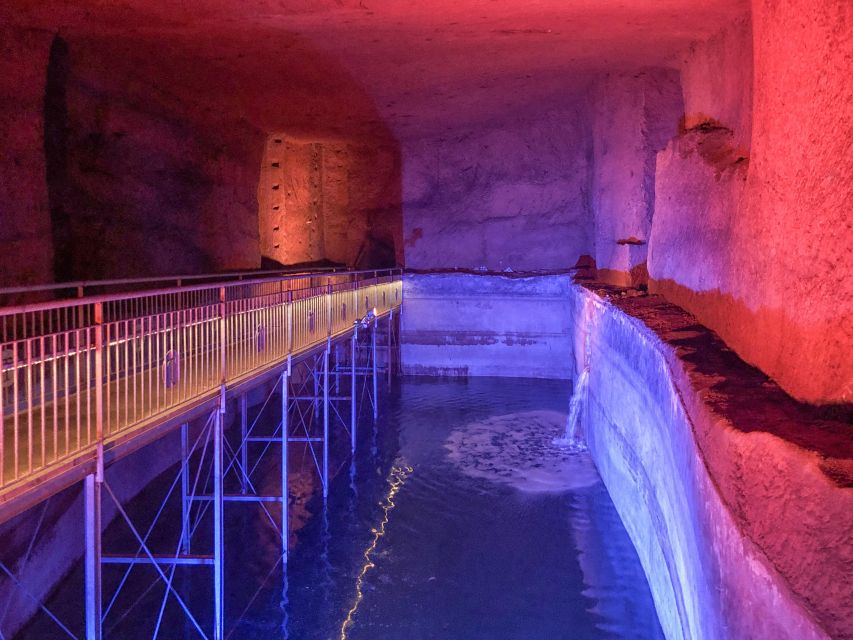
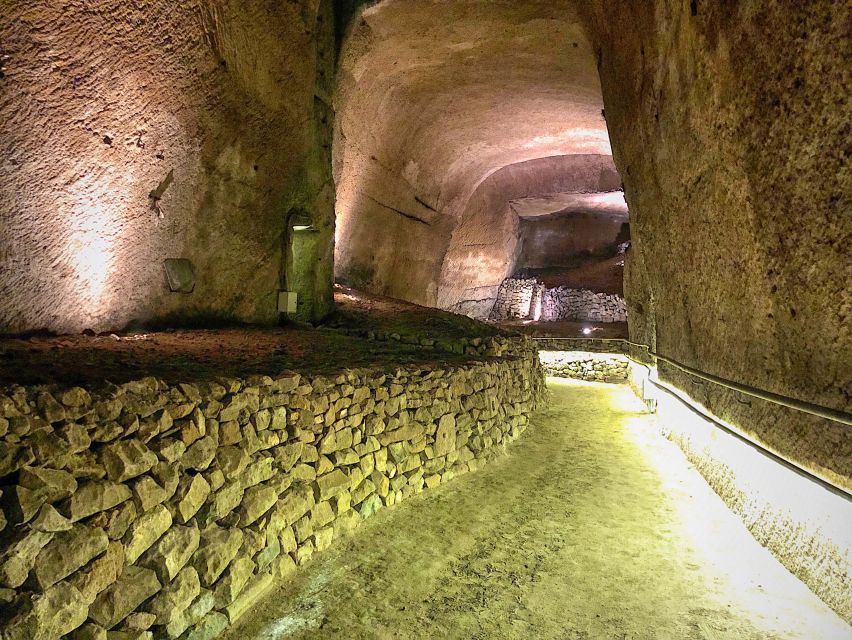
Naples keeps some of its best stories below street level. At the Lapis Museum, you descend beneath the Basilica of Pietrasanta in an archaeological lift, then walk through ancient Greco-Roman cisterns and water channels lit in changing colors. I like the 35-meter descent and the way the tour connects ancient engineering with the later Basilica. I also like the small groups of no more than 10 people, which should make it easier to follow the guide in Italian. The main drawback is clear: this is not a good choice if you have a mobility impairment or use a wheelchair.
The visit lasts 75 minutes and costs $15 per person, a fair price for an unusual underground attraction in Naples. It is conducted entirely in Italian, so you will get the most from it if you can follow spoken Italian or are happy to focus on the visual setting.
Key points at a glance
- Descend 35 meters in about 20 seconds: The archaeological lift links the Basilica’s crypt with the underground level.
- See ancient water systems below central Naples: The route passes through Greco-Roman cisterns, runoffs, and channels.
- Visit the Museo dell’Acqua di Napoli: The Water Museum forms the main hub of the underground route.
- Look for the Submerged Decumanus: This atmospheric section adds an archaeological layer to the visit.
- Experience the Basilica of Pietrasanta from below: The underground rooms reveal a side of the building most street-level sightseeing misses.
- Join a small Italian-speaking group: The maximum of 10 participants keeps the tour focused, though language is important.
Why Naples looks different from 35 meters below ground
The Lapis Museum gives you a useful reminder: Naples is not just a city of churches, pizza shops, and crowded lanes. Much of its story is built in layers, and this tour takes you beneath one of the historic center’s churches to see those layers at close range.
The Basilica of Pietrasanta now contains the Lapis Museum, whose underground route follows the old water infrastructure beneath the building. You are not simply looking at a few scattered ruins. The experience centers on a connected system of cisterns and water runoffs, shaped by centuries of construction and reuse.
The route is especially interesting because it joins several periods. The underground spaces relate to ancient Greco-Roman water engineering, while the basilica above was built by architect Cosimo Fanzago in the mid-seventeenth century on the remains of an ancient temple dedicated to the goddess Diana. That gives the visit a strong sense of Naples as a layered city, where one building can sit on top of another era.
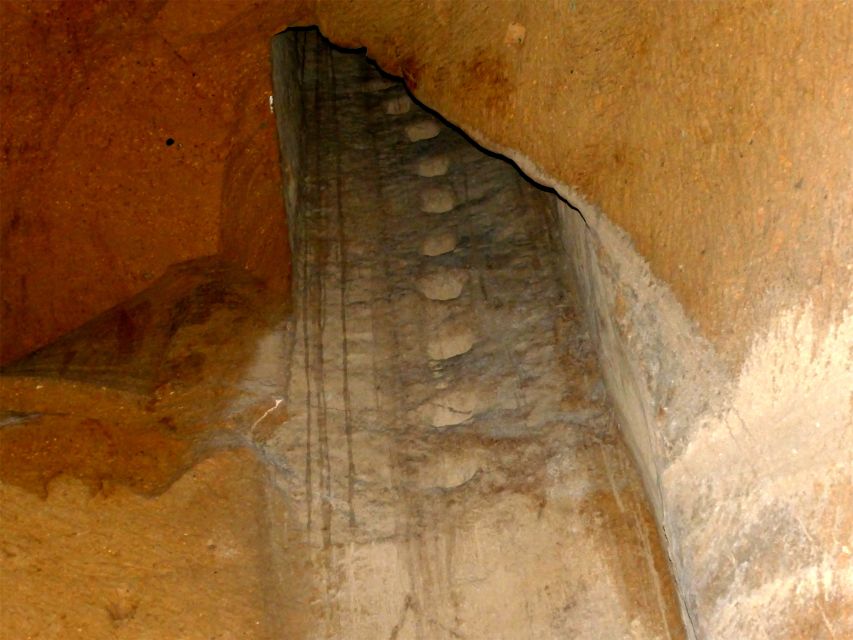
I find this more rewarding than a standard room-by-room museum visit. You are moving through the physical spaces themselves, seeing vaults, shafts, and water-related structures rather than only reading about them. The setting does much of the teaching.
More Museum Tours in Naples
- Naples: National Archaeological Museum Tour & Digital Guide
★ 4.2 · 177 reviews - Naples: National Archaeological Museum audio guide
★ 4.0 · 155 reviews - Capodimonte Museum in Naples
★ 4.0 · 115 reviews
The ancient lift makes the descent part of the tour
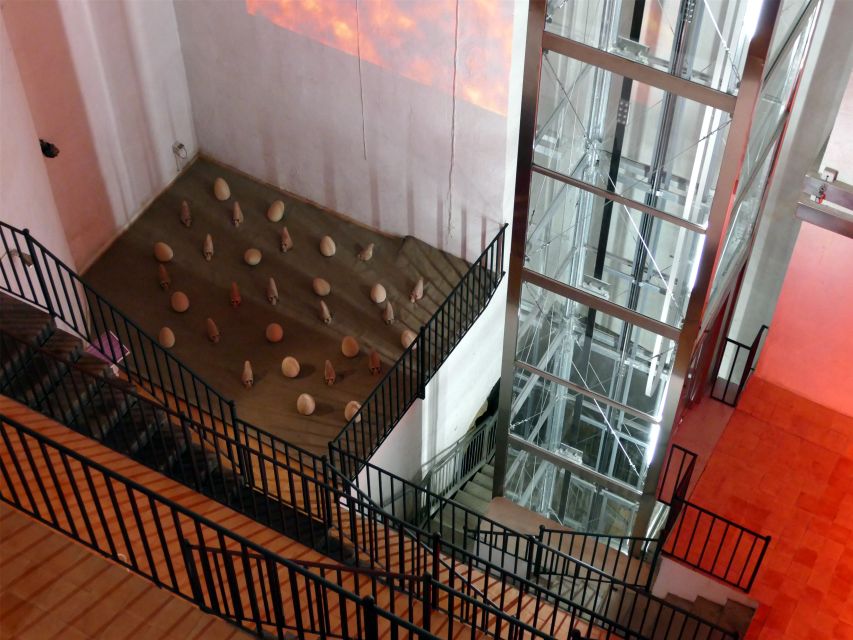
One of the most memorable parts of the visit comes before you reach the cisterns. The archaeological lift carries you from the crypt down to the underground level, reaching 35 meters below the surface in about 20 seconds.
That short ride changes the scale of the experience. You begin inside a familiar religious building, then quickly move into a far older world below it. The lift is also a practical part of the museum’s design, connecting the upper and lower spaces without requiring a long descent through the historic structure.
The lift is not a minor convenience. It is described as the first archaeological lift in Naples’ historic center, and its presence makes the underground route accessible to visitors who could manage the tour but might not want a long stair descent. Still, the experience is not suitable for wheelchair users or people with mobility impairments, so you should take that warning seriously.
Once below, the tour becomes a walking visit through the underground path. The route is called the Submerged Decumanus, a name that hints at its archaeological character and its connection to the ancient street grid associated with Roman Naples. The available information does not give a detailed step count or specify every surface along the route, so anyone with concerns about walking should ask the provider before booking.
The Museo dell’Acqua di Napoli and its working water spaces
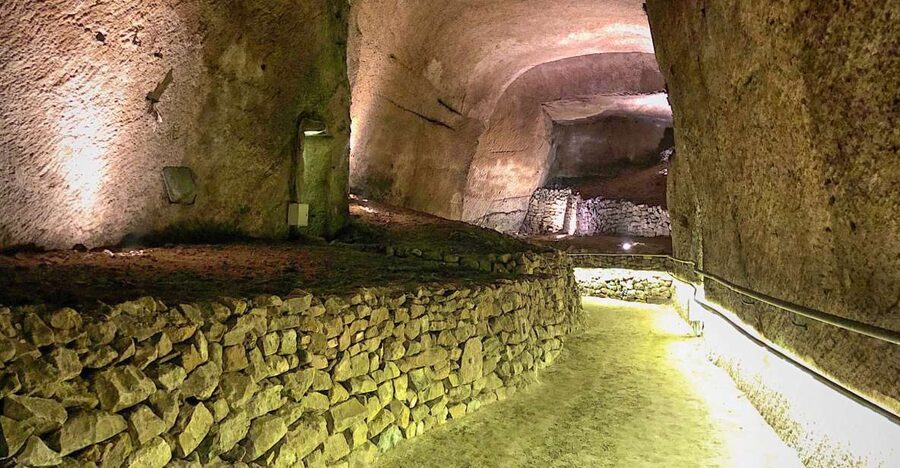
The Water Museum is the central point of the underground path. Its subject is practical rather than decorative: how Naples collected, stored, and moved water through underground structures.
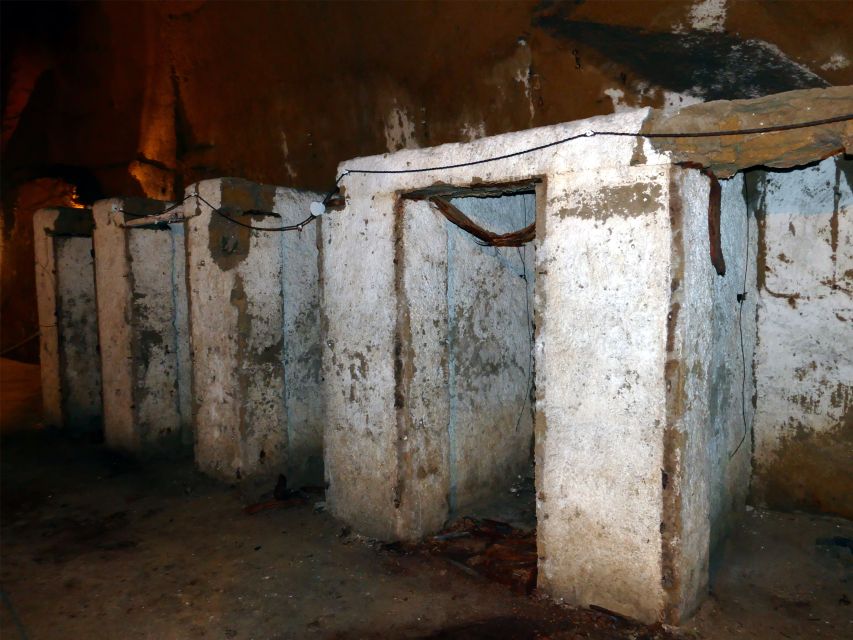
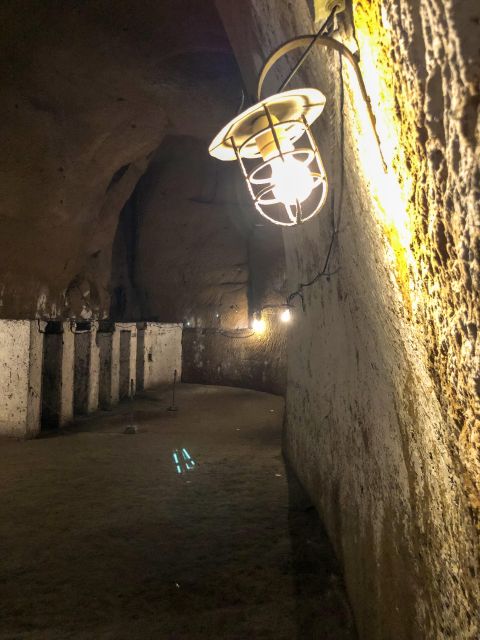
The Greco-Roman cisterns are the main attraction. These large underground chambers were built to hold water, and the route lets you see their scale from inside. Vaults and walls take on a different character when you understand that they were part of a hydraulic system, not merely empty rooms left behind.
The description of the museum says the cisterns now contain water and runoffs. That detail matters. You are not looking at completely dry archaeological shells. Water remains part of the atmosphere and helps explain why these spaces were built in the first place.
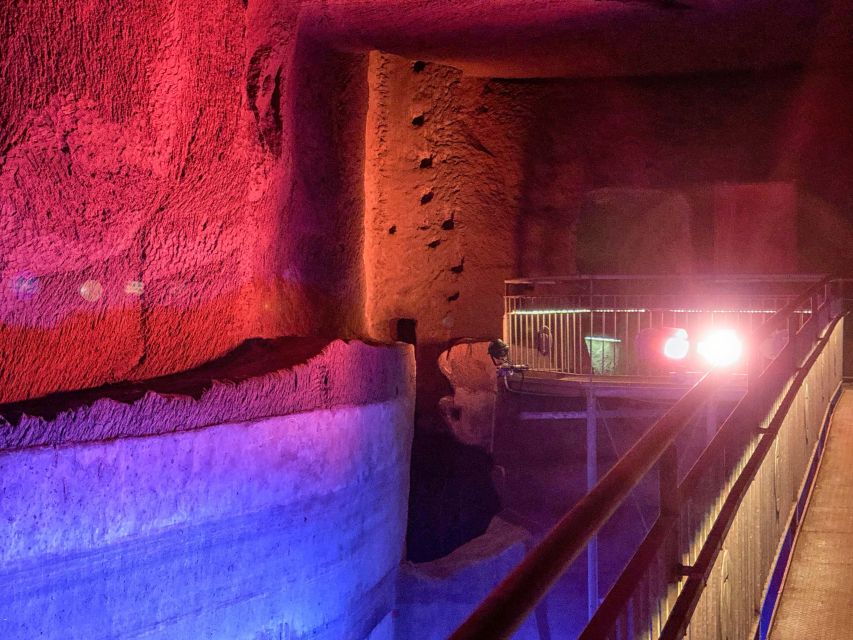
The lighting system adds drama by picking out the shapes of the vaults and chambers with different colors. This is not natural archaeology in the strictest sense, but it makes the form of the underground architecture easier to see. A bare cistern can be difficult to read in low light. Carefully placed lighting helps reveal its depth and curves.
I would treat the lighting as an aid, not the main reason to book. The real appeal is the combination of engineering, water, and underground architecture. The colored lights create the mood, but the cisterns supply the substance.
The Submerged Decumanus and the Basilica of Pietrasanta
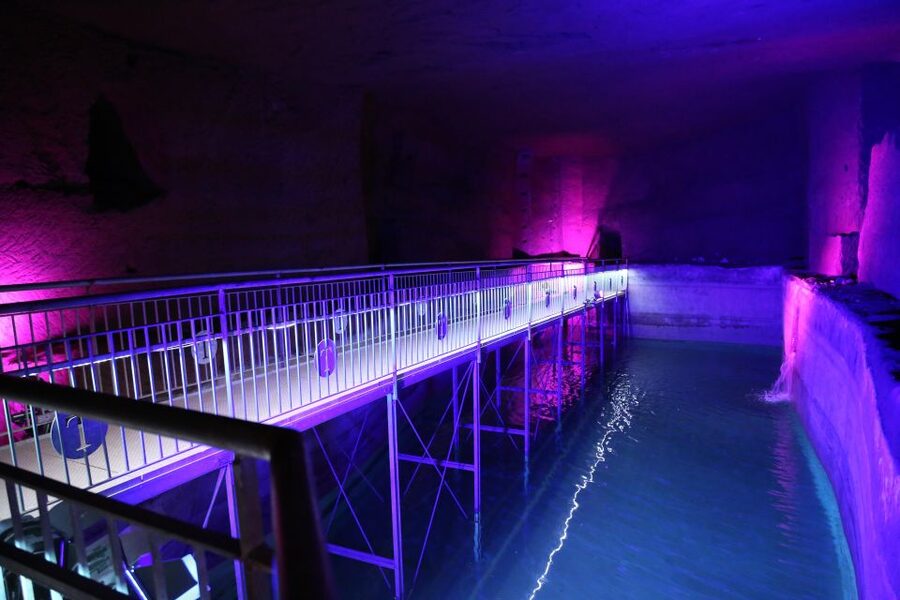
The route’s name, Submerged Decumanus, points to one of its most distinctive features. A decumanus was an east-west road in a Roman city, and the museum presents this underground section as part of Naples’ buried urban fabric.
The supplied details do not describe every feature of the route, so you should not expect a full reconstruction of an ancient Roman street based on the information available. What you can expect is an underground path that gives context to the city above and places the water system within a wider archaeological setting.
The Basilica of Pietrasanta also deserves attention. From the street, you see a church in Naples’ historic center. Below it, the museum reveals the older foundations and systems that occupy the same footprint. The connection between the basilica and the underground route is what gives the visit its sense of discovery.
The building’s link to Cosimo Fanzago adds another layer. He designed the basilica in the mid-seventeenth century, on the remains of the ancient temple of Diana. The tour therefore brings together an ancient temple site, Roman-era water infrastructure, a Baroque-era church, and a modern museum installation.
That combination is particularly useful if you have already seen some of Naples’ churches and historic streets. Instead of repeating the same view from above, the Lapis Museum shows how the city was built over time.
A few more museum visits around Naples worth comparing
- Naples: Jago Museum & Sant’Aspreno ai Crociferi Guided Tour
★ 4.9 · 96 reviews - Naples Archaeological Museum 2-Hour Guided Private Tour
★ 5.0 · 51 reviews - Naples: Chapel & Museum of San Gennaro Guided Tour
★ 4.5 · 35 reviews - Naples: Capodimonte Museum 2-Hour Guided Private Tour
★ 4.5 · 15 reviews
What the 75-minute itinerary feels like
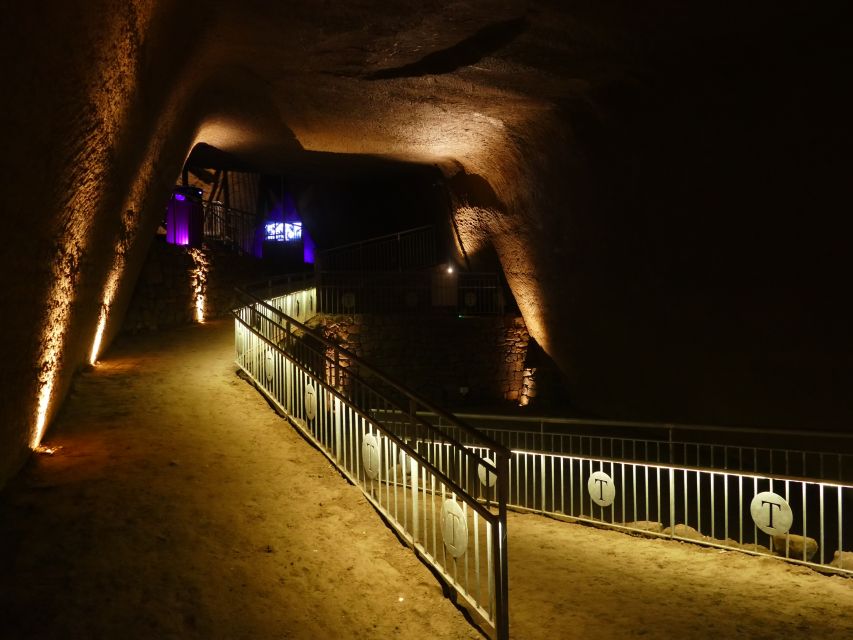
The visit is compact. In 75 minutes, you have enough time for a focused look at the underground route without giving up half a day.
You begin at the Basilica of Pietrasanta and enter the museum area. The guide introduces the setting and the Water Museum before taking the group toward the archaeological lift. The lift ride itself takes roughly 20 seconds, but the change from the crypt to 35 meters underground gives the tour a strong opening.
Below the surface, the guide leads you through the cisterns and related underground spaces. You can expect the guide to explain the water system, the structure of the chambers, and the archaeological setting in Italian. The small group limit of 10 should help you stay close enough to hear and see what is being pointed out.
The route then brings together the illuminated vaults, water runoffs, and the Submerged Decumanus. The lighting draws your eye toward the curved ceilings and the scale of the chambers. This is a place where you will want to pause, but the visit remains guided and timed, so you should not expect unlimited independent exploration.
The final part returns you to the significance of the site as a whole: Naples above, the basilica at street level, and the ancient water system below. The experience is short enough to fit before another historic-center visit, though you should allow extra time around the scheduled start for finding the meeting point.
Italian only, small groups, and the guide’s role
The live guide speaks Italian, and no other language is listed. This is the most important booking consideration after mobility.
If you understand Italian, the tour format should work well. A small group makes it easier to hear explanations in the underground chambers, where echoes and water sounds may affect communication. If your Italian is limited, you can still appreciate the architecture and lighting, but you may miss the historical explanations that give the route its meaning.
The available feedback describes the guide as very well prepared and the organization as very good. That matches the type of attraction this is: without explanation, you see dark rooms, water, and colored lights; with a strong guide, you understand how those rooms relate to Naples’ ancient and later development.
No guide name is provided, so I would not plan around a particular person. The important point is the language and the small-group format. If you need an English tour, this particular departure is not the right fit based on the information available.
Is $15 a good value for the Lapis Museum?
At $15, this is one of the easier Naples attractions to justify on price. The admission includes the museum entrance and an Italian-speaking guide, and the experience lasts 75 minutes.
The value comes from the unusual setting. You are not paying only to enter a church or view a small collection. The ticket includes the underground route, the lift descent to 35 meters, and a guided look at cisterns that are difficult to understand without access and interpretation.
The price also works well for a short itinerary slot. You can pair the visit with other sightseeing in the historic center rather than committing a whole day. That makes it useful for a first visit to Naples when you want one unusual stop between larger attractions.
The value is lower if you do not understand Italian and mainly want a self-guided archaeological visit. The information supplied does not indicate that written translations or multilingual explanations are provided. In that case, the lighting and spaces may still interest you, but the historical context will be less complete.
You can reserve now and pay later, which helps if your Naples schedule is still shifting. Cancellation is free up to 24 hours before the visit for a full refund. Bookings must be made no later than 24 hours before the desired visit, so this is not an ideal choice for a same-day decision.
Who should book this underground Naples visit?
I would recommend it most strongly to you if you enjoy archaeology, old engineering, churches with multiple building layers, or places that show Naples from an unusual angle.
It also suits repeat visitors who have already seen the main churches and museums. The underground route gives you something different from the usual historic-center circuit. The comments provided describe the experience as fascinating and moving, and one visitor specifically praised seeing Naples from a different viewpoint.
Families and casual sightseers may enjoy the lift and the atmospheric chambers, but the Italian-only narration will determine how much they take away. The 75-minute length is helpful for a mixed group because it is long enough to feel worthwhile without becoming an all-day commitment.
You should reconsider it if you use a wheelchair or have a mobility impairment. The tour is explicitly not suitable for those visitors. You should also think twice if you want a quiet, independent visit, since this is a guided small-group experience with a fixed duration.
Booking advice and practical details
Plan to reserve at least 24 hours ahead. The experience cannot be booked later than that cutoff, and the provider asks you to use the supplied mobile number for day-of-tour information, delays, entrance-time changes, or assistance at the meeting point.
Check the starting time carefully when booking. The duration is 75 minutes, but the available information does not provide a fixed daily schedule. You should confirm the time that works with your plans before making other reservations.
The group is limited to 10 people. That is a useful balance: small enough for a more personal guide experience, but not necessarily private. The admission ticket and Italian-speaking guide are included, while no additional inclusions are specified.
The tour takes place at the Basilica of Pietrasanta in Naples’ historic center. Because the attraction involves a descent into the subsoil and a route through old cisterns, wear practical shoes and avoid building a tight schedule around the end time. The information does not state the exact walking surface or temperature below ground, so leave a little breathing room rather than treating the 75 minutes as a precise door-to-door time.
Should you book the Lapis Museum?
Book this tour if you want a short, distinctive Naples experience that combines ancient water engineering, a Baroque basilica, and an unusual descent into the city’s lower layers. At $15, the 35-meter lift ride and 75-minute guided route offer good value, especially for Italian speakers and repeat visitors.
Skip it if you need an accessible route, require an English guide, or prefer to explore independently. For everyone else, the Lapis Museum offers a useful change of pace from Naples’ crowded streets and famous churches. You leave with a better sense of how much of the city exists below your feet.
FAQ
Where does the Lapis Museum visit take place?
The visit takes place at the Basilica of Pietrasanta in Naples’ historic center. The underground route is part of the Lapis Museum.
How long does the tour last?
The tour lasts 75 minutes.
How deep underground does the tour go?
The archaeological lift descends to a depth of 35 meters.
How long does the lift ride take?
The lift connects the crypt with the underground level in about 20 seconds.
Is the tour guided?
Yes. Admission includes a live Italian-speaking tour guide.
What language is the tour in?
The tour is conducted in Italian. No other tour language is listed.
How large is the group?
The experience is offered as a small-group tour limited to 10 participants.
What does the ticket include?
The ticket includes admission to the Lapis Museum and an Italian-speaking guide.
Is the tour suitable for wheelchair users?
No. The experience is not suitable for wheelchair users or people with mobility impairments.
Can I cancel the booking?
Yes. You can cancel up to 24 hours in advance for a full refund. You can also reserve now and pay later.
Just added around Naples
- Naples: City and Lapis Museum Tour with an Archaeologist★ 4.5 · 29 reviews
- Naples: Città della Scienza Interactive Museum Entry Ticket★ 4.1 · 32 reviews
- Naples: San Gennaro Experience With Filangieri Museum Option★ 4.3 · 55 reviews
- Naples: Chapel & Museum of San Gennaro Guided Tour★ 4.5 · 35 reviews
- Naples: Capodimonte Museum small group tour★ 4.8 · 51 reviews
- Naples: 3-Days Pass w/ Pompeii, Museums & Transport Included★ 4.4 · 13 reviews
- Naples: Capodimonte Museum 2-Hour Guided Private Tour★ 4.5 · 15 reviews
- Naples: 7 Days Pass – Pompeii, Museums & Transport Included★ 3.7 · 17 reviews
Museum Tours in Naples, compared.

National Archaeological Museum Tour & Digital Guide
Read our review →


San Gennaro Experience With Filangieri Museum Option
Read our review →
Naples Archaeological Museum 2-Hour Guided Private Tour
Read our review →

Maradona Museum: The first museum dedicated to Diego Armando Maradona
Read our review →Browse the lists this tour appears in