
Review · ROME
Rome: Borghese Gallery Guided Small Group Tour
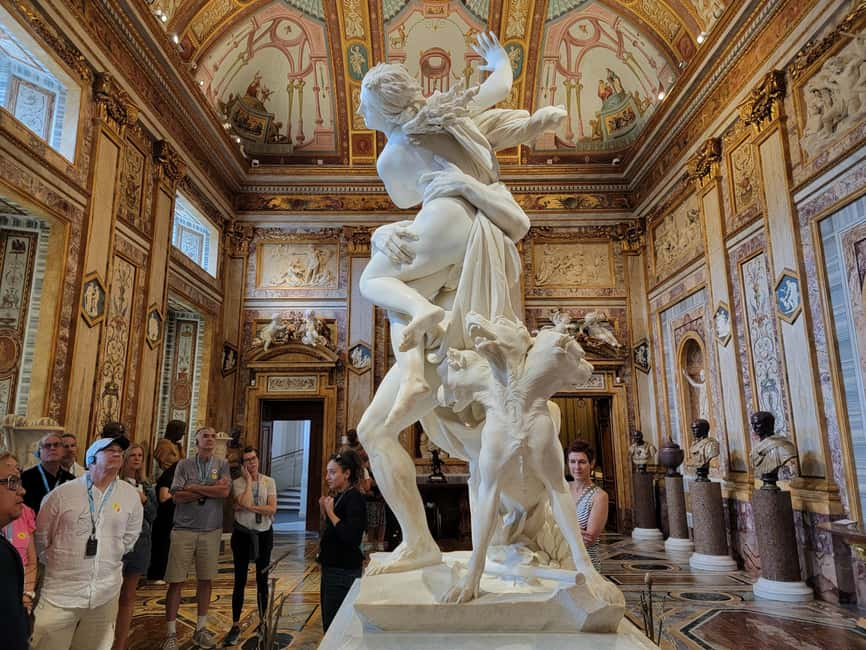
The best part of this tour is the setting: at about 5 p.m., you enter the Borghese Gallery as the day’s crowds begin to thin and evening light reaches across the marble sculptures. I especially like the six-person maximum, which gives your guide room to explain details without turning the visit into a lecture shouted over a crowd. I also like the clear focus on major works by Bernini, Caravaggio, and Raphael, rather than a rushed attempt to cover every corner of the museum.
The main consideration is the price, $168.79 per person for two hours. That is a serious outlay, even in Rome, so this tour makes the most sense if you value a close, art-focused experience and want help understanding what you are seeing. The separate mention of Rome’s Jewish Quarter can also cause confusion, since the described activity begins and ends at the Borghese Gallery and does not provide a detailed Jewish Quarter visit.
Key points at a glance
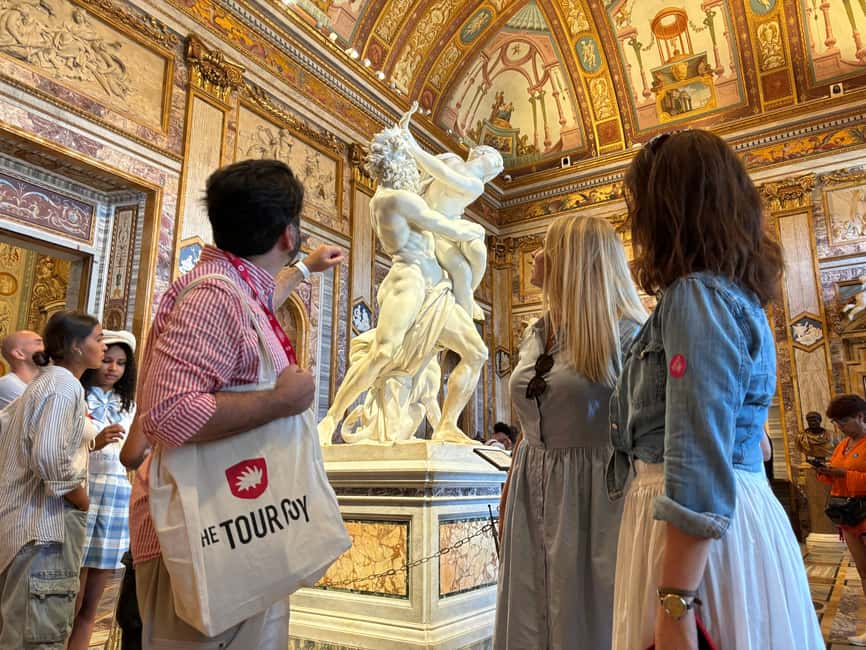
- See Bernini’s Apollo and Daphne: Study one of the Borghese Gallery’s most famous marble groups and hear the story behind its transformation and movement.
- Enter at the quieter 5 p.m. hour: The late timing can make the rooms feel calmer and gives the sculptures a softer evening glow.
- Keep the group to six people: A small party allows more direct conversation with the English-speaking guide.
- Focus on Caravaggio and Raphael: Hear the background to David with Goliath’s Head and The Deposition, along with works by Rubens and Titian.
- Add a walk through Villa Borghese Gardens: The tour ends at the museum, so you can explore the park independently before or after your visit.
- Book well ahead: Museum tickets are limited and reservations are mandatory.
Why the Borghese Gallery is worth two focused hours
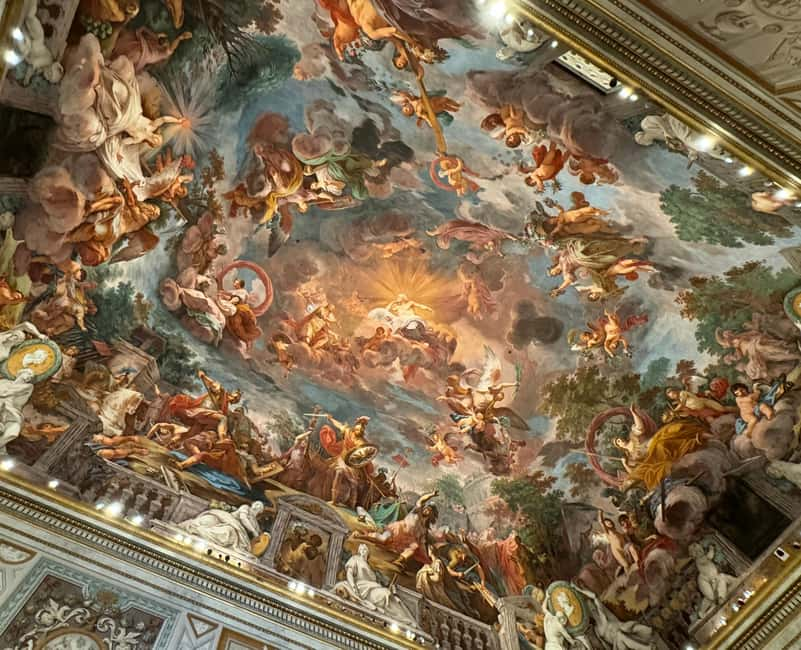
The Borghese Gallery is not a huge museum that demands an entire day. Its strength is concentration. You move through a former villa filled with major sculpture and painting, with the building itself forming part of the experience.
Cardinal Scipione Borghese commissioned the villa in the early 1600s. He was the nephew of Pope Paul V and used the house to display his growing collection. That original purpose still shapes the visit. Rooms are decorative, formal, and designed to make art feel central rather than incidental.
I like this kind of museum for a first visit to Rome because you can see important works without the fatigue that often comes with a giant collection. Two hours is enough time to pay attention. It is also short enough to leave room for the gardens, dinner, or another evening plan.
The museum sits inside Villa Borghese, one of Rome’s largest parks. You get art indoors and a peaceful break outdoors, a useful combination after time on the city’s busy streets.
More Museum Tours in Rome
- Vatican Museums, Sistine Chapel & St. Peter’s Basilica Tour
★ 4.3 · 73,970 reviews - Vatican Museums, Sistine Chapel & St Peter’s Basilica Guided Tour
★ 4.5 · 39,149 reviews - Rome: Vatican Museums, Sistine Chapel and Basilica Tour
★ 4.3 · 16,039 reviews
Meeting your guide outside the main entrance
You meet outside the main entrance to the Borghese Gallery. Look for the guide holding a LivItaly Tours sign. The tour returns to this same meeting point after the museum visit, so you do not need to arrange a separate pickup or find your way to another neighborhood at the end.
This simple setup matters in Rome, where meeting points can be confusing. Give yourself enough time to reach the gallery and identify the entrance before the scheduled start. The information provided for this experience lists a 5 p.m. entry, but you should check the available date and time when booking.
The guide leads in English. The small group is limited to six participants, which is one of the strongest reasons to choose this option over a large museum group. You can usually expect a more personal exchange, with room to ask why a work matters or how an artist handled a particular subject.
The guide’s role is especially useful here because the Borghese Gallery rewards close looking. A sculpture may seem beautiful at first glance, but the guide can point out the turning body, carved fabric, facial expression, or visual trick that makes the work remarkable.
Bernini’s marble theater in Apollo and Daphne
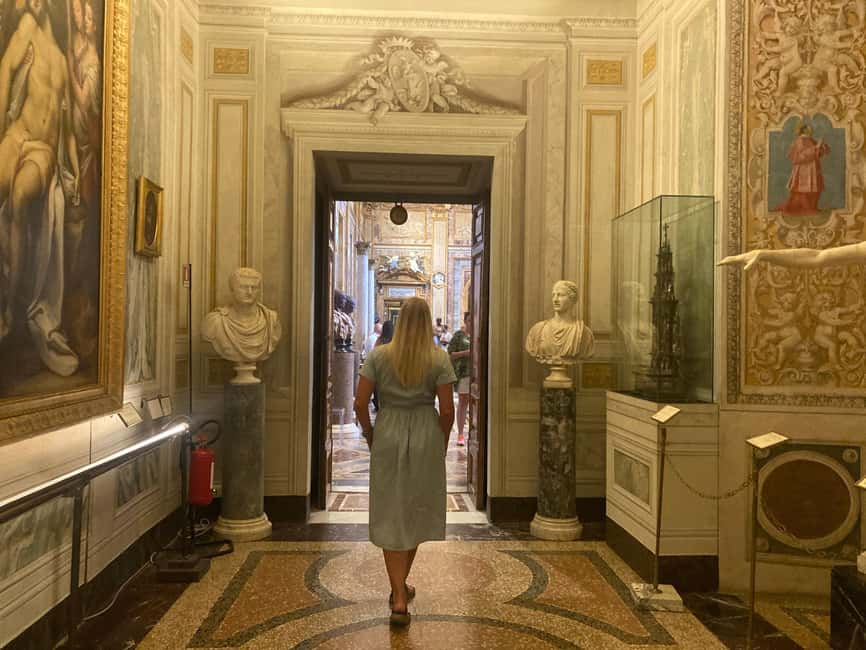
Bernini is the star of the sculpture rooms, and Apollo and Daphne is a major reason many people visit. The work captures the moment Daphne changes into a laurel tree while Apollo reaches toward her.
You can look at the sculpture as a dramatic story, but the real pleasure comes from walking around it. Marble appears to become skin, hair, leaves, and bark. Bernini makes the figures seem caught in motion, even though the material is heavy stone.
A guide adds useful structure to this kind of viewing. Without context, you may notice the technical skill and move on. With an explanation of the myth and the figures’ changing forms, you begin to see how the composition tells the story from several angles.
The room itself also matters. The sculpture was made for a villa collection, not for a plain modern gallery. The surrounding decoration helps explain how wealthy Roman collectors wanted art to be seen: as part of a grand setting, with sculpture, architecture, and storytelling working together.
Caravaggio’s sharp light and uneasy subjects
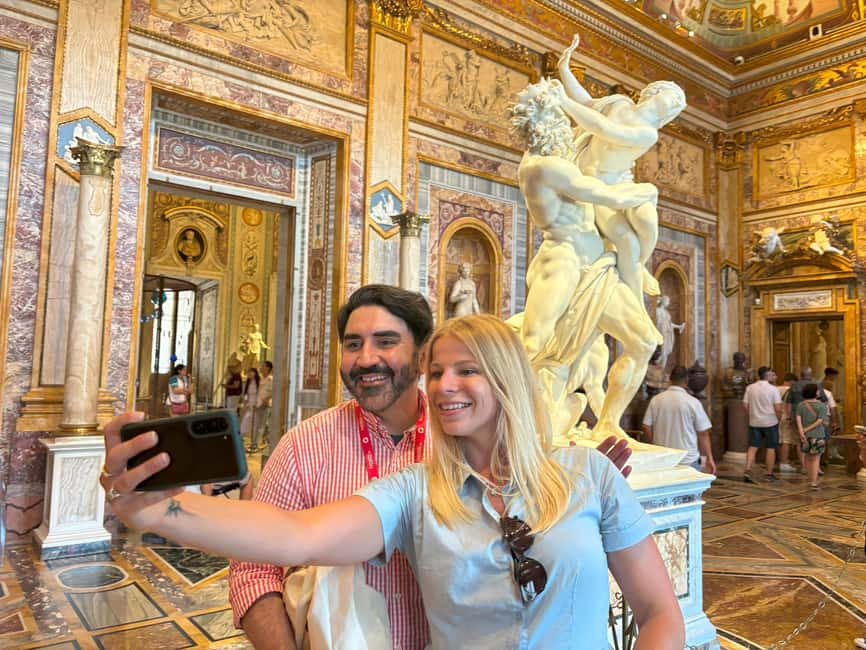
Caravaggio brings a different mood. His paintings are direct, dark, and emotionally charged. David with Goliath’s Head is one of the works singled out for discussion, and it gives the guide plenty to explain about the artist’s use of light, religious drama, and human expression.
Caravaggio often makes sacred or biblical subjects feel close to ordinary life. His figures do not float in an ideal world. They appear physical and vulnerable, which can make the paintings feel immediate even centuries later.
I would pay attention to the contrast between Caravaggio’s paintings and Bernini’s sculpture. Both artists create drama, but they do it in different ways. Bernini uses the body in motion and the viewer’s changing position. Caravaggio uses light, darkness, and a frozen moment that seems to continue beyond the frame.
This is where a strong guide can make a real difference. The tour’s past feedback gives particular weight to art-historical knowledge, humor, and fascinating true stories. Those qualities suit Caravaggio, whose life and working methods often make the paintings easier to remember.
A few more museum visits around Rome worth comparing
- Rome: Borghese Gallery Skip-the-Line Ticket & Audioguide
★ 4.3 · 4,318 reviews - Rome: Borghese Gallery Ticket + Audioguide or Guided Tour
★ 4.6 · 3,219 reviews - Rome: Borghese Gallery Guided Tour with Skip-the-Line Entry
★ 4.8 · 2,649 reviews - Rome: Borghese Gallery Skip-the-Line Tickets with Audioguide
★ 4.6 · 2,562 reviews
Raphael, Rubens, and Titian add range
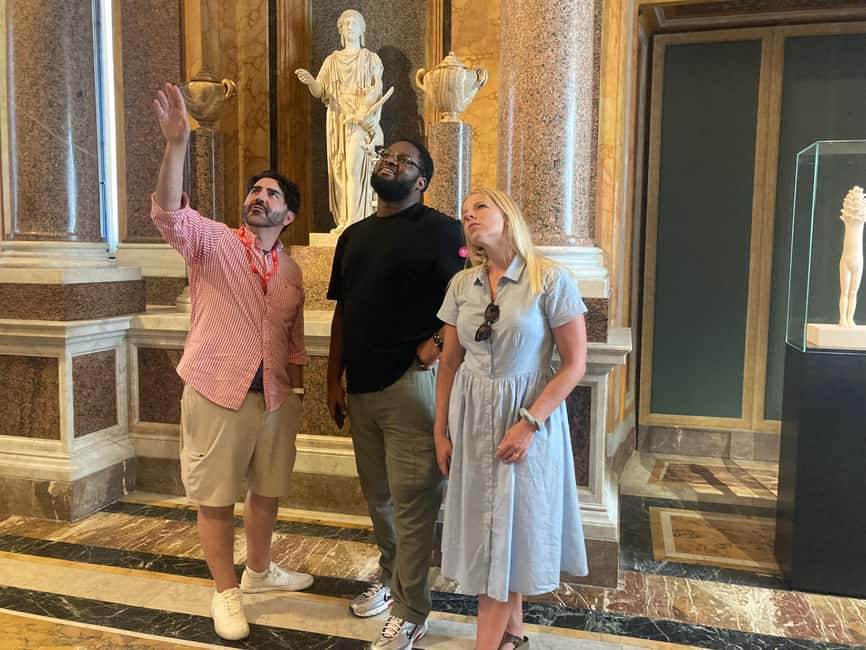
The gallery is not only a Bernini and Caravaggio stop. Raphael’s The Deposition is another major work discussed during the visit. It brings a more measured, balanced style into the mix.
Seeing Raphael after Caravaggio helps you notice different approaches to composition and emotion. Raphael organizes the scene carefully, while Caravaggio often makes the viewer feel pulled into a sharp, urgent moment. The contrast is more useful than seeing either artist in isolation.
Works by Rubens and Titian broaden the collection further. You get a sense of how varied the Borghese holdings are, from intense religious scenes to powerful color and grand Venetian painting.
The guide’s job is not simply to identify names and dates. The most useful explanations help you compare what is in front of you. Look for differences in gesture, color, lighting, space, and the way each artist directs your eye.
The 5 p.m. timing and evening light
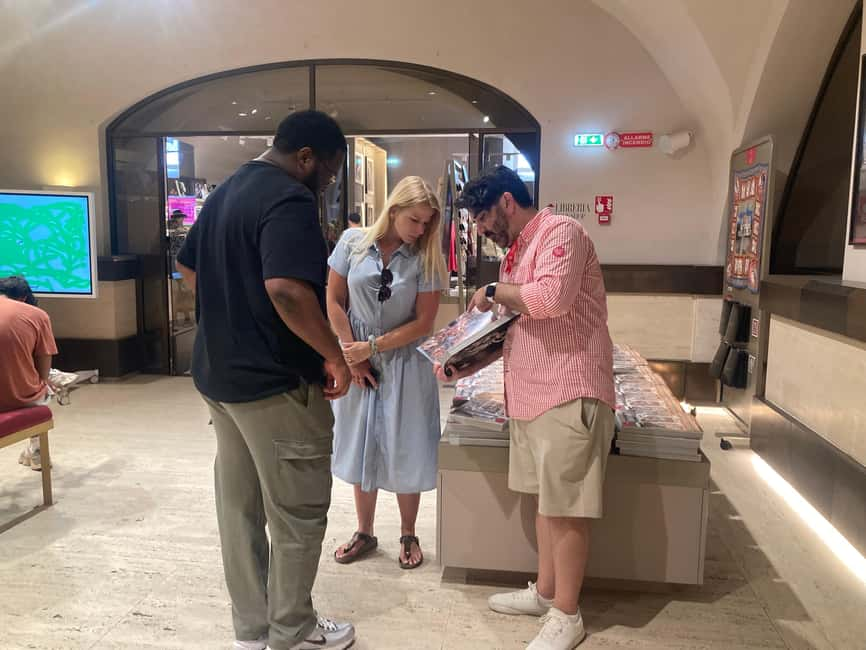
The late entry is a strong feature, though the exact atmosphere will depend on the season and the day’s schedule. The stated entry time is 17:00, when daytime crowds have begun to disperse. Evening light can make the marble look warmer and the rooms feel more settled.
I would choose this timing if you prefer a calmer museum visit and want to combine the gallery with an evening in central Rome. It also lets you use the daylight before the tour for another sight, then spend the later part of the day inside the villa.
There is one practical catch: the tour lasts two hours, so the gardens may have less daylight afterward depending on the time of year. If walking through Villa Borghese is important to you, go before the museum or check the sunset time for your date.
Villa Borghese Gardens beyond the museum
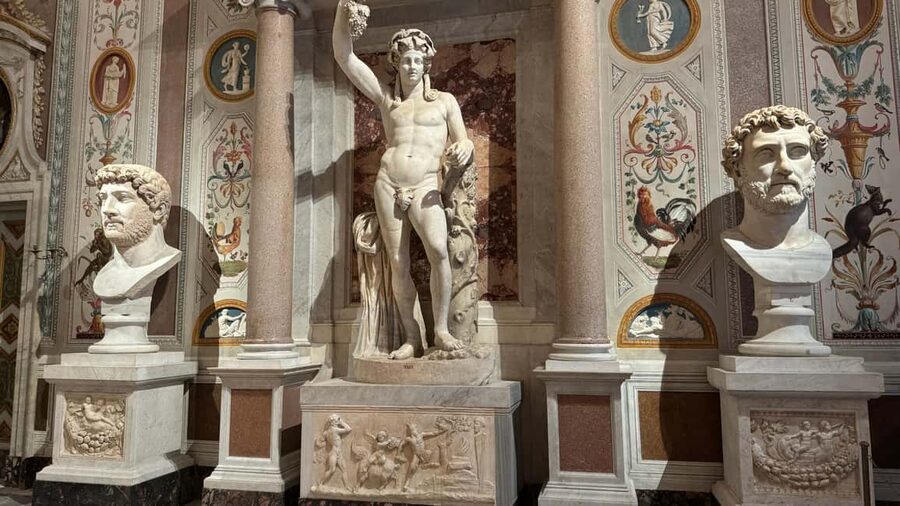
The gallery sits in Villa Borghese, Rome’s third-largest park. The tour itself ends back at the museum entrance, but you can make the park part of your own plan.
The gardens provide a welcome change from stone streets and traffic. You might follow the paths, look for the unusual water clock, or visit the Alpini monument dedicated to Italy’s elite mountain army corps.
Do not treat the park as an included guided stop. The information for this activity describes the gardens as something to explore independently before or after the museum. That freedom is useful if you want a quiet walk, but it means the guide will not be responsible for explaining each garden sight.
The separate reference to Rome’s Jewish Quarter needs similar care. It appears among the highlights, yet the stated meeting point, route, and ending point are all tied to the Borghese Gallery. I would not book this activity specifically for a Jewish Quarter visit unless the provider confirms that detail for your chosen departure.
What $168.79 buys you
At $168.79 per person, this is not a budget museum visit. The value rests in the combination of the entry ticket, skip-the-ticket-line access, a live English-speaking guide, and a group capped at six.
The price is easier to justify if you have limited time in Rome or do not feel confident interpreting Renaissance and Baroque art on your own. A guide can help you spend two hours on the works that matter most instead of wandering through rooms without a plan.
It is harder to justify if you already know the collection well, prefer reading labels at your own speed, or are mainly looking for entry to the museum. In that case, the guided format may offer more than you need.
The high rating of 4.7 from 29 reviews supports the tour’s strongest feature: the guide. The clearest praise focuses on art history, humor, fascinating stories, and the sense that the guide is genuinely passionate about Italian history. One person described the guide as the best of several tours taken during an Italy trip, while another called the art-historical detail a major benefit. Those comments point to the human side of the experience, not just the ticket.
Who will get the most from this tour
I would recommend it most strongly to:
- First-time visitors who want an organized introduction to the Borghese collection
- Couples or friends who prefer a small group to a large headset tour
- Art lovers interested in Bernini, Caravaggio, Raphael, Rubens, and Titian
- People who enjoy stories about artists and historical context
- Visitors who want a two-hour museum visit followed by time in Villa Borghese
Families and mixed-interest groups may also appreciate the short duration, though the tour is clearly art-focused. If your group has little interest in painting or sculpture, the price may feel steep.
You should also be comfortable following a fixed guided route. A small group is more personal, but it is not the same as wandering alone and stopping only at your favorite pieces.
Booking advice and practical details
Tickets are very limited, and reservations are mandatory. Book in advance, especially if you want the late afternoon departure or are visiting Rome on a tight schedule.
The tour includes the guide and entry ticket. Meals are not included. The experience lasts two hours and begins and ends at the Borghese Gallery.
You can cancel up to 24 hours before the activity for a full refund. A reserve-now, pay-later option is also available, which helps if your Rome plans are still shifting.
The tour is in English only. Check the available start times carefully, since the general duration is two hours but the exact departures depend on the date.
Should you book the Borghese Gallery tour?
Book it if the Borghese Gallery is high on your Rome list and you want the art to make sense, not simply pass before your eyes. The six-person limit, late entry, and strong focus on Bernini, Caravaggio, and Raphael give this tour a clear purpose.
Skip it if you mainly want the cheapest possible museum admission, prefer complete independence, or expect a substantial guided visit to the Jewish Quarter. The stated experience is centered on the gallery.
For most first-time visitors with room in the budget, I think the small group and passionate guide are the real value. Two hours is enough to leave you with a firm grasp of why this villa matters, and the surrounding park gives you a pleasant place to continue the evening.
FAQ
Where does the tour meet?
Meet your guide outside the main entrance of the Borghese Gallery. The guide will hold a LivItaly Tours sign.
Where does the tour end?
The activity ends back at the Borghese Gallery and Museum meeting point.
How long does the tour last?
The guided visit lasts two hours.
What time does the tour start?
The described museum entry is at 17:00, but you should check the available starting times for your chosen date.
How large is the group?
The tour has a maximum of six participants.
What language is the tour in?
The live guided tour is in English.
Is the museum entry ticket included?
Yes. The entry ticket and guide are included.
Does the tour let me skip the ticket line?
Yes. Skip-the-ticket-line access is included.
Are meals included?
No. Meals are not included.
Can I cancel for a refund?
Yes. You can cancel up to 24 hours in advance for a full refund.
Can I reserve now and pay later?
Yes. The reserve-now, pay-later option lets you hold a place without paying at the time of booking.
Which artworks will I see?
The tour includes major works by Bernini, Caravaggio, Raphael, Rubens, and Titian. Featured pieces include Bernini’s Apollo and Daphne, Caravaggio’s David with Goliath’s Head, and Raphael’s The Deposition.
Just added around Rome
- Vatican City: Sistine Chapel, Museums, Basilica Private Tour★ 4.8 · 158 reviews
- Rome: Hop-on Hop-off Bus & Vatican Museums Ticket★ 3.5 · 41 reviews
- Rome: Vatican Museums, Sistine Chapel, and St. Peter’s Tour★ 4.5 · 49 reviews
- Skip-The-Ticket Line-Vatican Museum & Sistine Chapel★ 3.9 · 383 reviews
- Skip the line Vatican Museum Sistine & St.Peter Private Tour★ 4.7 · 40 reviews
- Skip-the-Line Vatican Museums and Sistine Chapel Guided Tour★ 4.3 · 130 reviews
- Skip-the-Line Tickets: Vatican Museum and Sistine Chapel★ 3.5 · 114 reviews
- MAXXI – Museum of Contemporary Art of 21st century★ 4.0 · 91 reviews
Museum Tours in Rome, compared.
Vatican Museums, Sistine Chapel & St. Peter’s Basilica Tour
Read our review →
Vatican Museums, Sistine Chapel & St Peter’s Basilica Guided Tour
Read our review →
Vatican Museums, Sistine Chapel and Basilica Tour
Read our review →
Vatican Museums & Sistine Chapel Skip-the-Line Entry Ticket
Read our review →
Vatican Museums, Sistine Chapel & Basilica Tour
Read our review →
Vatican Museums & Sistine Chapel Guided Tour
Read our review →
Vatican Museums & Sistine Chapel Skip-the-Ticket-Line Tour
Read our review →
Vatican Museums, Sistine Chapel and St. Peter’s Basilica Tour
Read our review →Browse the lists this tour appears in