
Review · PRAGUE
Prague: Mucha Museum Entry Ticket
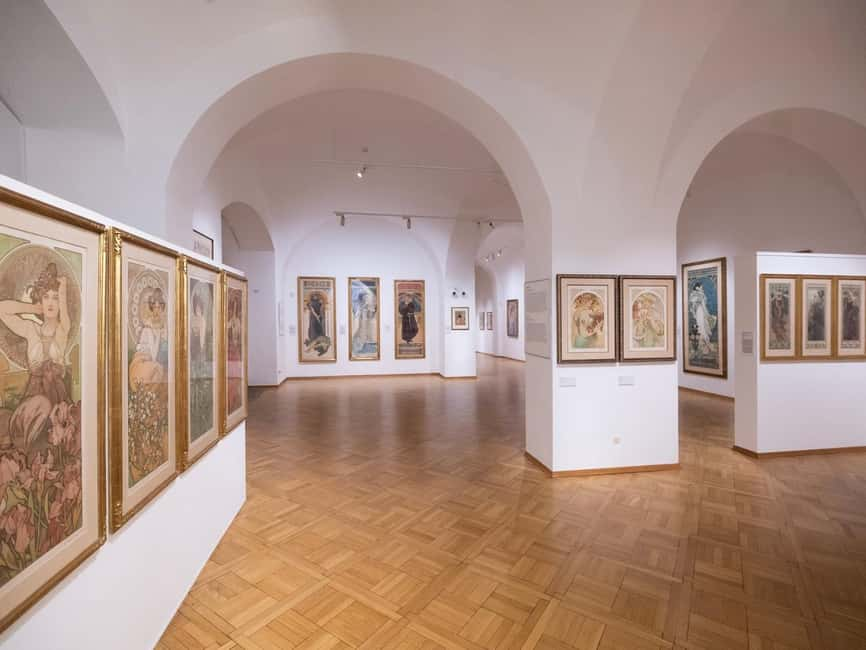
Alfons Mucha’s elegant women, curling flowers, and bold lettering helped define Parisian Art Nouveau, and this small Prague museum gives you a direct look at the original work. I especially like the original posters and decorative panels, plus the chance to see commercial designs for Moët & Chandon, Job Cigarettes, and Lefèvre-Utile Biscuits.
I also like the MUSEUS interactive guide, which answers questions in six languages instead of simply handing you a wall label. The main drawback is size: the exhibition covers 500 square meters, so you can see it in a short visit. If you want a broad account of Mucha’s entire career, this may feel brief.
Key points to know before you go
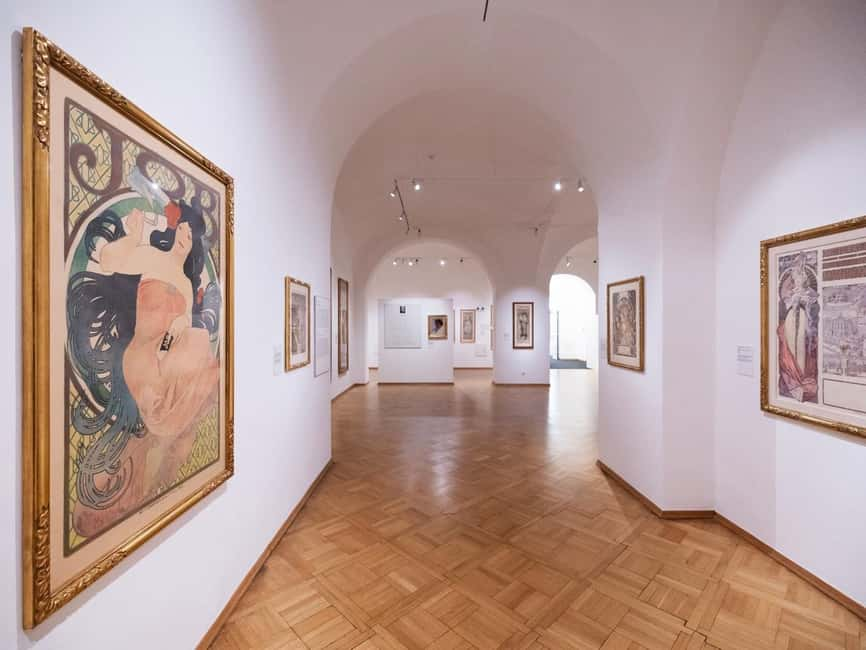
- Original Parisian posters: See the graceful advertising designs that made Mucha famous in late 19th-century Paris.
- Ivan Lendl collection: View nearly 100 original pieces from the collection assembled by tennis champion Ivan Lendl and art specialist Jack Rennert.
- Five themed sections: The museum moves through Decorative Panels, Parisian Posters, Advertisements, Czech Posters, and Memorabilia.
- MUSEUS AI guide: Scan the QR code near the start for artwork information and questions in English, French, Czech, Japanese, Chinese, or Korean.
- Central Prague location: The museum is inside historic Kaunický Palace on Panská Street, making it easy to fit into a day of city sightseeing.
- Short, focused visit: The one-day ticket gives you access to the full exhibition, but the compact format is better for a focused art stop than a half-day museum outing.
Why Mucha still matters in Prague
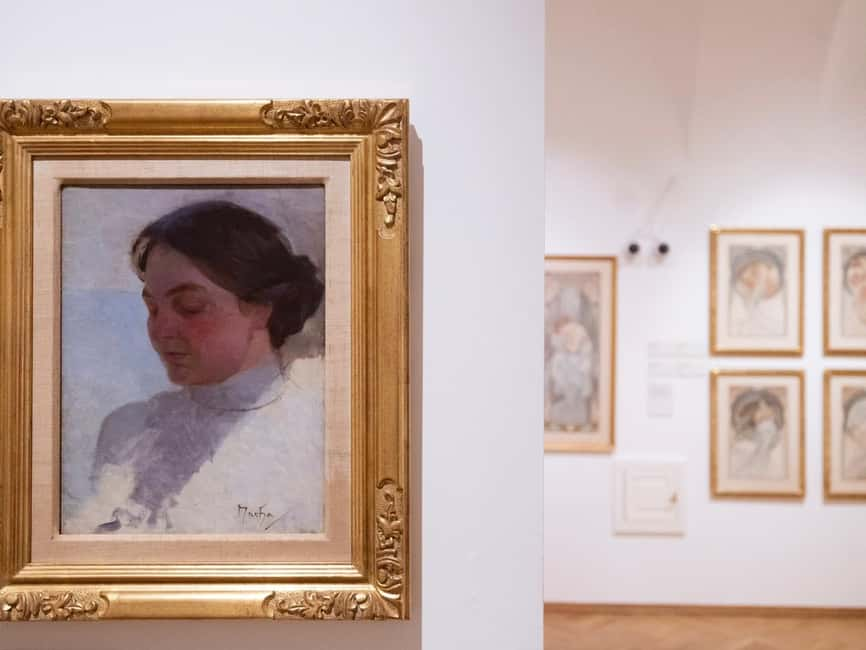
Mucha is often reduced to a single style: pale women with long hair, flowers, halos, and decorative borders. That familiar look is here, but the museum helps you see the wider skill behind it. Mucha was not only a painter. He was a designer who brought art into posters, packaging, advertisements, theater publicity, and household decoration.
His work suited the commercial world of Paris because it caught the eye from a distance. A passerby could recognize the flowing outlines and carefully arranged lettering before reading every word. That practical side matters. Mucha’s pictures were made to sell plays, drinks, cigarettes, biscuits, and other products, yet they were designed with the care of fine art.
I find this mix of art and advertising one of the museum’s strongest features. You do not have to know much about Art Nouveau to understand the appeal. You can simply look at how Mucha controls the frame, repeats curved lines, and turns a product into part of a larger decorative scene.
The museum opened in 1998 as the first museum devoted solely to Alfons Mucha. It has since welcomed more than 2.6 million people. That figure gives you an idea of its place in Prague’s art circuit, but the experience itself remains fairly personal in scale.
More Museum Tours in Prague
- Prague: Museum of Fantastic Illusions Entry Ticket
★ 4.3 · 4,337 reviews - IAM Illusion Art Museum Entry Ticket
★ 4.2 · 1,664 reviews - Prague: Museum of Senses Admission Ticket
★ 4.0 · 1,445 reviews
Entering Kaunický Palace on Panská Street
The Mucha Museum occupies historic Kaunický Palace on Panská Street in central Prague. The setting adds a useful sense of place, since you are not visiting a modern gallery removed from the city. You enter a palace building and then move into a display devoted to one of Prague’s best-known artistic figures.
Your ticket is valid for one day and includes all exhibition sections. There is no scheduled transport or lengthy tour program to manage. You simply visit the museum during its available entry period, follow the exhibition, and leave when you are ready.
That flexibility suits a Prague sightseeing day. You can place the museum between other stops rather than reserve half a day for it. The information provided does not set out a fixed starting time, so check the available entry options when booking.
The museum is priced at $14 per person. I consider that fair if you have a real interest in Mucha or Art Nouveau and plan to spend time with the original works. It is less compelling if you are only looking for a quick souvenir-style stop, especially since the exhibition is compact.
Begin with the Decorative Panels
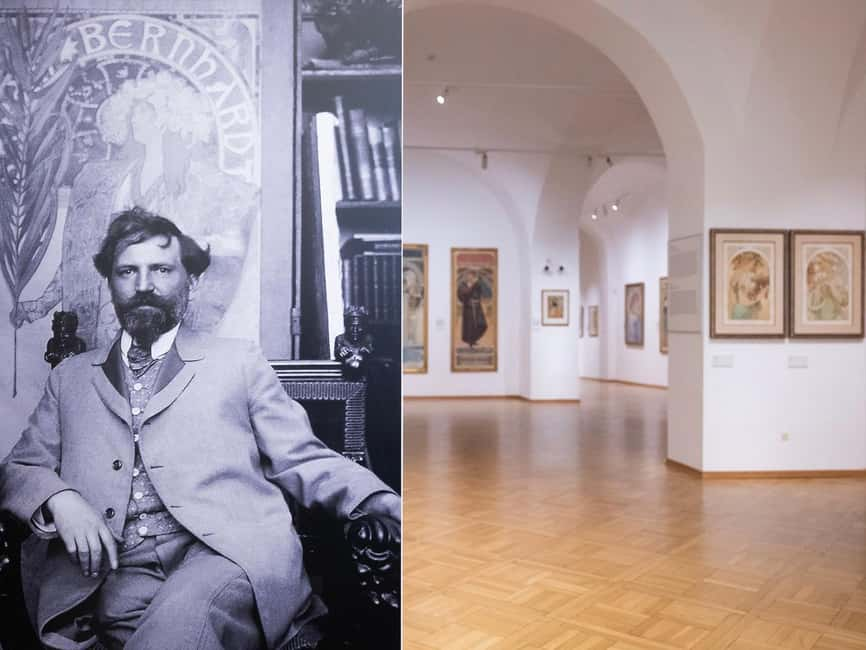
The Decorative Panels section introduces one of Mucha’s most recognizable ideas: art designed to fill a room or create a matched visual series. These works are less about a single dramatic event and more about rhythm, color, figures, plants, and repeated shapes.
Look closely at the borders and background details. Mucha often gives the figure a strong central role, but the surrounding ornament is what makes the design feel complete. Hair, leaves, halos, and architectural motifs are arranged so your eye keeps moving around the image.
This section is a good place to slow down. The overall shapes are easy to appreciate from several steps away, but the small details reward a closer look. You might find that the decorative frame is nearly as important as the person shown inside it.
For visitors who know Mucha mainly from posters, these panels show how his style could work beyond advertising. They also explain why his designs were so easy to reproduce and adapt. His visual language was decorative, organized, and instantly recognizable.
The Parisian posters that made his name
The Parisian Posters section is likely to be the main reason you visit. Mucha became widely known through posters connected with Parisian theater and public life, and the museum places these famous designs alongside other work from the same period.
The posters are not shy. They were intended to command attention on city streets, so large figures, strong vertical compositions, and ornamental lettering do much of the work. Even when the subject is a product or performance, the woman at the center often carries the emotional force of the image.
This is where the museum’s original works matter most. Reproductions are common in books, home décor, and online images, but the originals let you see the paper, color, line, and scale more directly. You can better understand how Mucha’s controlled outlines hold the design together.
Take time to compare the posters instead of treating them as a row of similar pictures. Small changes in costume, flowers, lettering, and pose reveal how Mucha adjusted the formula for different clients and subjects.
A few more museum visits around Prague worth comparing
- IAM Illusion Art Museum Prague Fast Pass Ticket
★ 5.0 · 957 reviews - Admission Ticket to Museum of Senses in Prague
★ 4.5 · 861 reviews - Prague: Museum of Bricks Entry Ticket
★ 4.2 · 851 reviews - Prague: Ticket to Audiovisual Light Art at Lumia Gallery
★ 4.4 · 607 reviews
Advertisements for Moët, Job, and Lefèvre-Utile
Mucha’s advertisements show how Art Nouveau entered ordinary consumer culture. The museum highlights designs connected with Moët & Chandon, Job Cigarettes, and Lefèvre-Utile Biscuits. These names cover very different products, yet Mucha gives each one a polished visual identity.
The Moët & Chandon designs use elegance and celebration to sell a drink. Job Cigarettes show how a commercial image could turn a common item into something stylish. Lefèvre-Utile Biscuits demonstrate the same approach with food packaging and advertising.
I like this part because it removes the false boundary between high art and commercial design. Mucha was paid to persuade people to buy something. That does not cancel the artistic work. It explains why the compositions had to be clear, memorable, and attractive at a glance.
As you look, ask yourself what your eye notices first. Is it the face, the lettering, the product, or the decorative border? That simple question reveals how carefully the advertisement is built.
The Ivan Lendl collection and Jack Rennert’s selection
A major feature is the group of nearly 100 original pieces from the Ivan Lendl collection. The collection was assembled with art specialist Jack Rennert, giving the museum a substantial body of authentic material rather than a display made only from familiar reproductions.
This section gives the museum extra weight. You are not seeing just a few famous posters surrounded by general information. You are seeing a larger sample of Mucha’s work, including pieces that help explain the range of his commercial and artistic output.
The mention of Ivan Lendl adds an unusual Prague connection. Lendl is best known as a tennis champion, but his collection of Mucha’s work became an important part of the museum’s holdings. For you, the practical benefit is simple: more original material to compare in one place.
Do not rush through this section because you recognize the style. Look for changes in scale, subject, and purpose. Some works may feel immediately familiar, while others help fill out the story of how Mucha worked across different commissions.
Czech posters and the turn toward home
The Czech Posters section shifts attention from Mucha’s Parisian period to work connected with his home country. This is important because Mucha’s career is often presented as a Paris story, even though his Czech identity remained central to his later work and reputation.
The change in subject gives you a chance to see how his visual language functions outside the Parisian commercial setting. The posters may still carry his signature ornament, but the national and cultural focus changes the way you read them.
This section is especially useful if you already know the famous Paris posters. It helps prevent the museum from becoming a single-style display. Mucha was not frozen in the image of the Paris poster artist. His work continued to connect decoration, identity, public culture, and design.
The exhibition does not claim to tell every part of his life in great depth. Instead, it gives you a focused look at the images that made his career visible to a wide public.
Memorabilia and the practical side of fame
The Memorabilia section adds objects and material connected with Mucha’s public legacy. This helps show how an artist’s influence survives beyond individual paintings and posters.
Memorabilia can be less visually thrilling than the large posters, but it serves a purpose. It places Mucha’s work in the world of collecting, publishing, advertising, and popular taste. His images were not locked away for specialists. They circulated widely and became part of everyday visual culture.
I would treat this section as the final piece of the museum’s story rather than the main event. The strongest visual impact comes from the posters and panels, while the memorabilia helps explain why those images remain so recognizable.
Using the MUSEUS guide in six languages
At the start of the exhibition, you can scan a QR code with your phone to access the MUSEUS interactive guide. It describes the artworks and can answer questions, which makes the visit more flexible than a standard label-only display.
The guide currently supports English, French, Czech, Japanese, Chinese, and Korean. That is particularly useful for visitors who want more detail in their own language or who prefer asking a question rather than reading a short caption.
The French option has been especially useful in the museum experience, and the system is designed to give precise information about the works. The museum plans to add Polish, Spanish, Italian, German, Brazilian Portuguese, Hindi, Ukrainian, and Arabic in the coming months.
Keep your phone ready near the beginning so you do not miss the QR code. Since this is an interactive phone-based guide, your experience will depend partly on your device and willingness to use the digital format. If you prefer a quiet, label-only museum, the guide is optional rather than required.
How much time should you allow?
The ticket is valid for one day, but the museum itself is a compact visit. The exhibition covers 500 square meters and is divided into five main sections, so you can see the complete display without giving it the same time you would give Prague’s largest museums.
For a quick look, you might move through the rooms fairly fast. For a more satisfying visit, allow enough time to compare posters, read the artwork information, and use the MUSEUS guide for questions. The exact duration is not fixed, which is an advantage if you are fitting it around other plans.
The compact size is also the main limitation. One French visitor found the exhibition too short after learning about the separate Mucha Foundation, which may offer a broader way to study the artist. That is useful advice: treat this museum as a focused introduction and a strong collection of originals, not as the final word on Mucha.
The museum shop and what you can take home
Your visit ends at the museum shop, where you can browse exclusive gifts and posters inspired by Mucha’s art. Souvenirs are not included in the ticket, so plan to pay separately if something catches your eye.
The shop makes sense here because Mucha’s work has always lived partly through reproduction. A poster or printed design can carry the visual idea home in a way that reflects the artist’s original role in public advertising.
Still, I would visit the shop after seeing the exhibition, not before. Once you have noticed Mucha’s lettering, borders, and repeated motifs, you can make a more informed choice instead of buying the first pretty image you see.
Who will get the most from this museum?
I would recommend the Mucha Museum most strongly to:
- Art Nouveau fans who want to see original posters and panels.
- Visitors curious about the link between fine art and advertising.
- Anyone interested in Parisian poster design or Czech cultural identity.
- Museumgoers who prefer a short, self-guided stop.
- Visitors who value multilingual explanations and phone-based access to more detail.
Families and casual art visitors can also enjoy it because Mucha’s designs are immediately readable. You do not need a long art lecture to see the beauty of the figures and ornament.
I would be more cautious if you expect a large museum with a full biography, extensive historical context, or a long guided program. Guided tours, food, beverages, and souvenirs are not included, and no guide’s name is provided because the experience is self-guided.
At $14, the value depends on your interest. If Mucha is one of your Prague priorities, the price is reasonable for access to original works and the full set of themed sections. If your schedule is tight and you only want a general introduction to Art Nouveau, the short format may make the ticket feel expensive.
Should you book the Mucha Museum?
Book it if you want a focused look at Alfons Mucha’s original work in central Prague, especially the Parisian posters, decorative panels, and Ivan Lendl collection. The MUSEUS guide adds useful detail without forcing you into a scheduled tour, and the one-day validity keeps the visit easy to fit into your plans.
Skip it if you want a large, all-day museum or a full account of every stage of Mucha’s life. For most visitors who like Art Nouveau, though, this is a clear and practical stop. Give the posters time, compare the advertising designs, and use the QR guide to turn a short visit into a more informed one.
FAQ
Where is the Mucha Museum located?
The museum is located in historic Kaunický Palace on Panská Street in Prague, in the Central Bohemian Region of the Czech Republic.
How much does entry to the Mucha Museum cost?
The listed price is $14 per person.
How long is the ticket valid?
The entry ticket is valid for one day.
What does the ticket include?
It includes entry to the Mucha Museum and access to all exhibition sections.
Is a guided tour included?
No. Guided tours are not included. The museum offers an interactive MUSEUS guide accessed by scanning a QR code with your phone.
Which languages does the interactive guide support?
The guide currently provides information in English, French, Czech, Japanese, Chinese, and Korean. More languages are planned for the future.
Can I cancel the booking?
Yes. You can cancel up to 24 hours in advance for a full refund. A reserve now and pay later option is also available.
Just added around Prague
- Prague: Steel Art Museum Entry Ticket★ 4.8 · 572 reviews
- Prague: Signal Space Digital Art Gallery Entry Ticket★ 4.6 · 38 reviews
- Prague: Tickets for the Franz Kafka Museum★ 4.2 · 188 reviews
- Prague: River Cruise, Charles Bridge Museum, & Walking Tour★ 4.7 · 62 reviews
- Prague: National Museum Ticket & Online Audioguide City Tour★ 4.3 · 325 reviews
- Prague: Museum of Torture Entry Ticket★ 3.6 · 317 reviews
- Choco Art Museum in Prague Entry Ticket★ 3.6 · 29 reviews
- Prague: Story of Prague Immersive Museum Experience★ 4.5 · 176 reviews
Museum Tours in Prague, compared.
IAM Illusion Art Museum Prague Fast Pass Ticket
Read our review →
Ticket to Audiovisual Light Art at Lumia Gallery
Read our review →
Browse the lists this tour appears in