
Review · ROME
Leonardo da Vinci Museum Tour with Interactive Activities
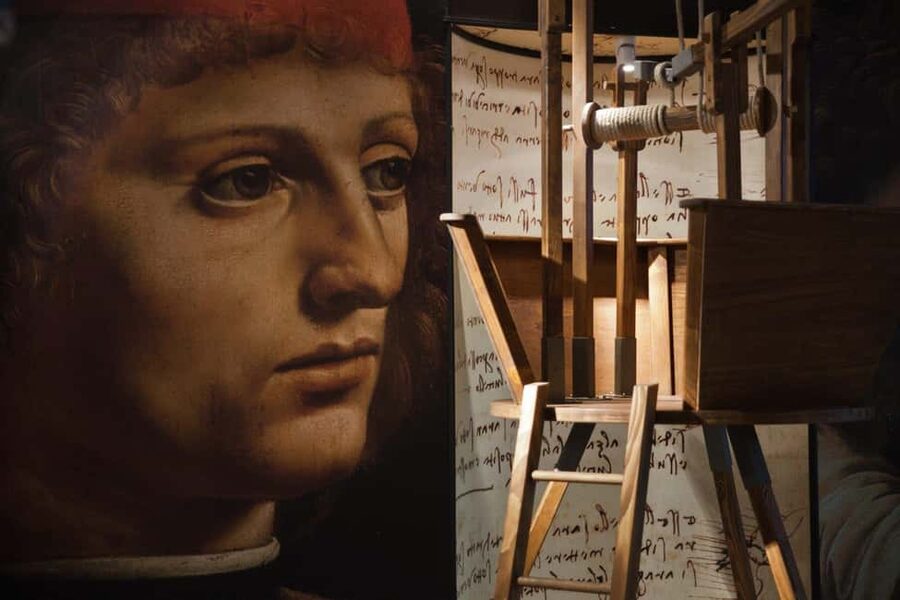
The most fun part of this one-hour Leonardo da Vinci Museum tour is that you do not simply look at inventions behind glass. You can handle some of the machines, test how they work, and pose beside full-size models of a helicopter and armored tank. I like the hands-on approach, and I like the way the tour connects Leonardo’s art, optics, engineering, and early ideas about flight.
The main caution is value for time. At $41 per person, this is a short visit to a small museum. A good guide can make the hour worthwhile, but a rushed or thin explanation may leave you feeling that you paid too much for too little. Also, check the meeting address carefully: the information supplied gives Tuscany as the location but lists Via della Conciliazione 19 in Rome.
Key points at a glance
- Fifty full-scale machines: See large replicas of flying machines, robots, submarines, armored vehicles, and solar-powered devices.
- Hands-on displays: Some inventions can be touched and operated, which makes this more useful for children and curious adults than a quiet gallery visit.
- A Room of Mirrors: Explore Leonardo’s studies of light and how they relate to photography and projection.
- Twenty painting reproductions: See certified copies of Leonardo’s masterpieces, restored by artists associated with the Vatican Museums.
- Guide quality matters: Carla and Naomi are praised for detailed, clear explanations, while one booking raised concerns about limited guiding information.
- Short, central visit: The advertised duration is one hour, with skip-the-line access through a separate entrance.
What the one-hour visit is really like

This is not a large museum that takes half a day. It is a compact, focused experience built around replicas, demonstrations, and a guided explanation of Leonardo’s ideas.
You meet your guide directly in front of the museum entrance at Via della Conciliazione 19. The tour is described as semi-private, so you should expect a smaller, more personal format than a large group walk. The guide speaks English, French, or Italian, depending on the booking.
The short duration is both a strength and a limit. If you have only an hour between sightseeing stops, the visit fits neatly into a busy Rome schedule. If you want time to study every machine, take photographs, and read every display, one hour may feel tight.
I would arrive ready to move at a steady pace. Wear comfortable shoes, bring a camera, and remember that flash photography is not allowed. The museum permits regular photographs, so you can record the larger models and the more unusual optical displays.
More Museum Tours in Rome
- Vatican Museums, Sistine Chapel & St. Peter’s Basilica Tour
★ 4.3 · 73,970 reviews - Vatican Museums, Sistine Chapel & St Peter’s Basilica Guided Tour
★ 4.5 · 39,149 reviews - Rome: Vatican Museums, Sistine Chapel and Basilica Tour
★ 4.3 · 16,039 reviews
Leonardo’s machines, from flight to submarines
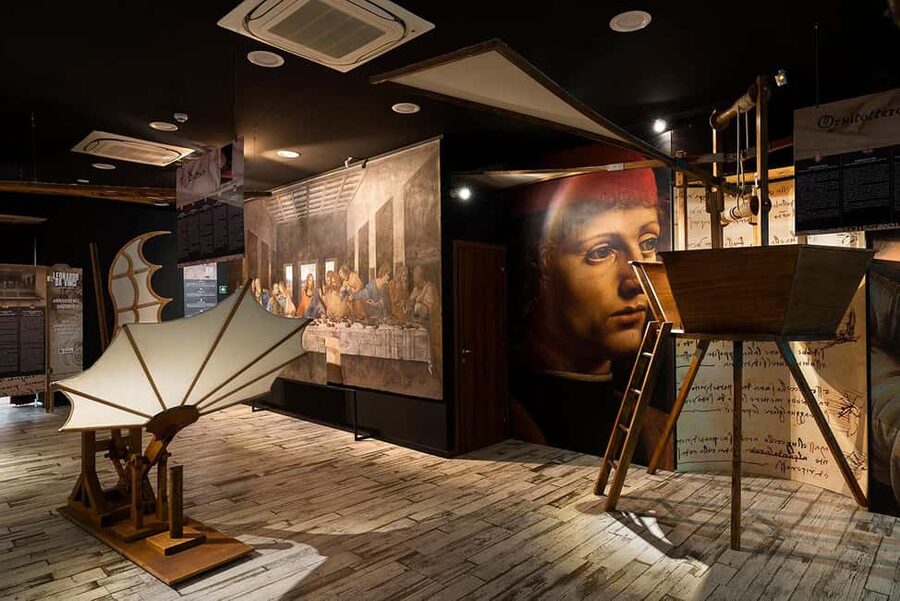
The central attraction is the collection of 50 full-scale replicas. These models show the range of Leonardo’s thinking better than a list of inventions ever could. His notebooks moved across art, anatomy, military design, mechanics, water, air, and light. Here, those subjects are presented as objects you can see at human scale.
The flying machines are likely to attract the most attention. A full-size helicopter model gives you a strong sense of the ambition behind Leonardo’s sketches, even though the original designs were never modern aircraft in the current sense. The value is in seeing how he tried to reason through lift, motion, and structure.
The armored tank offers a different lesson. It links engineering with military planning and gives you an easy photo opportunity. You can compare the shape of the model with the basic idea of a modern armored vehicle, while also remembering that Leonardo’s designs were concepts from another age, not ready-to-build machines.
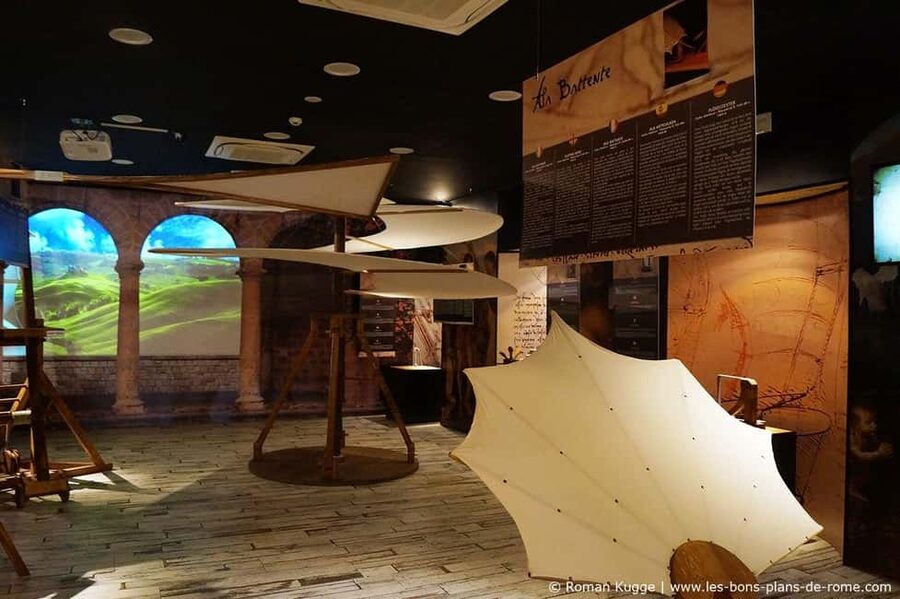
Other replicas include robots, submarines, and solar-powered devices. The point is not that Leonardo invented these things in their modern form. The interesting part is that he explored mechanical principles that still appear in later technology. A guide who explains that distinction will help you appreciate the displays without turning every sketch into an exaggerated claim.
The hands-on element makes a real difference. Some machines can be handled, and that gives you a better feel for gears, levers, movement, and force than a painted diagram can provide. Children often respond well to this format, but adults who enjoy engineering or history will also find it useful.
The Room of Mirrors and Leonardo’s study of light
The Room of Mirrors adds a change of pace after the large mechanical models. Here, you explore how Leonardo studied reflection, light, and visual perception.
This section is especially helpful if you think of Leonardo only as a painter or inventor. His work with light connects his scientific observations to later developments in projection and photography. The room gives you a physical way to see how mirrors and reflected images can alter what you observe.
It is also one of the better parts of the visit for families. The effect is immediate, so children do not need a long explanation before they understand that the room is playing with their view of space and reflection. Adults can use it as a prompt to think about the link between optical experiments and image-making.
Do not expect a full lesson in the history of photography. The museum presents a broad connection rather than a detailed technical course. The guide’s explanation matters here, since a clear account can turn a quick visual trick into a useful piece of context.
Twenty reproductions of Leonardo’s paintings
The museum also displays 20 certified reproductions of Leonardo’s paintings. These are not the original works, which remain in museums and collections around the world. That distinction matters when you decide how much to pay for the visit.
Still, reproductions have a practical benefit. You can see several works together and discuss them with the guide rather than spending a long day moving between major museums. The copies were restored by artists associated with the Vatican Museums, giving the display a more serious purpose than a basic poster collection.
This part of the tour works best as a companion to the machines. Leonardo’s art and engineering were not separate boxes in his mind. His study of proportion, shadow, anatomy, and light supported his painting, while his artistic eye helped him record mechanical ideas with unusual clarity.
If your main goal is to see original Renaissance paintings, this tour will not replace a major art museum. If you want a quick introduction to Leonardo’s range, the reproductions give the guide material to explain how the artist and engineer were connected.
A few more museum visits around Rome worth comparing
- Vatican Museums & Sistine Chapel Skip-the-Line Entry Ticket
★ 4.4 · 13,838 reviews - Rome: Vatican Museums, Sistine Chapel & Basilica Tour
★ 4.7 · 13,217 reviews - Rome: Vatican Museums & Sistine Chapel Guided Tour
★ 4.3 · 12,117 reviews - Vatican Museums & Sistine Chapel Skip-the-Ticket-Line Tour
★ 4.3 · 10,486 reviews
Why the guide can make or break the experience
A guided visit is included, and the semi-private setup should give you more room to ask questions than a large group tour. That is important because many of the replicas need explanation. Without context, a room full of wooden machines can become a collection of odd shapes.
Several guide names receive especially strong praise. Carla is described as friendly and detailed, while Naomi is praised for speaking very clear English and giving the interactive displays enough explanation to make the price feel reasonable. Those comments point to the experience you should hope for: a guide who shows you what to touch, explains the principle behind it, and links one display to the next.
The quality may not be entirely consistent. One account describes a guide checking with the front desk about whether the booking had been registered. Another assessment says the museum was small and the guide had limited knowledge, despite being kind. That does not prove every tour will be weak, but it is a useful warning. The guide is a major part of what you are buying.
I would ask questions as you go. Ask how a machine is meant to work, which designs were practical, and how the optical displays relate to later technology. A responsive guide can make this feel like a lively lesson. A guide who simply walks you from object to object will make the short visit seem even shorter.
Is $41 fair for only one hour?
At $41 per person, the price is not a bargain if you judge it by time alone. The tour lasts one hour, and the museum is described as small. You are paying for the guide, skip-the-line entry, the replicas, and the chance to interact with the displays.
The price becomes easier to justify if you value three things: a personal explanation, a hands-on museum format, and a convenient visit that fits between larger Rome sights. A family may get more from the machines than from a formal gallery, especially if children learn by touching and testing.
For a solo visitor mainly interested in original art, the calculation is different. The painting section contains reproductions, and the museum cannot offer the scale or collection of a major institution. You may prefer to spend the same money on a larger museum or a longer guided walk.
The tour’s overall rating is 4 out of 5 from 15 reviews, but the range is wide. Some ratings are very positive, with praise for the guide’s information and the interactive format. Others call the experience poor value because of the short visit, the small size of the museum, or limited guiding detail. I would treat that spread as a reminder to book for the format, not for the promise of a huge museum.
Who will enjoy this museum most?
This experience suits you if you like science, art, and physical demonstrations in equal measure. It also works well for families, since children can interact with selected machines instead of standing quietly in front of paintings.
It is a good choice for:
- First-time visitors who want a quick introduction to Leonardo’s ideas.
- Families looking for an educational indoor activity.
- Adults who enjoy engineering, invention, optics, or Renaissance art.
- Visitors with a packed Rome schedule who can spare one hour.
- People who prefer a guide to explain displays rather than reading every label alone.
You may want to skip it if you expect original masterpieces, a large museum, or a long academic tour. It is also a weak fit if you dislike replicas or do not want to pay a premium for a short guided visit.
The accessibility information needs special care. One part of the booking details says the activity is wheelchair accessible, while another says it is not suitable for wheelchair users. Because those statements conflict, contact the provider before paying if step-free access is important to you.
Meeting point, timing, and small practical details
The stated meeting point is in front of the Leonardo da Vinci Museum entrance at Via della Conciliazione 19, Rome. Yet the general location is also given as Tuscany, Italy. That is a serious detail to verify, not a minor wording issue. Confirm the exact city and address on your booking before setting out.
Skip-the-line access is provided through a separate entrance, which can help when you are fitting the museum around other plans. It does not make the tour longer, so arrive prepared to use the hour well.
Bring a camera for the helicopter, armored tank, and optical displays. Flash photography is prohibited, but ordinary photography is allowed. Comfortable shoes are sensible, especially if you plan to continue sightseeing afterward.
Food and drinks are not included, and hotel pickup and drop-off are not provided. You make your own way to the museum and arrange refreshments separately.
The booking offers free cancellation up to 24 hours before the activity, and you can reserve now and pay later. Those terms are useful if your schedule is still changing, but check the final booking conditions for your chosen date.
My advice on booking
I would book this tour if you want a compact, hands-on introduction to Leonardo and you are comfortable with replicas rather than originals. The interactive machines, Room of Mirrors, and strong guides such as Carla or Naomi can make the hour lively and worthwhile.
I would not book it blindly at $41. First, confirm the Rome address, ask about the language and guide arrangement, and think honestly about whether one hour is enough for your interests. If the price feels high for a small museum, choose it only if the touchable machines and guided explanation are exactly what you want.
For families and curious minds, the format has real appeal. For serious art lovers or anyone seeking a major museum collection, the better value may lie elsewhere. The deciding question is simple: do you want to understand Leonardo through working models and a guide, or do you mainly want to see original art?
FAQ
Where does the Leonardo da Vinci Museum tour meet?
The meeting point is listed as in front of the Leonardo da Vinci Museum entrance at Via della Conciliazione 19, Rome. Because the activity information also names Tuscany as the location, confirm the exact address before you go.
How long does the tour last?
The tour lasts one hour. Starting times depend on availability.
What languages are available?
The live guide is available in English, French, and Italian.
Does the tour include skip-the-line entry?
Yes. The ticket includes skip-the-line access through a separate entrance.
Can I touch Leonardo’s inventions?
Some of the inventions are interactive and can be handled. The tour includes access to 50 full-scale replicas.
Are the paintings original works?
No. The museum displays 20 certified reproductions of Leonardo’s masterpieces, restored by prominent Vatican Museum artists.
Is the museum wheelchair accessible?
The supplied information is contradictory. One section says the activity is wheelchair accessible, while another says it is not suitable for wheelchair users. Contact the provider before booking to confirm the current access arrangements.
Just added around Rome
- Vatican City: Sistine Chapel, Museums, Basilica Private Tour★ 4.8 · 158 reviews
- Rome: Hop-on Hop-off Bus & Vatican Museums Ticket★ 3.5 · 41 reviews
- Rome: Vatican Museums, Sistine Chapel, and St. Peter’s Tour★ 4.5 · 49 reviews
- Skip-The-Ticket Line-Vatican Museum & Sistine Chapel★ 3.9 · 383 reviews
- Skip the line Vatican Museum Sistine & St.Peter Private Tour★ 4.7 · 40 reviews
- Skip-the-Line Vatican Museums and Sistine Chapel Guided Tour★ 4.3 · 130 reviews
- Skip-the-Line Tickets: Vatican Museum and Sistine Chapel★ 3.5 · 114 reviews
- MAXXI – Museum of Contemporary Art of 21st century★ 4.0 · 91 reviews
Museum Tours in Rome, compared.
Vatican Museums, Sistine Chapel & St. Peter’s Basilica Tour
Read our review →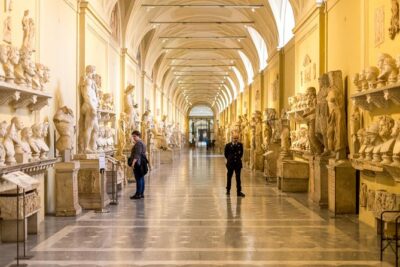
Vatican Museums, Sistine Chapel & St Peter’s Basilica Guided Tour
Read our review →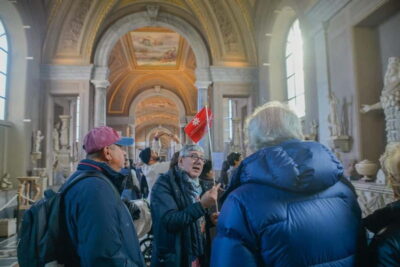
Vatican Museums, Sistine Chapel and Basilica Tour
Read our review →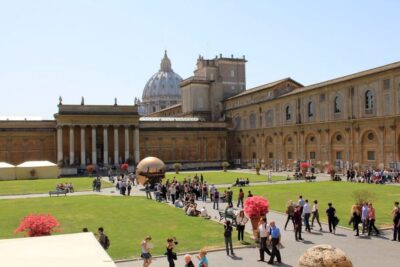
Vatican Museums & Sistine Chapel Skip-the-Line Entry Ticket
Read our review →
Vatican Museums, Sistine Chapel & Basilica Tour
Read our review →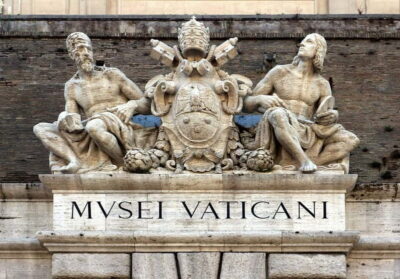
Vatican Museums & Sistine Chapel Guided Tour
Read our review →
Vatican Museums & Sistine Chapel Skip-the-Ticket-Line Tour
Read our review →
Vatican Museums, Sistine Chapel and St. Peter’s Basilica Tour
Read our review →Browse the lists this tour appears in