
Review · PALACE MUSEUM
Copenhagen: Amalienborg Palace Museum Entry Ticket
Amalienborg Palace Museum brings you close to the Danish royal family without turning the visit into a grand, formal production. Inside Christian VIII’s Palace, you walk through private rooms preserved almost exactly as their occupants left them, from Christian X’s dark study to Queen Louise’s family salon. The personal rooms make the monarchy feel human, while the Gala Hall supplies the full palace spectacle.
I like the compact route and the strong historical focus. I also like that children have access to audio-guide material, making this a good family stop rather than a museum built only for adults. The main drawback is value: at $19 per person, the museum may feel expensive if you finish in 45 minutes and are mainly interested in grand architecture.
Key points to know before you go

- Royal rooms with personal detail: See the dining room, study, salon, and other spaces used by Danish monarchs.
- The Gala Hall: Look for the eight-meter ceiling, gilding, and sculptures by Bertel Thorvaldsen.
- Fabergé jewelry: The chamber focuses on Russian pieces and the close links between Danish and Russian royal families.
- A short, focused visit: Plan on roughly 45 minutes to an hour inside, with extra time for Amalienborg Square.
- Good for families: Child-friendly audio material is available in the museum route.
- Strict arrival rules: Scan your online ticket downstairs, and arrive no more than 20 minutes after your booked time.
What Amalienborg Museum actually gives you
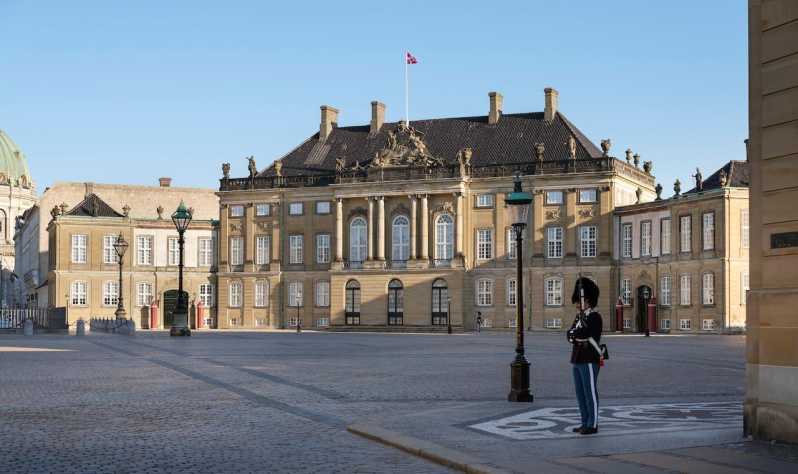
Amalienborg is not one single palace block. It is a square made up of four palaces, and the Royal Family still uses the complex. The museum occupies Christian VIII’s Palace, the first building on your left when you enter Amalienborg Square from Frederiksgade or the Marble Church.
That location matters because the museum visit begins with the square itself. Before you go indoors, take a moment to look around the symmetrical setting. You get the sense of a working royal residence, not simply a historic building emptied and packaged for display.
Inside, the museum covers roughly the last 150 years of Danish monarchy. Instead of giving you only portraits and dates, it places you in rooms where members of the family ate, worked, received visitors, and displayed their taste. Personal belongings and furnishings do much of the storytelling.
I find this approach more useful than a long line of royal portraits. A desk, dining table, framed family photograph, or piece of jewelry can tell you how people lived. It also helps you separate the public crown from the private individual.
More palace museums in the world:
- Istanbul: Topkapi Palace & Harem Museum Ticket & Audio Guide
★ 4.1 · 3,977 reviews - Venice’s Best: Basilica, Doge’s Palace, Gondola & History Gallery
★ 4.5 · 2,478 reviews - Royal Palace & Prado Museum Skip the Line Guided Tour
★ 4.5 · 1,347 reviews
Start with the palace rooms, not the royal titles
The route is well planned and easy to follow. You move through a series of preserved interiors, each tied to a particular member of the royal family or a distinct period of design.
The rooms are not all alike. Some are formal and ceremonial, while others feel like working or private spaces. That change of mood keeps the visit moving and gives you a clearer sense of how palace life operated beyond official events.
You may spend about 45 minutes to an hour inside, depending on how closely you read the information and listen to the audio material. I would allow extra time if you are visiting with children, since the child-oriented audio guide gives younger visitors another way into the story.
The museum is compact enough to fit into a busy Copenhagen day. It works well between a visit to the Marble Church, a walk through the central city, or time spent around Amalienborg Square. It is not a full-day palace experience, and that is both its strength and its limitation.
Christian X and Queen Alexandrine’s dining room
The dining room used by Christian X and Queen Alexandrine is one of the strongest stops because it has been preserved with unusual care. The room appears much as it did during their years at the palace, from 1899 until Christian X’s death in 1947 and Queen Alexandrine’s death in 1952.
A dining room gives you a practical picture of royal life. You can consider the arrangement of the room, the furnishings, and the sense of routine behind formal family occasions. It feels less remote than a throne room because meals are an ordinary part of daily life, even when the setting is royal.
This room is especially helpful if you prefer objects and interiors to political explanation. You are not just told that the couple lived here. The preserved setting lets you picture their domestic world.
Do not rush through it on your way to the more decorated spaces. The dining room is one of the places where the museum’s central idea works best: Danish monarchy is presented through individuals and family life, not only ceremony.
Christian X’s study shows the king at work
Christian X’s study has a very different tone. The dark walls and heavy furniture reflect the style of a gentleman’s study around 1900. The room also points to the king’s background as an officer.
It has been preserved as if Christian X had just left. That detail is important because a study can reveal more about a person than a formal portrait. The furnishings suggest a serious working room, and the military character helps explain the man behind the public role.
I like this room because it avoids the usual royal gloss. It is not designed to impress you with bright decoration. Instead, it shows a more private and workmanlike side of palace life.
If you have limited time, make a point of seeing both the study and the dining room. Together, they give you two different views of the same royal household: one domestic and one official, but both grounded in everyday use.
A few more museum visits around the world worth comparing
- Vatican: Museums & Sistine Chapel Entrance Ticket
★ 4.5 · 144,003 reviews - Paris: Louvre Museum Timed-Entrance Ticket
★ 4.6 · 71,977 reviews - Amsterdam: Van Gogh Museum Ticket
★ 4.7 · 52,054 reviews - NYC: 9/11 Memorial & Museum Timed-Entry Ticket
★ 4.8 · 31,428 reviews
Queen Louise’s private salon and a European family network
Queen Louise’s private salon, dating from around 1895, reflects the more modern interior style of its period. It is lighter in feeling than Christian X’s study and tells a different story through paintings and framed photographs.
The photographs are particularly useful. They point to Queen Louise’s close family connections across Europe, showing how royal families maintained relationships across borders. In this room, family life becomes part of political and social history without requiring a long lecture.
Look closely at the tables and walls rather than simply passing through. The photographs and paintings are not filler. They help you understand the salon as a personal space shaped by family ties.
This room may appeal most to adults who enjoy social history, interior design, or family connections. Children may respond more quickly to the audio material and the rooms that look like obvious working spaces. Still, the salon adds an important balance to the more formal palace rooms.
The Fabergé Chamber links Denmark and Russia
The Fabergé Chamber displays handcrafted Russian jewelry made between 1860 and 1917. Its focus is not simply on luxury objects. The collection also shows the close ties between the Danish and Russian monarchies.
One notable object is a Fabergé coronation brooch created for the coronation of Tsar Nicholas II. A piece like this gives the collection a clear historical anchor. It connects craftsmanship, ceremony, and royal relationships in one small object.
The chamber is a good reminder that palace history is not limited to the building in front of you. Royal families were linked through marriage, diplomacy, visits, and gifts. The jewelry provides a compact way to see those connections.
You do not need to be a jewelry expert to enjoy this section. Pay attention to the workmanship and the reason these objects existed. Their value lies not only in materials or appearance, but also in what they reveal about royal networks before 1917.
The Gala Hall provides the big visual finish
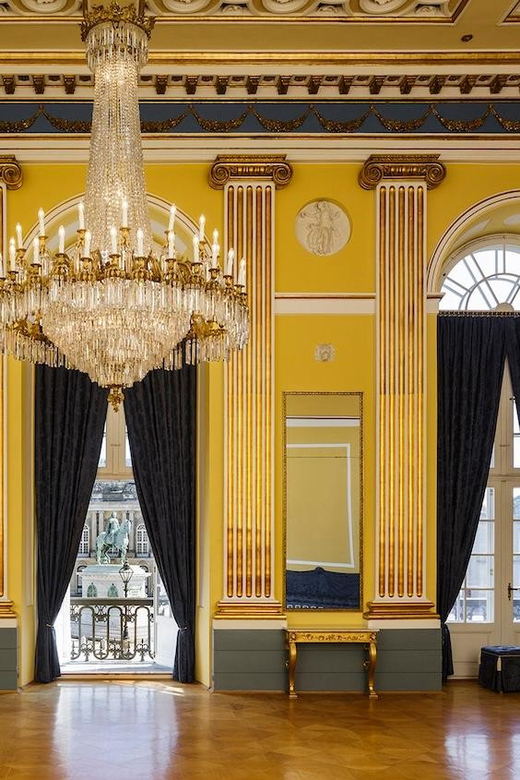
The Gala Hall is the museum’s grandest room. Its ceiling rises eight meters, and the space is decorated with lavish gilding and a view toward the palace square.
The Royal Family commissioned Nicolai Abildgaard to design the interior in 1794. Sculptor Bertel Thorvaldsen created the sculptures. Those names matter because the hall is not just a large decorated room. It reflects a deliberate artistic project commissioned for royal use.
After the more intimate rooms, the Gala Hall can feel like a dramatic change of scale. Here, the palace presents ceremony, status, and public display. The room is the clearest answer for visitors who want to see traditional palace grandeur.
I would save a few minutes to look upward and across the room. The height and decoration are easy to miss if you focus only on moving along the route. This is also the best place to understand why Amalienborg remains an important royal setting rather than only a museum collection.
The Frederik X exhibition has a fixed date
The museum presented FREDERIK X: King of Tomorrow from March 22 through September 8, 2024. The exhibition marked the succession of the Danish throne on January 14 and used photographs, objects, video clips, paintings, and sound to create a portrait of the new king.
This is a dated exhibition, so you should not assume it will be available for a visit after September 8, 2024. If you are planning a current trip, check the museum’s present exhibition information before you book.
When available, the exhibition adds a contemporary layer to the older palace rooms. You move from monarchs and interiors preserved from earlier periods to a presentation about a newly established reign. That contrast can make the wider royal story easier to follow.
The exhibition is also a reason to check what is currently on display rather than treating the ticket as access to a fixed collection. The permanent rooms remain the core of the visit, but temporary displays can change the balance of what you see.
How the ticket works at the entrance
The ticket is valid for one day, with starting times based on availability. You need to enter through the museum in Christian VIII’s Palace, which is the first building on your left when approaching the square from Frederiksgade or the Marble Church.
There is one practical step that can catch you off guard. Before going upstairs to the exhibition, you need to go downstairs to the cashier, where staff scan and process your online ticket. Keep the QR code ready and allow a few extra minutes for this exchange.
Arriving more than 20 minutes late makes the ticket invalid. This is worth taking seriously if you are coming from another attraction or relying on a tight walking schedule. The museum is central, but a delayed lunch, crowded streets, or a wrong turn can quickly use up that margin.
Large bags, backpacks, large purses, oversize luggage, food, and drinks are not allowed inside. Baby strollers and pets are also excluded, although assistance dogs are permitted. Travel light, especially if Amalienborg is one stop in a longer day of sightseeing.
The museum is wheelchair accessible. The ticket includes entry to all exhibitions, but it does not include a guided tour. You should plan to explore at your own pace rather than expect a guide to lead you from room to room.
Is $19 a fair price?
At $19 per person, the ticket is not a bargain if you measure value only by time. A typical visit takes about 45 minutes to an hour, and some people may find that there is not enough to see for the price.
The value improves if you enjoy interiors, royal family stories, decorative arts, or Danish history. You are paying for access to rooms that remain unusually personal in character, not just for a large collection of objects. The dining room, study, salon, Fabergé Chamber, and Gala Hall each offer a different kind of evidence about royal life.
The ticket also works better as part of a larger central Copenhagen day. You can visit the square, walk to nearby sights, and use the museum as a focused historical stop rather than a destination that needs to fill half a day.
Families may get better value because children have their own audio material and the route is short enough to hold attention. Adults looking only for grand architecture may find the price harder to justify, since the Gala Hall is impressive but the museum as a whole is fairly compact.
The 4.3 rating from 291 evaluations suggests a broadly positive experience with some disagreement over the amount included for the price. That fits the practical reality: the museum is well organized and enjoyable, but it is not extensive.
Who will enjoy this museum most?
I would recommend Amalienborg Museum if you want royal history presented through real rooms and personal belongings. It is a strong choice for anyone who prefers a focused museum visit to a long, crowded palace route.
It also suits families. The child audio material gives younger visitors a way to engage with the rooms, and the visit length is manageable. A seven-year-old may not care about every royal date, but the palace setting and audio format can keep the experience accessible.
History and design enthusiasts will have plenty to notice in the differences between the rooms. The dark officer’s study, Queen Louise’s salon, the Russian jewelry, and the enormous Gala Hall create a useful range of styles and subjects.
You might skip it if your schedule is packed, you dislike royal collections, or you expect several hours of entertainment for $19. The museum is not a sprawling palace complex open for unrestricted wandering. It is a carefully arranged selection of royal rooms within one of Amalienborg’s four palaces.
My advice for planning your visit
Book this as a short, well-timed stop rather than the centerpiece of your Copenhagen schedule. Arrive on time, keep your bags small, and go downstairs first to scan the online ticket before heading upstairs.
Give yourself at least an hour if you want to read the displays and use the audio material. Add time outside for Amalienborg Square, since the setting is part of the experience even though the ticket focuses on the museum.
If you are particularly interested in the Gala Hall, do not skip the smaller rooms on the way. The hall gives you the visual impact, but Christian X’s study, Queen Louise’s salon, and the dining room provide the personal details that make the visit worthwhile.
Should you book Amalienborg Palace Museum?
Book it if you want a compact look at Danish royal life, especially through preserved interiors and family objects. It is particularly well suited to families, design fans, and visitors already exploring the Marble Church and central Copenhagen.
Think twice if $19 feels high for a visit under an hour or if you want a large palace with many wings to explore. For the best value, combine the museum with time in Amalienborg Square and nearby sights, and confirm the current exhibitions before booking.
FAQ
Where is the Amalienborg Palace Museum?
The museum is in Christian VIII’s Palace at Amalienborg in Copenhagen, Region Zealand, Denmark. Enter Amalienborg Square from Frederiksgade or the Marble Church, then use the first building on your left.
How long is the museum ticket valid?
The ticket is valid for one day. Starting times depend on availability.
How long should I plan for the museum?
Plan on about 45 minutes to one hour inside. You may want extra time to explore Amalienborg Square outside.
What does the ticket include?
The ticket includes entry to the Amalienborg Palace Museum and access to all exhibitions.
Is a guided tour included?
No. A guided tour is not included with the entry ticket.
What happens if I arrive late?
If you arrive more than 20 minutes late, your ticket is no longer valid.
Can I bring a large bag or backpack?
No. Large bags, large purses, backpacks, oversize luggage, food, drinks, baby strollers, and pets are not allowed inside. Assistance dogs are allowed.
Is the museum wheelchair accessible?
Yes, the museum is wheelchair accessible.
Just added around the world
- Girona, Figueres, Dalí Museum and Cadaqués Tour from Barcelona★ 4.5 · 36 reviews
- Football Club Barcelona Museum Immersive Tour Guided Visit★ 3.5 · 52 reviews
- Erotic Museum Admission Ticket with Audioguide★ 5.0 · 527 reviews
- Dali Museum and Costa Brava Small Group Day Trip from Barcelona★ 5.0 · 77 reviews
- Madrid by High-Speed Train with Prado Museum Private Tour★ 4.0 · 33 reviews
- Guitar Legends Hall: Entrance to the Immersive Rock Museum★ 5.0 · 25 reviews
- White Rabbit Museum: The Best Immersive Experience in Catalonia★ 5.0 · 538 reviews
- Private Dali Museum, Besalú & Girona Tour from Barcelona★ 5.0 · 15 reviews
Palace Museum Tours, compared.

Topkapi Palace & Harem Museum Ticket & Audio Guide
Read our review →
Venice’s Best: Basilica, Doge’s Palace, Gondola & History Gallery
Read our review →
Royal Palace & Prado Museum Skip the Line Guided Tour
Read our review →
City Pass with Museums including Doge’s Palace
Read our review →
Crete: Knossos Palace and Museum E-Tickets with Audio Guides
Read our review →
Venice Museum Pass & Doge’s Palace Entrance Ticket
Read our review →
Palace, Museum, Madrasa & Medina Highlights Tour
Read our review →Browse the lists this tour appears in