
Review · ROME
Rome: Leonardo da Vinci Exhibition Entrance Ticket
Leonardo da Vinci’s sketches can look mysterious on paper. Here, they become full-size machines you can inspect, and in many cases touch and operate. The exhibition at Palazzo della Cancelleria turns his ideas about flight, water, war, architecture, and mechanics into something much easier to grasp.
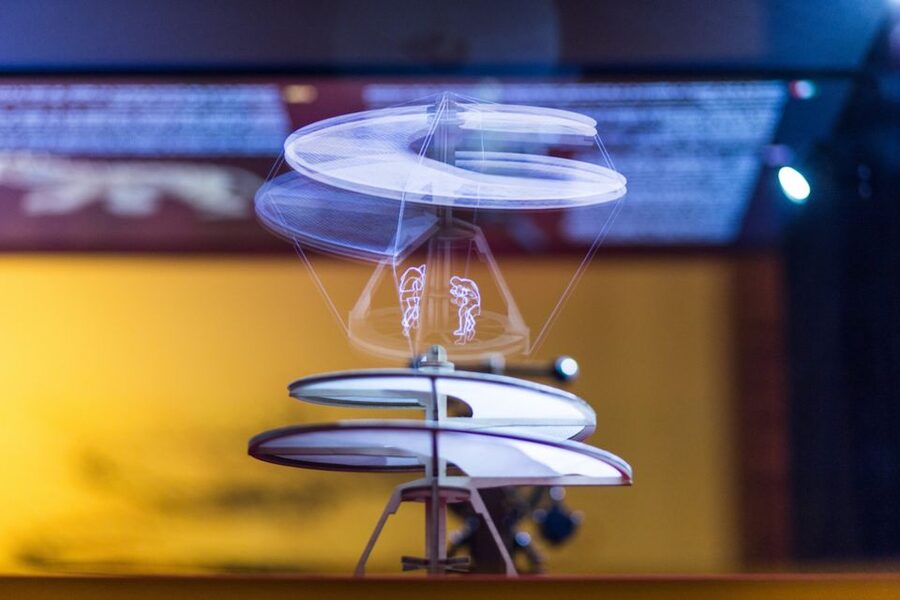
I like the hands-on approach, especially the chance to build a version of Leonardo’s bridge and test parts of his machines. I also like the nine holograms, which show paintings and inventions in 3D and add motion to an otherwise model-filled display.
The main drawback is its modest size. You may finish in 45 to 60 minutes, though careful reading, the audio guide, and the many interactive stations can stretch a visit to two hours. Some room numbers and directions can also feel unclear.
Key points to know before you go
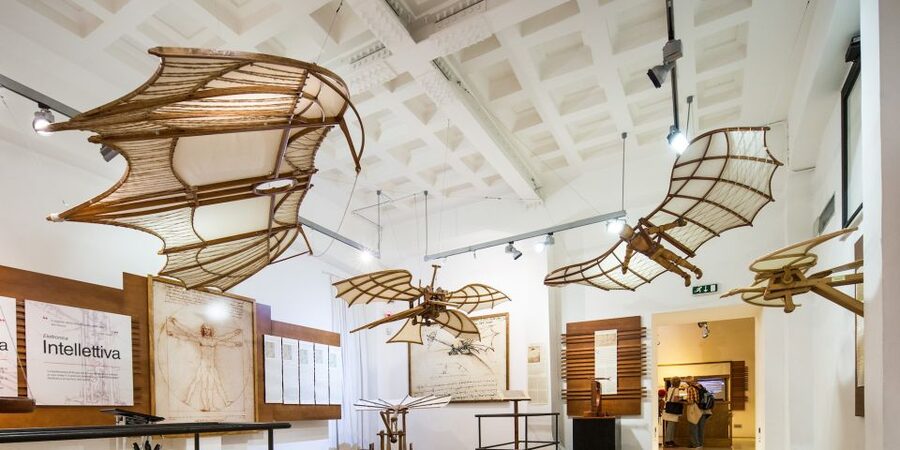
- Sixty-five full-scale inventions: See working reproductions based on Leonardo’s drawings, including flying machines, military designs, instruments, and water studies.
- Touch-friendly displays: Many models are made to be handled, making this a strong choice for curious children and adults.
- Four themed sections: The exhibition examines Leonardo’s ideas through Water, Air, Fire, and Earth.
- Nine 3D holograms: These present Leonardo’s art and inventions in a lively multimedia format.
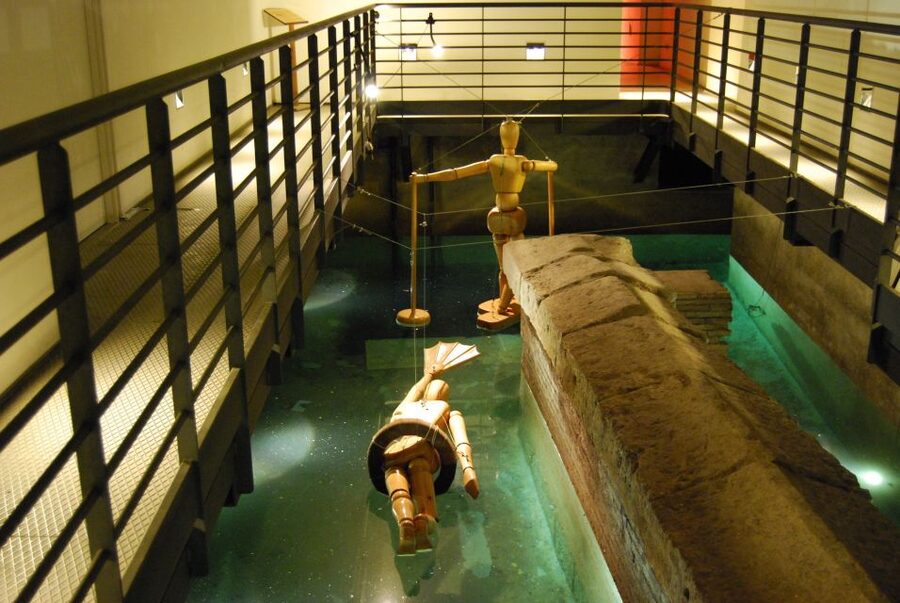
- A Roman tomb underground: The building contains the tomb of architect Auro Irzio, dated to 43 BC and set in a natural underground pond.
- Good value at about $10: You receive a gadget with admission, and an audio guide is available for an additional fee.
Why this small Rome exhibition is worth your time
You will not find a grand gallery filled with original Leonardo paintings here. This is a compact educational exhibition built around reproductions, explanations, models, and interactive displays.
That difference matters. If your main goal is to see original Renaissance art, this is not the right stop. If you want to understand how Leonardo thought, the models do a better job than a wall of framed sketches could.
The exhibition shows Leonardo as more than the painter of the Mona Lisa and The Last Supper. His work reaches into engineering, aviation, military design, architecture, sculpture, science, and music. A copy of The Last Supper appears here, but the larger appeal is seeing his machines and instruments brought into physical form.
I find the price especially reasonable for Rome. At about $10 per person, this is far less costly than many major Roman sights, and it gives you a focused indoor activity near Piazza Navona and Campo de’ Fiori. It will not occupy an entire day, but it can fill an hour well without demanding a major chunk of your sightseeing budget.
More Museum Tours in Rome
- Vatican Museums, Sistine Chapel & St. Peter’s Basilica Tour
★ 4.3 · 73,970 reviews - Vatican Museums, Sistine Chapel & St Peter’s Basilica Guided Tour
★ 4.5 · 39,149 reviews - Rome: Vatican Museums, Sistine Chapel and Basilica Tour
★ 4.3 · 16,039 reviews
Four sections built around Water, Air, Fire, and Earth
The route is arranged in four sections linked to the classical elements. This gives the exhibition a simple structure and helps you see how broad Leonardo’s interests were.
Water
Leonardo studied water as both a natural force and a tool for engineering. In this section, you can examine models connected with movement, flow, and mechanical control.
The value here is not just the machine itself. You can see how Leonardo observed nature, then tried to copy or control its patterns. His water studies connect directly to ideas used in canals, pumps, bridges, and transport.
This area works well for children because the models are more understandable when you can watch a mechanism move. The hands-on format turns a difficult technical drawing into a practical puzzle.
Air
The flying machines are among the exhibition’s most eye-catching displays. Leonardo studied birds and tried to work out how humans might rise into the air.
Do not expect a modern aircraft museum. These are early concepts, not successful planes. Their importance is in the questions they ask: how much lift is needed, how wings should move, and how a person might control a flying device.
The full-scale models help you judge their size and shape. A sketch can make an invention seem simple. A large reproduction shows the structure, the weight, and the problems Leonardo was trying to solve.
A few more museum visits around Rome worth comparing
- Vatican Museums & Sistine Chapel Skip-the-Line Entry Ticket
★ 4.4 · 13,838 reviews - Vatican Museums & Sistine Chapel Skip-the-Ticket-Line Tour
★ 4.3 · 10,486 reviews - Rome: Vatican Museums & Sistine Chapel Skip-the-Line Ticket
★ 4.3 · 8,103 reviews - Rome: Borghese Gallery Skip-the-Line Ticket & Audioguide
★ 4.3 · 4,318 reviews
Fire
The Fire section brings you closer to military technology and mechanical power. You will find designs linked to weapons and battlefield machinery, including a model of Leonardo’s tank.
This is one of the clearest places to see the tension in Leonardo’s work. He designed elegant machines with great technical skill, but some were meant for war. The exhibition presents that side of his work without reducing him to either a peaceful artist or a weapons designer.
The models are useful because they reveal practical limits. You can see how wheels, gears, armor, and movement had to work together. It is a hands-on way to understand the gap between a clever design and a machine ready for real use.
Earth
Earth brings together architecture, structures, tools, and mechanical systems. Leonardo’s bridge is a highlight because you can build your own version and see why the design works.
This is a particularly good stop for families. The activity gives children something to do, while adults can think about balance, weight, and structure. It also helps show that Leonardo’s genius was not magic. He studied ordinary materials and forces, then rearranged them in smart ways.
The full-size models make the ideas click
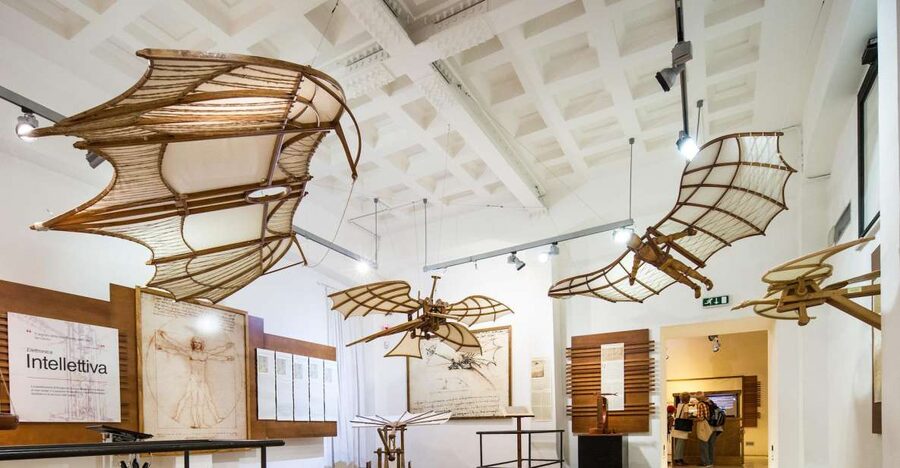
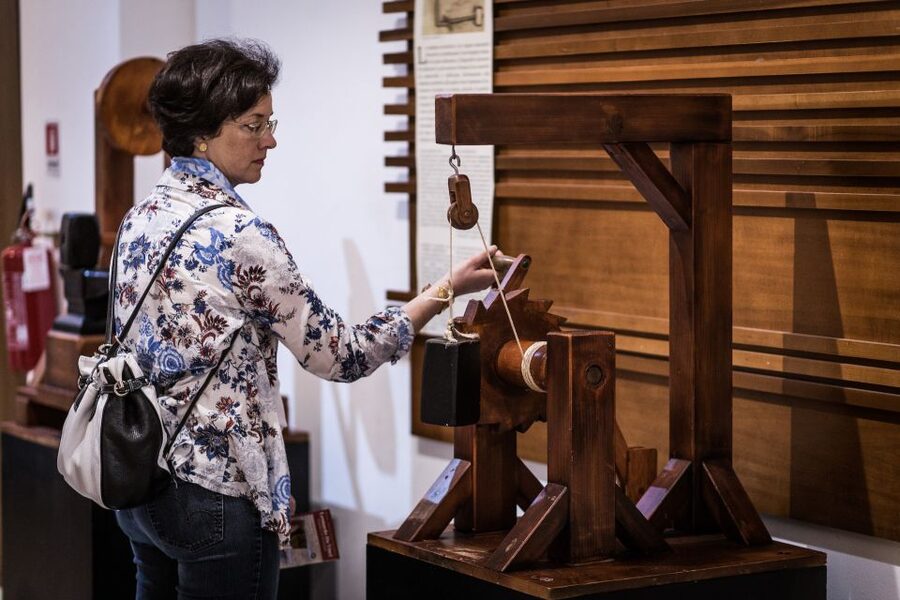
The best part of this experience is the scale of the reproductions. You are not simply looking at a tiny model behind glass. Many machines are large enough to inspect from several angles, and many can be touched or tested.
That makes a difference for anyone who finds technical drawings hard to follow. You can move from Leonardo’s original idea to the model, then watch how the parts relate to one another.
The exhibition includes machines connected with transportation, architecture, military design, science, and flight. Musical instruments and scientific tools add variety, so the visit does not become a long series of similar gears and levers.
Some displays show their age, and a few machines may not be in perfect condition. That is worth keeping in mind if you expect polished museum pieces. The exhibition works best as an educational display rather than a formal art museum.
Holograms and interactive stations add motion
Nine holograms show Leonardo’s paintings and inventions in three dimensions. These displays give the exhibition a modern feel and help break up the mechanical models.
The holograms are especially useful for younger visitors, who may lose interest when an exhibit relies only on written panels. They also give you another way to see how Leonardo moved between art and engineering.
Seven interactive installations use his drawings to explain more of his work. You can expect to press, turn, build, and examine rather than simply walk past displays.
The touch-friendly design is one of the exhibition’s strongest features. It encourages questions and conversation. You may find yourself asking why a device was shaped in a certain way, what problem it solved, or why it was never built as a practical machine.
Keep an eye on the instructions. One practical weakness is that the difference between touch and do not touch is not always obvious. There are also some trip hazards, so small children need close supervision.
The underground Roman tomb is an unexpected extra
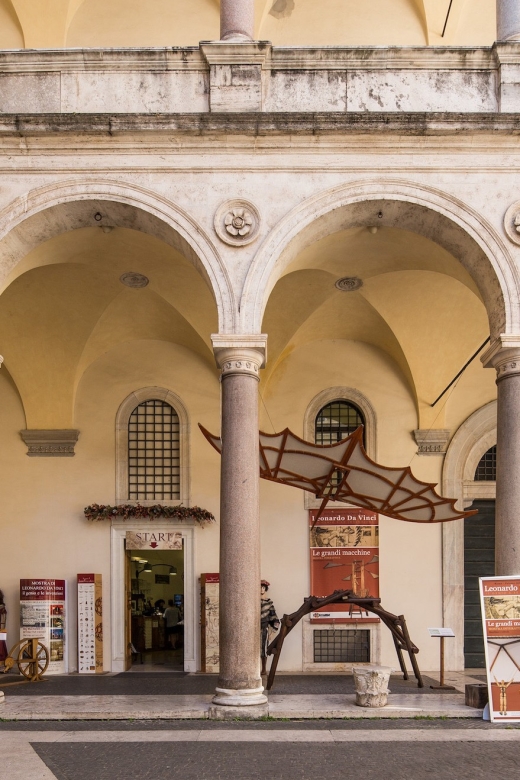
The Palazzo della Cancelleria is worth noticing before you even reach the exhibition rooms. The building belongs to the Vatican and is known for its architecture.
Below the exhibition, you can see the tomb of Auro Irzio, identified as an architect and dated to 43 BC. It sits in an underground natural pond, making this one of the more unusual details of the visit.
The tomb gives you a brief connection to ancient Rome alongside the Renaissance material upstairs. It is not a separate archaeological tour, so do not expect a large collection of Roman remains. Still, it adds a surprising layer to a short museum stop.
The underground setting has another practical benefit in summer. The rooms provide a cool break from Rome’s heat, especially if you are walking between Campo de’ Fiori, Piazza Navona, and the Pantheon area.
Audio guide or self-guided visit?
Admission includes a gadget, but a guide is not included. An audio guide can be obtained for an additional charge, and I would consider it worthwhile if you want more than a quick look.
The recorded explanations add context about Leonardo’s work and its connection to modern transportation and architecture. English explanations are available throughout the display, so you can still follow the exhibition without paying extra.
The audio route may not always follow the room order perfectly. Numbering and directions can also be a little confusing, especially when moving between rooms. Take a moment to get your bearings before starting the commentary.
If you are visiting with children, you may prefer to explore first and use the audio guide selectively. Adults interested in engineering or Renaissance science will likely get more from listening to every explanation.
How long should you allow?
Plan on at least 45 minutes for a quick visit. That gives you time to see the main models, read some explanations, and try several interactive stations.
Allow 60 to 90 minutes for a more balanced visit. This is enough time for the four sections, holograms, Roman tomb, and a selection of the hands-on displays.
Two hours is possible if you read closely, watch the short videos, and use the audio guide. The museum is not huge, but the number of machines and explanations can slow you down in a good way.
Because the ticket is valid for one day, you have flexibility around your Rome plans. Admission is available until one hour before closing, so check the current opening times and do not arrive at the last moment.
Location and practical planning
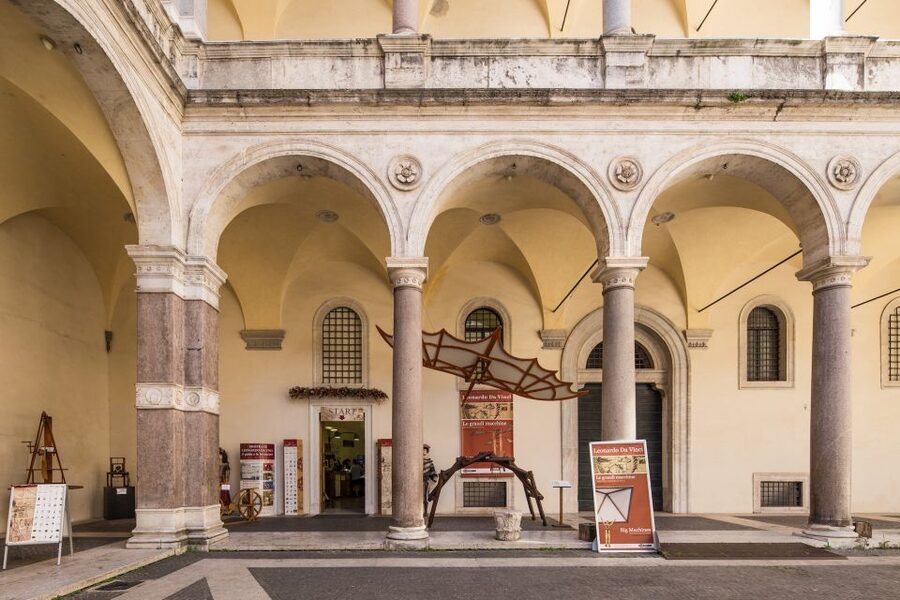
The entrance is at Piazza della Cancelleria 1, close to Campo de’ Fiori and Piazza Navona. This makes it easy to add to a walking day in central Rome.
You can pair it with a visit to Piazza Navona, the Pantheon, Campo de’ Fiori, or nearby churches and palaces. It is not a major all-day attraction, so it works best between larger sights rather than as the main event of your day.
The exhibition is wheelchair accessible. The ticket includes admission and a gadget, while a guide is not included. You can skip the ticket line, and cancellation is allowed up to 24 hours in advance for a full refund. A reserve-now, pay-later option is also available.
The gift shop is a pleasant extra, with more unusual choices than the standard souvenir stalls found around Rome. Staff are described as friendly and helpful, which is useful in a small venue where you may need directions.
Who will enjoy this most?
This is a good pick for families with school-age children, especially those who like to touch, build, and test things. It can turn a famous name from a textbook into a person who solved problems with wood, gears, ropes, water, and careful observation.
It also suits adults interested in engineering, transport, architecture, military technology, and the history of ideas. You do not need advanced technical knowledge. The models and explanations keep the material approachable.
Art lovers may enjoy the multimedia displays and copy of The Last Supper, but this is not primarily a painting museum. If you want original works by Leonardo, choose an art-focused collection instead.
I would be less likely to recommend it to someone seeking a grand, quiet museum with rare objects. The rooms are compact, some displays show wear, and the route can be slightly awkward. Its strength is interaction, not prestige.
Should you book the Leonardo da Vinci exhibition?
Book it if you want an affordable, hands-on break near Piazza Navona and Campo de’ Fiori. The full-size inventions, holograms, and interactive machines make Leonardo’s ideas easy to picture, and the cool underground rooms are welcome during a hot Roman afternoon.
Skip it if your schedule is packed with major ancient sites or if you only want original Renaissance art. For most visitors with an hour to spare, though, the $10 price is fair, the subject is broad, and the visit offers a side of Leonardo that Rome’s traditional galleries may not show.
FAQ
Where is the Leonardo da Vinci exhibition in Rome?
The exhibition is at La Mostra Leonardo da Vinci, Piazza della Cancelleria 1, near Campo de’ Fiori and Piazza Navona.
How much does admission cost?
The listed price is $10 per person.
How long is the ticket valid?
The ticket is valid for one day. Check availability for the available starting times.
Is a guide included?
No. The entrance ticket includes exhibition admission and a gadget, but a guide is not included. An audio guide is available for an additional cost.
How many Leonardo da Vinci inventions are on display?
The exhibition presents more than 65 full-scale machines based on Leonardo’s designs.
Can you touch the inventions?
You can touch and play with almost all of the machines on display. Some areas may have unclear touch instructions, so follow the signs and supervise young children.
Is the exhibition wheelchair accessible?
Yes, the exhibition is wheelchair accessible.
What else can you see at the Palazzo della Cancelleria?
The building is owned by the Vatican and is notable for its architecture. You can also see the tomb of architect Auro Irzio, dating to 43 BC, set in an underground natural pond.
Just added around Rome
- Vatican City: Sistine Chapel, Museums, Basilica Private Tour★ 4.8 · 158 reviews
- Rome: Hop-on Hop-off Bus & Vatican Museums Ticket★ 3.5 · 41 reviews
- Rome: Vatican Museums, Sistine Chapel, and St. Peter’s Tour★ 4.5 · 49 reviews
- Skip-The-Ticket Line-Vatican Museum & Sistine Chapel★ 3.9 · 383 reviews
- Skip the line Vatican Museum Sistine & St.Peter Private Tour★ 4.7 · 40 reviews
- Skip-the-Line Vatican Museums and Sistine Chapel Guided Tour★ 4.3 · 130 reviews
- Skip-the-Line Tickets: Vatican Museum and Sistine Chapel★ 3.5 · 114 reviews
- MAXXI – Museum of Contemporary Art of 21st century★ 4.0 · 91 reviews
Museum Tours in Rome, compared.
Vatican Museums, Sistine Chapel & St. Peter’s Basilica Tour
Read our review →
Vatican Museums, Sistine Chapel & St Peter’s Basilica Guided Tour
Read our review →
Vatican Museums, Sistine Chapel and Basilica Tour
Read our review →
Vatican Museums & Sistine Chapel Skip-the-Line Entry Ticket
Read our review →
Vatican Museums, Sistine Chapel & Basilica Tour
Read our review →
Vatican Museums & Sistine Chapel Guided Tour
Read our review →
Vatican Museums & Sistine Chapel Skip-the-Ticket-Line Tour
Read our review →
Vatican Museums, Sistine Chapel and St. Peter’s Basilica Tour
Read our review →Browse the lists this tour appears in