
Review · ROME
Rome: Galleria Borghese Museum Entry Ticket and Guided Tour
Bernini’s marble seems to move at the Borghese Gallery. Apollo reaches for Daphne as she turns into a laurel tree, while Pluto’s fingers press into Proserpine’s flesh. I like that this tour puts those famous sculptures alongside Caravaggio’s intense paintings and the gallery’s theatrical ceiling frescoes. You get the ticket, a live guide, and headsets, which matters in a busy room.
I also like the focused two-hour route. It gives you enough time for the major works without turning the museum into an all-day art marathon. A possible drawback is consistency: one booking was reported as lasting only 45 minutes, so confirm the meeting details and make sure the guide knows you expect the full tour.
Key points to know before you book
- Bernini takes center stage: See Apollo and Daphne, Rape of Proserpine, David, and earlier works such as Aeneas, Anchises and Ascanius.
- Caravaggio is well represented: Look for Saint John the Baptist, Boy with Basket of Fruit, Saint Jerome Writing, Sick Bacchus, and other works.
- The ceilings deserve your attention: Mariano Rossi’s fresco in the Salone uses dramatic foreshortening to create an almost three-dimensional effect.
- The tour is short but concentrated: Two hours works well for first-time visitors who want the essential rooms and sculptures.
- Headsets are included: You can hear the guide more clearly while standing near major works.
- Languages and access are practical: Live tours and audio support are offered in English, French, and Italian, and the activity is wheelchair accessible.
Why the Borghese Gallery feels different from a standard museum visit
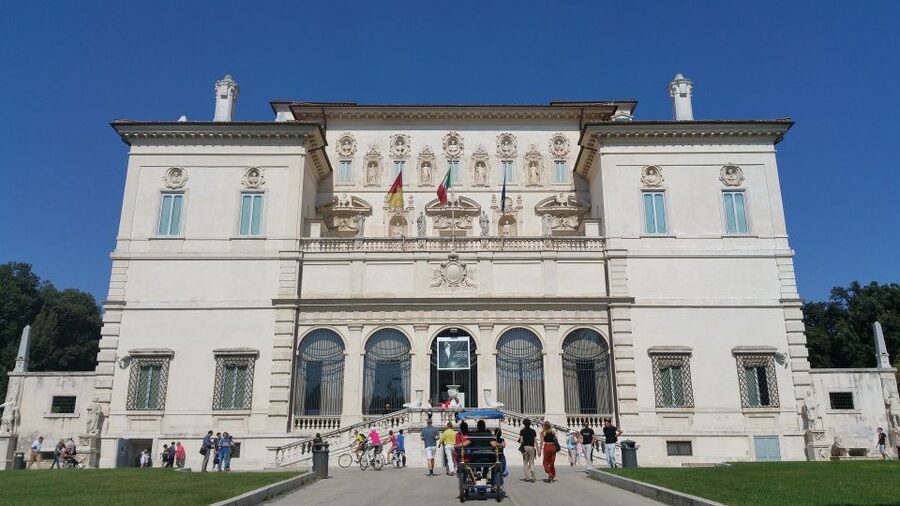
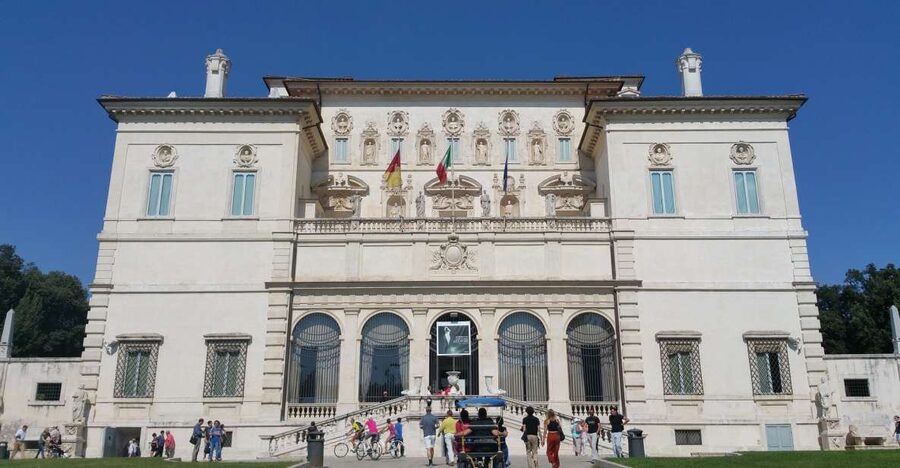
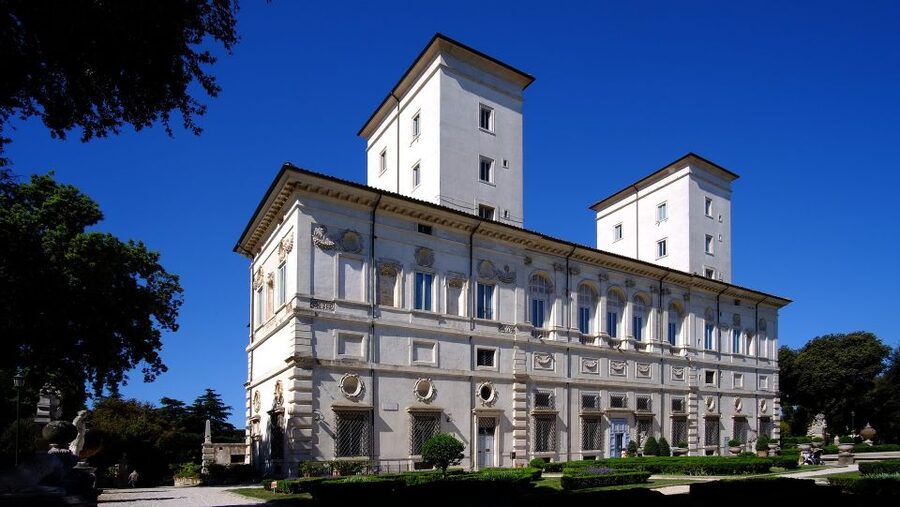
The Borghese Gallery is not simply a large collection spread across endless corridors. It is a former villa built around the taste of Cardinal Scipione Borghese, an avid collector and nephew of Pope Paul V. His interests shaped what you see: dramatic Baroque sculpture, powerful religious paintings, portraits, antiquities, and works by artists he actively supported.
I like this setting because the art does not feel detached from the building. Marble sculpture fills the rooms, painted ceilings pull your eyes upward, and the decoration competes for your attention in the best possible way. You are constantly switching between three dimensions, painted illusion, and the room itself.
That can also make the gallery tiring. There is a lot to look at in a compact visit, and the two-hour tour moves with purpose. If you want to examine every painting at length, you may find the schedule brisk. If you want a clear introduction to the collection’s finest works, the pace is useful.
More Museum Tours in Rome
- Vatican Museums, Sistine Chapel & St. Peter’s Basilica Tour
★ 4.3 · 73,970 reviews - Vatican Museums, Sistine Chapel & St Peter’s Basilica Guided Tour
★ 4.5 · 39,149 reviews - Rome: Vatican Museums, Sistine Chapel and Basilica Tour
★ 4.3 · 16,039 reviews
Meeting your guide at Piazzale Scipione Borghese
The listed meeting point is Piazzale Scipione Borghese, 5. Look for a guide holding a red flag marked with the Saints Tour logo. That detail is worth remembering because the gallery sits within the Villa Borghese area, and a precise meeting signal saves time.
The activity does not include hotel pickup or drop-off, food, or drinks. You need to reach the meeting point on your own, so allow enough time to find the guide before the scheduled start. Bring your passport or identity card, and leave large bags and luggage behind because they are not allowed.
The tour takes place rain or shine. That matters less once you are inside the gallery, but it matters at the meeting point, particularly on a wet day. A small bag and practical shoes are the sensible choice.
The Salone and its remarkable ceiling
One of the first rewards is the Salone, where the ceiling fresco demands a look upward before you rush toward the sculpture. Mariano Rossi painted Marcus Furius Camillus relieving the siege of the Capitol by the Gauls. Through strong foreshortening, the figures appear to project out of the ceiling.
This is a good example of why a guide adds value here. On your own, you may walk straight toward the famous Bernini sculptures and miss the painted architecture above you. A guide can help you read the scene and understand how the illusion works, rather than leaving you to admire it as a swirl of color.
The ceiling is also a useful pause between major works. You can look up, reset your eyes, and then return to the marble with a better sense of how the entire room was designed to impress.
The Chamber of Ceres and the first rooms
The first room of the Salone is the Chamber of Ceres. A marble vase showing Oedipus and the Sphinx gives the room a mythological focus and reminds you that the collection is not limited to paintings from the Renaissance and Baroque periods.
The next room has a ceiling fresco by Francesco Caccianiga depicting the Fall of Phaeton. These rooms help explain the visual program of the villa. The decoration is not filler between masterpieces. It creates a setting in which mythology, power, religion, and artistic skill sit together.
You will want to keep your eyes moving. Look at the walls, the ceiling, the floor, and the sculpture in front of you. The gallery rewards people who pause for the room itself, not only for the names on the labels.
A few more museum visits around Rome worth comparing
- Rome: Borghese Gallery Skip-the-Line Ticket & Audioguide
★ 4.3 · 4,318 reviews - Rome: Borghese Gallery Ticket + Audioguide or Guided Tour
★ 4.6 · 3,219 reviews - Rome: Borghese Gallery Guided Tour with Skip-the-Line Entry
★ 4.8 · 2,649 reviews - Rome: Borghese Gallery Skip-the-Line Tickets with Audioguide
★ 4.6 · 2,562 reviews
Bernini’s Apollo and Daphne
Apollo and Daphne is one of the essential stops. Bernini shows the instant when Daphne escapes Apollo by changing into a laurel tree. Her fingers become leaves, her hair turns into branches, and her feet begin to root into the ground.
The sculpture works from several angles, so listen carefully as the guide positions the group and explains what to notice. The transformation is easy to understand from a distance, but the smaller details make the work extraordinary: the bark, the fingers, the movement of the bodies, and the way the marble seems to change before your eyes.
The subject also carries a warning. Apollo may be reaching Daphne, but she is escaping him, not welcoming him. A good explanation helps you see both the technical achievement and the disturbing story behind it.
The Rape of Proserpine and Bernini’s touch
Bernini’s Rape of Proserpine is another major reason to visit the gallery. The sculpture shows Pluto carrying Proserpine away, and the most famous detail is the pressure of his fingers against her thigh. The marble looks soft enough to bruise.
That detail is not a trick separated from the whole composition. It makes the violence feel physical and immediate. Proserpine twists away while Pluto’s body drives the movement forward. You can see how Bernini turns a mythological scene into a moment of action.
The title uses the older meaning of rape, meaning abduction, but the scene is still unsettling. I appreciate a guide who does not treat it as only a clever display of carving skill. The sculpture is beautiful, forceful, and troubling at the same time.
David, early works, and the range of Bernini
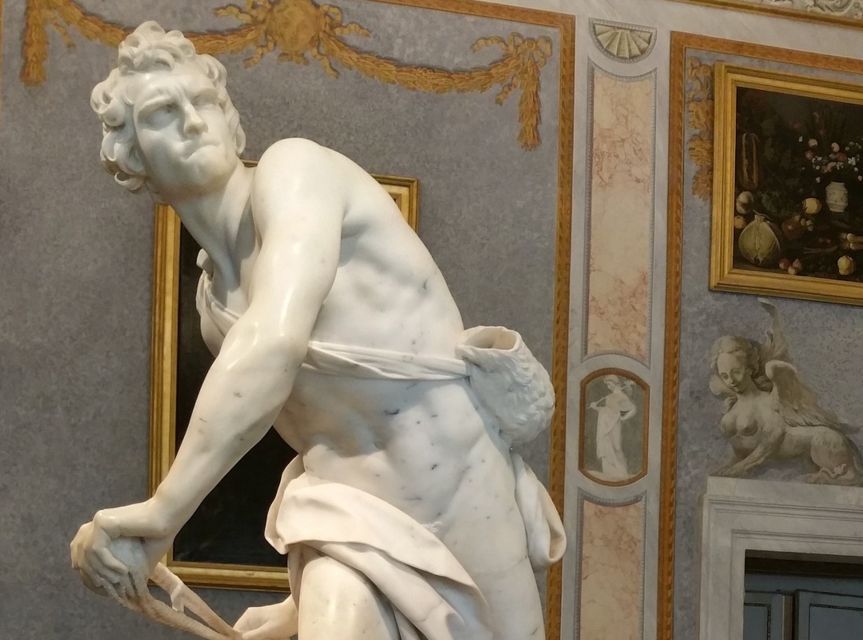
The Borghese Gallery holds a strong portion of Bernini’s secular sculpture. David shows the hero in motion, not as a calm figure after victory. His body twists as he prepares to release the stone, and the work asks you to imagine the action continuing beyond the marble.
You will also see earlier pieces such as Goat Amalthea with Child Jupiter and Faun and Aeneas, Anchises and Ascanius. These help you trace Bernini’s development. The young artist was already handling complex bodies and stories, but the later works bring greater force, movement, and emotional tension.
This range is one reason a guided visit works well. Without context, the sculptures can blur into a parade of famous names. With a clear route, you can compare the early and mature works and notice how Bernini’s treatment of movement changes.
Caravaggio’s sharp, human paintings
Caravaggio gives the collection a different kind of drama. His paintings do not rely on marble movement. They use light, shadow, direct faces, and ordinary human presence to make sacred or mythological subjects feel close.
The collection includes Boy with Basket of Fruit, Saint Jerome Writing, Sick Bacchus, and Saint John the Baptist. The last is specifically highlighted as one of the key works to see. These paintings reward close attention to skin, fabric, fruit, and expression, so your guide’s explanation can help you slow down after the grand scale of Bernini.
I especially like the contrast between the two artists. Bernini pulls you around a sculpture, while Caravaggio controls your gaze on a flat surface. One makes stone seem alive; the other makes paint feel physical and immediate.
Do not rush past the smaller details. The fruit, the hands, the exposed skin, and the dark backgrounds are central to Caravaggio’s effect. The paintings can look severe at first, but their power comes from how direct they are.
Portraits, antiquities, and Cardinal Scipione Borghese
The collection also includes portrait busts of Pope Paul V and Cardinal Scipione Borghese. These portraits give you a more personal link to the man who assembled much of what you are seeing.
Cardinal Scipione was not a passive owner filling rooms with fashionable objects. His preferences shaped the collection, particularly his interest in Caravaggio and Bernini. Looking at his portrait alongside the works he commissioned or collected helps you understand the gallery as a personal project as much as a museum.
The antiquities add another layer. The Borghese taste reached across periods, so the visit is not only a survey of seventeenth-century art. The mix can feel crowded, but it also gives you a sense of how collectors used ancient sculpture and modern works together to create a powerful public image.
How the two-hour guided format works
The advertised duration is two hours, with the Borghese Gallery and the ground-floor sculptures as the main focus. That is enough time for a well-organized introduction to the essential rooms, but not enough for a slow study of every object.
The guide leads the visit, and headsets are included so you can hear clearly. This is particularly helpful when the group gathers around Apollo and Daphne or the Rape of Proserpine. You can keep your eyes on the art instead of trying to stand shoulder to shoulder with the guide.
The guide language options are English, French, and Italian. An audio guide is also listed in those three languages. If you are booking for a family, it is worth noting that one small group had what amounted to a private experience, with guide Silvia adapting well to teenagers. Group size can affect how personal the visit feels, but the exact group size is not specified.
One important caution: a booking was reported as ending after 45 minutes rather than the advertised two hours. That is a serious shortfall for a $94 ticket. Arrive early, identify the guide by the red Saints Tour flag, and politely confirm the full duration at the start.
Is $94 good value?
At $94 per person, this is not a cheap museum entry. You are paying for the admission ticket, a live guide, headsets, and a concentrated route through one of Rome’s most important collections.
The value depends on your priorities. I think the price makes more sense if Bernini and Caravaggio are high on your list and you want help making sense of the rooms. A guide can point out the ceiling illusion, explain the mythological scenes, and connect the artists rather than leaving you to read labels one by one.
The price is harder to justify if you prefer to wander slowly or already know the collection well. You may want more time with individual paintings than a guided route allows. The short reported visit also shows why you should pay attention to the meeting arrangements and make sure the promised two hours are delivered.
The booking terms add some flexibility. You can cancel up to 24 hours before the activity for a full refund, and you can reserve now and pay later. Those terms do not change the cost, but they can help if your Rome schedule is still taking shape.
Who should choose this Borghese tour?
I would choose it for a first visit, especially if you have only a few hours for art in Rome. The route concentrates on works that are easy to miss without direction, and the guide can give you a basic framework for understanding Bernini, Caravaggio, the Borghese family, and the building.
Families may also like the short format. Two hours is long enough to feel worthwhile but short enough to keep younger visitors from fading completely. The positive experience with teenagers suggests that a flexible guide can make a difference, though no tour can guarantee a particular guide or group size.
Art students and repeat visitors should weigh the format more carefully. You will see important pieces, but the tour is designed for highlights rather than extended research. Wheelchair access is available, which makes the experience suitable for visitors who need an accessible museum option.
Should you book the Borghese Gallery tour?
Book this tour if you want the main Bernini sculptures, several important Caravaggio paintings, and the gallery’s ceiling frescoes explained in a tight two-hour visit. The strongest reasons are the art itself, the included entry, and the headsets that make a live explanation easier to follow.
I would skip it if you want a quiet, unhurried visit or if you are uncomfortable paying $94 for a highlights route. If you book, bring identification, avoid large bags, arrive at Piazzale Scipione Borghese, 5 with time to spare, and look for the red Saints Tour flag. Most important, confirm that your tour will run for the full two hours.
FAQ
How long does the Borghese Gallery tour last?
The advertised duration is two hours. One booking was reported as lasting only 45 minutes, so confirm the duration with the guide at the start.
What does the $94 price include?
The price includes the museum entry ticket, a live guide, and headsets for hearing the guide clearly.
Which artists can I see?
The tour features Bernini and Caravaggio. Works by Bernini include Apollo and Daphne, Rape of Proserpine, David, and Aeneas, Anchises and Ascanius. Caravaggio works include Saint John the Baptist, Boy with Basket of Fruit, Saint Jerome Writing, and Sick Bacchus.
Is a guide included?
Yes. A live guide is included, with tours offered in English, French, and Italian.
Is an audio guide available?
Yes. Audio guide support is listed in English, French, and Italian.
Where is the meeting point?
The meeting point is Piazzale Scipione Borghese, 5. Your guide will hold a red flag with the Saints Tour logo.
What identification should I bring?
Bring your passport or identity card.
Can I bring luggage or a large bag?
No. Luggage and large bags are not allowed.
Is the tour wheelchair accessible?
Yes, the activity is listed as wheelchair accessible.
Can I cancel the booking?
You can cancel up to 24 hours in advance for a full refund. You can also reserve now and pay later.
Just added around Rome
- Vatican City: Sistine Chapel, Museums, Basilica Private Tour★ 4.8 · 158 reviews
- Rome: Hop-on Hop-off Bus & Vatican Museums Ticket★ 3.5 · 41 reviews
- Rome: Vatican Museums, Sistine Chapel, and St. Peter’s Tour★ 4.5 · 49 reviews
- Skip-The-Ticket Line-Vatican Museum & Sistine Chapel★ 3.9 · 383 reviews
- Skip the line Vatican Museum Sistine & St.Peter Private Tour★ 4.7 · 40 reviews
- Skip-the-Line Vatican Museums and Sistine Chapel Guided Tour★ 4.3 · 130 reviews
- Skip-the-Line Tickets: Vatican Museum and Sistine Chapel★ 3.5 · 114 reviews
- MAXXI – Museum of Contemporary Art of 21st century★ 4.0 · 91 reviews
Museum Tours in Rome, compared.
Vatican Museums, Sistine Chapel & St. Peter’s Basilica Tour
Read our review →
Vatican Museums, Sistine Chapel & St Peter’s Basilica Guided Tour
Read our review →
Vatican Museums, Sistine Chapel and Basilica Tour
Read our review →
Vatican Museums & Sistine Chapel Skip-the-Line Entry Ticket
Read our review →
Vatican Museums, Sistine Chapel & Basilica Tour
Read our review →
Vatican Museums & Sistine Chapel Guided Tour
Read our review →
Vatican Museums & Sistine Chapel Skip-the-Ticket-Line Tour
Read our review →
Vatican Museums, Sistine Chapel and St. Peter’s Basilica Tour
Read our review →Browse the lists this tour appears in